
Here is one of the oldest calculators I own: Ropp’s Commercial Calculator. A “calculator” it is – says so right on the red cover. Copyright by C. Ropp of Bloomington, Illinois, in 1887, at the height of the Victorian age.
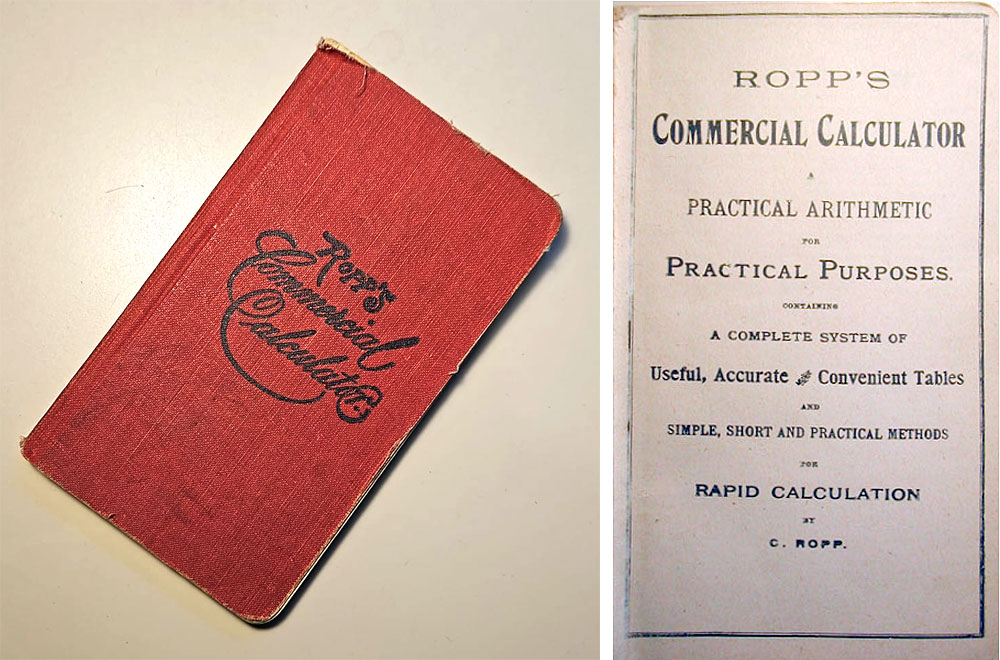
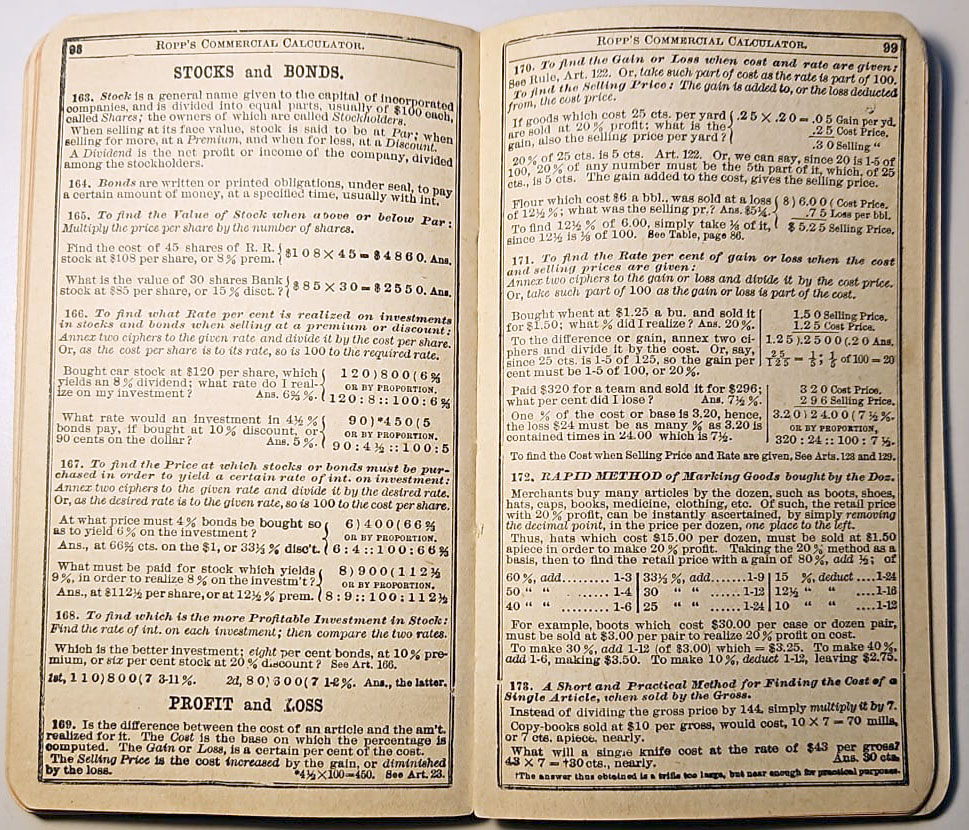
This 9×16 cm booklet is full of useful mathematical information, methods and tables spanning 128 pages. And it does some stuff that us city dwellers would find outright alien — like computing the price of batches of hogs, cattle, grain, and other commodities. The introduction to this booklet clarifies:
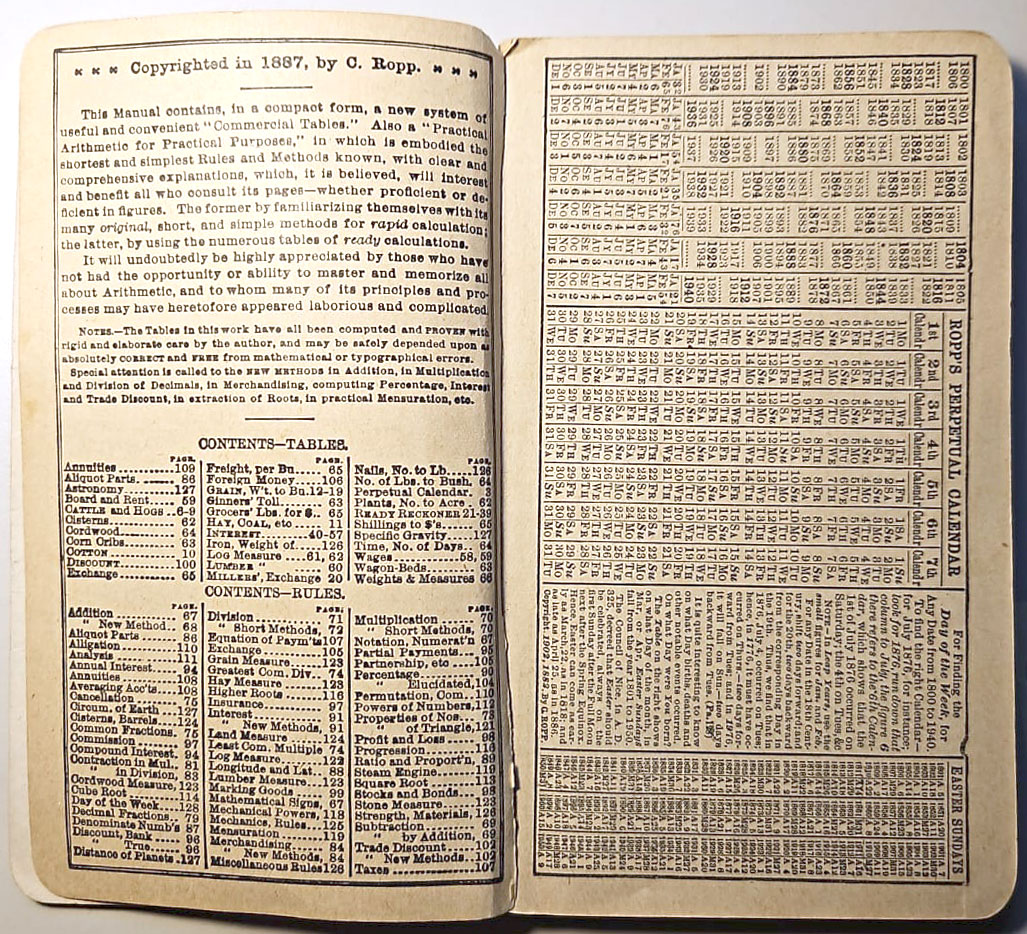
This Manual contains, in a compact form, a new system of useful and convenient “Commercial Tables.” Also a “Practical Arithmetic for Practical Purposes,” in which is embodied the shortest and simplest Rules and Methods known, with clear and comprehensive explanations, which, it is believed, will interest and benefit all who consult its pages-whether proficient or deficient in figures. The former by familiarizing themselves with its many original, short, and simple methods for rapid calculation; the latter, by using the numerous tables of ready calculations.
In full agreement, the “Manufacturer and Builder” magazine stated in a review in its December 1890 issue, that this
condensed vest-pocket book [contains] tables for the use of cattlemen, grain handlers, cotton dealers, farmers, grocers, and others, which will spare them much time and trouble, and many a headache.
Just what we’re trying to do today with our modern computers, to varying degrees of success…
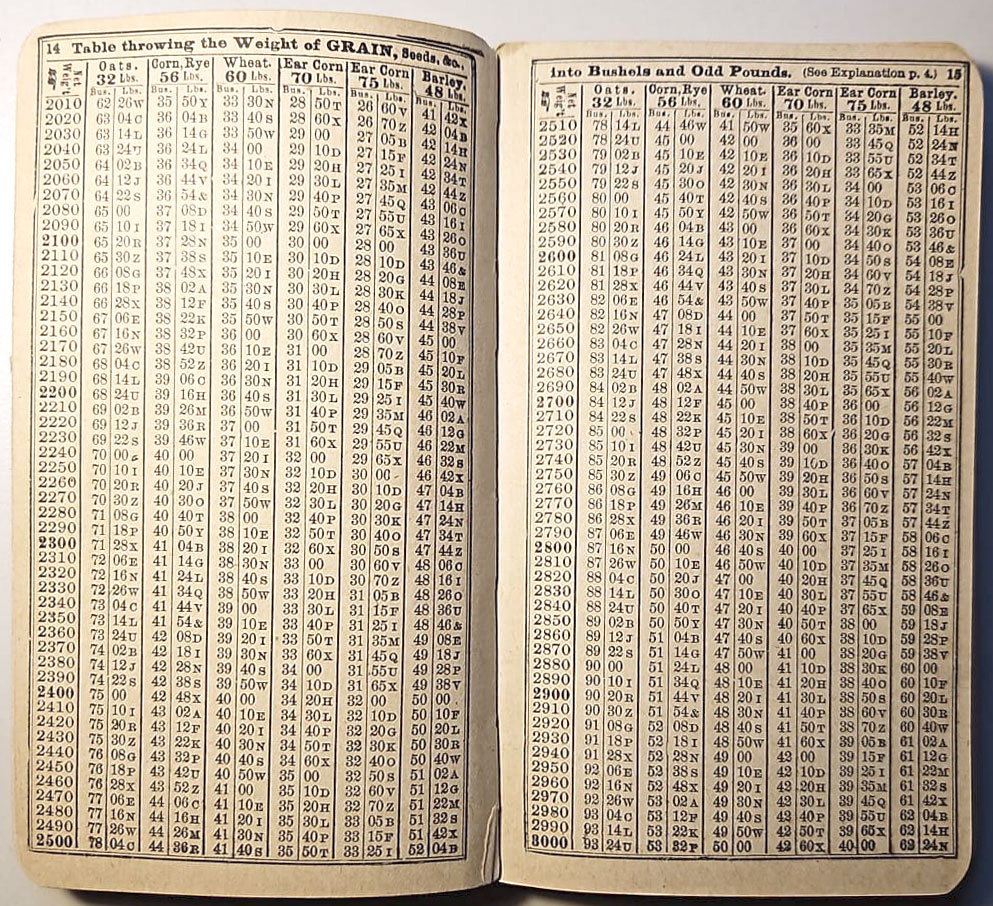
The names of the tables in this booklet provide an intriguing peek into the commercial world of another age. They include “Table throwing the Weight of GRAIN, seeds, &c., into Bushels and Odd Pounds”, “Millers’ and Farmers’ Exchange Table”, “Table showing the value of Baled COTTON”, “Ginners’ table, showing the Toll of COTTON”, and “Table showing SPECIFIC GRAVITY of well known substances”, the latter including Ale, Beeswax, Gum Arabic and Lignum Vitae…
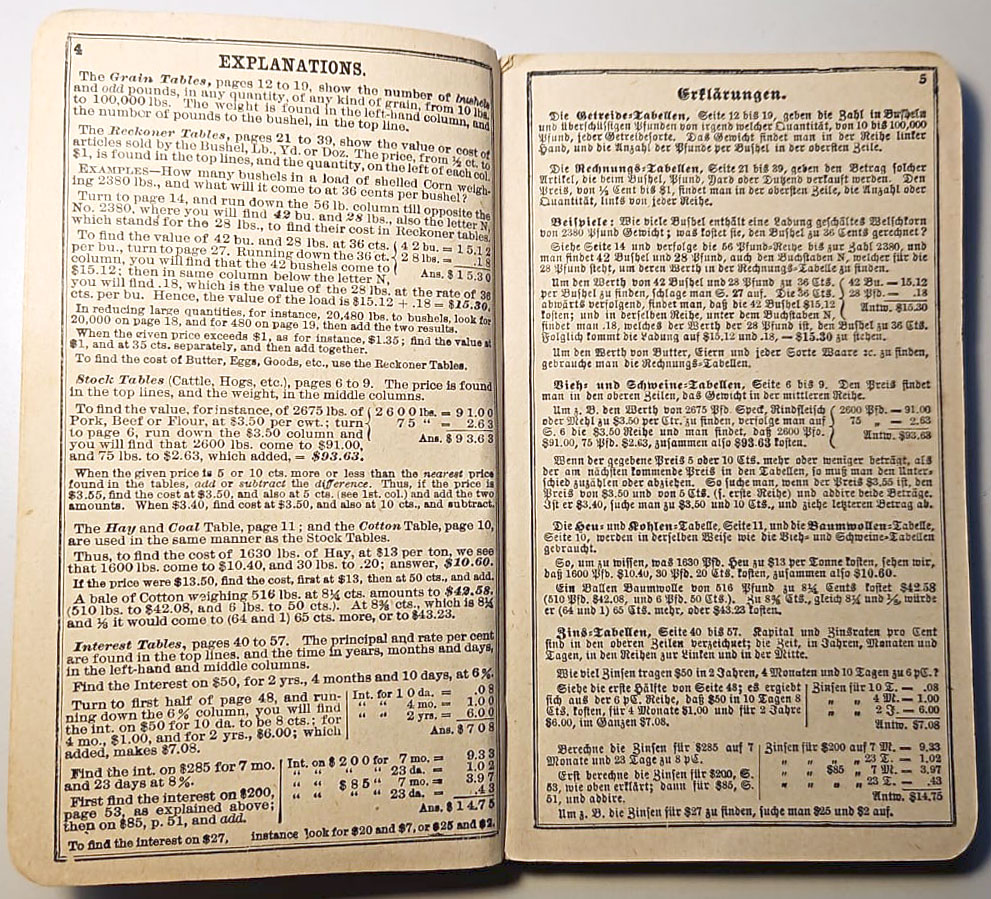
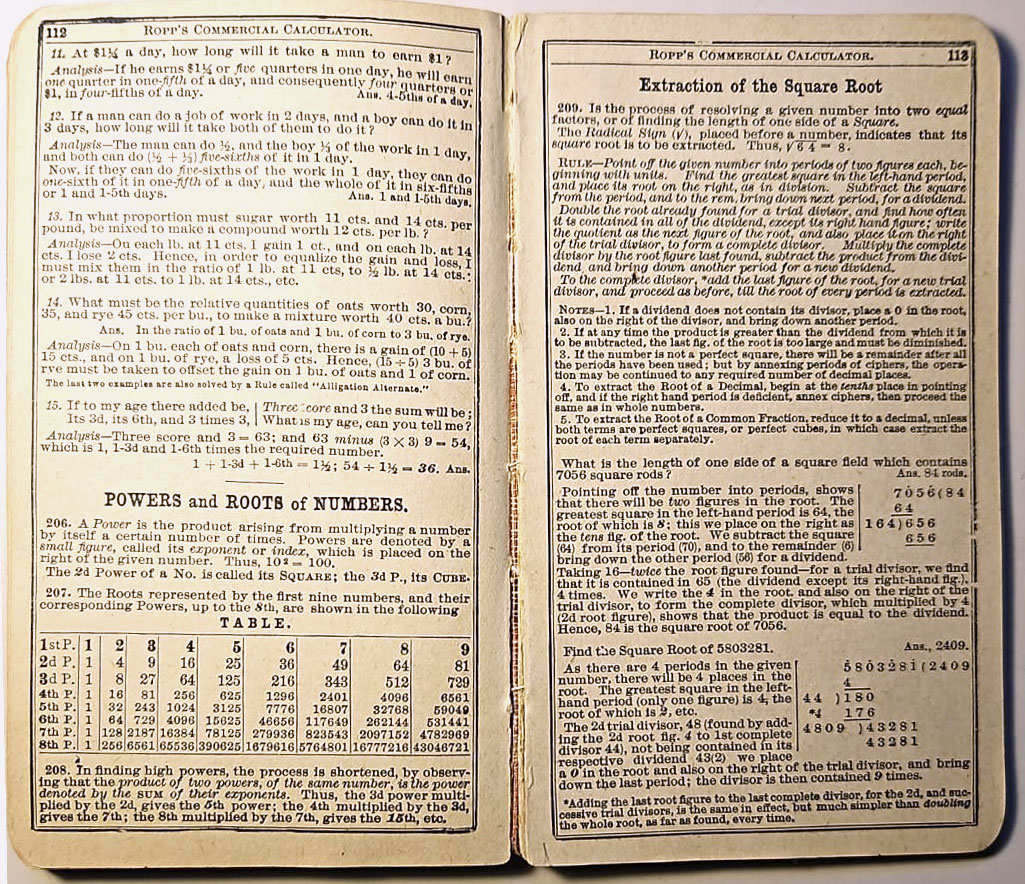
Below are some scans from the Calculator; the first shows the full table of contents, and the second gives the instructions for use — in English and in German, the latter in a Gothic font (though the rest of the booklet is in English). The variety of materials is interesting, and they do span tables, mathematics and worked-out exampes, as suggested by the introduction cited above.
Originally I had no idea who C. Ropp was, though I found some references on the Web to show that his handiwork continued to appear in new editions until at least 1919. But then I got a message from Mr. Joseph Staker, who presented himself as a relative of the author of the Commercial Calculator! This turns out to have been Christian Ropp Jr. (1837-1929), an enterprising Amish Mennonite farmer from Illinois. Mr. Staker kindly permitted me to publish his detailed message, and here it is:
Feb. 3, 2006
Nathan:
The Ropp family is descended from Rupps who were among the original Amish Mennonites. Jacob Amman’s mother was Anna Rupp.
Several male Rupps brought their families out of the Lake Thun region of Bern (now a canton in Switzerland, the a city-state in the Swiss Confederation) after 1692. This was the result of the religious division between Jacob Amman and more lenient Anabaptists. They went to the mining town of Ste. Marie-aux-Mines in Alsace. The French government halted the increase in their numbers in 1712, and they spread out to other locations. Most of the Ropps went to the Principality of Salm, an enclave within Alsace. A minister named Johannes Rupp (about 1740-1788) died in Alsace, leaving his children orphans. One of them was Andreas Ropp (a French variation of the spelling) 1776-1868.
Now this may not all seem relevant, but it is.
Andreas and the other children lost possession of their only inheritance — part ownership of a grist mill. He was force to “work for strangers” (i.e. take work outside the Amish Mennonite community) until his marriage in 1805 brought land. But far from being prosperous, he suffered through the Napoleonic Wars, the French occupation of Switzerland, the ‘Little Ice Age’ winters of 1814-1817, periodic epidemics, etc.
In 1826 Andreas took his family to Philadelphia, with little or no savings. He worked a year in Lancaster County, just long enough to be paid for the working as a laborer on the fall harvest.
From there he moved on to the German Block of Wilmot Township, Ontario. This was the ‘low income housing’ of the day; the English government let settlers occupy lots for no down payment, and promised later ownership if they would build a house, cultivate, and clear a portion of road.
The settlers expected to buy adjoining lots at a low price, and eventually own reasonably-sized farms. But the government gave the back lots to a university, which raised the asking price. In 1831-32 the Ropps and others moved south to the Amish Mennonite communities in Butler County, Ohio.
The Ropps lived in Ohio one year, where Andreas’s wife died. Presumably they cleared a farm, then sold it to buy land for $1.25 an acre in Central Illinois.
They cleared a number of small areas above Morton, Illinois before eventually settling in Elm Grove and Pekin. The sons cleared timber and worked as teamsters hauling freight during the construction of the railroad east of Pekin 1836-37.
To make a long story short, land in Illinois proved to be incredibly fertile, and the Ropps prospered. Their fortunes increased with the invention of the Deere plow that could cut through hardbaked prairie topsoil — making inexpensive land suddenly valuable.
Two of the sons became Amish Mennonite elders (also called bishops). One was Christian Ropp (1812-1896). He purchased land for as little as 25 cents an acre and as much as $15 an acre between 1837 and 1864. He was one of the first local farmers to move out from the creeks and timberlands and onto the prairie. He first farmed prairie land at White Oak Township near Carlock, using a 10-oxen hitch and a plowshare that he had smithed himself.
Although the use of labor-saving tools was hotly debated among Illinois Amish Mennonites, the Ropps had already gone through the adversities of clearing at least four homesteads/farms with primitive hand tools. They never objected to their use.
Christian’s oldest son Christian Ropp Jr. (1837-1929) devised the Commercial Calculator, which became a million-seller. He moved to Chicago to be closer to his publishing interests, and is buried there in Mount Olivet Cemetery.
I guess the point is, you could not find a pioneer family that went through more hardships than the Ropps. It is not surprising that an instrument that could make life easier for farmers came out of their experiences.
They are such a good example of adversity and success that in July the Ropps will be the first family chosen for what will be an annual series on Illinois pioneers. Presentations are to be given at the University of Illinois. It will coincide with the annual reunion at the Mennonite Heritage Center in Metamora, which brings 1,000-2,000 people each year.Joseph Staker
So now I know who C. Ropp was, and incidentally, why the instructions are duplicated in German. Mr. Staker also sent me some additional information from which we learn that the pocket-sized book was first published in 1875, then went through several versions up to 1919. The title page of a later version called it “Ropp’s new commercial calculator and short-cut arithmetic, containing a new, complete and comprehensive system of useful tables.” To my mind, this kind of knowledge sharing is the essence of what the Internet should really be about — connecting us to people and things we’d never meet otherwise!
Exhibit provenance:
I found this item, rather unexpectedly, while searching eBay for vintage calculators.