
The maker’s advertising proclaims: “Supremathic has absolutely nothing in common with all the circular slide rules known up to this day”. True indeed…
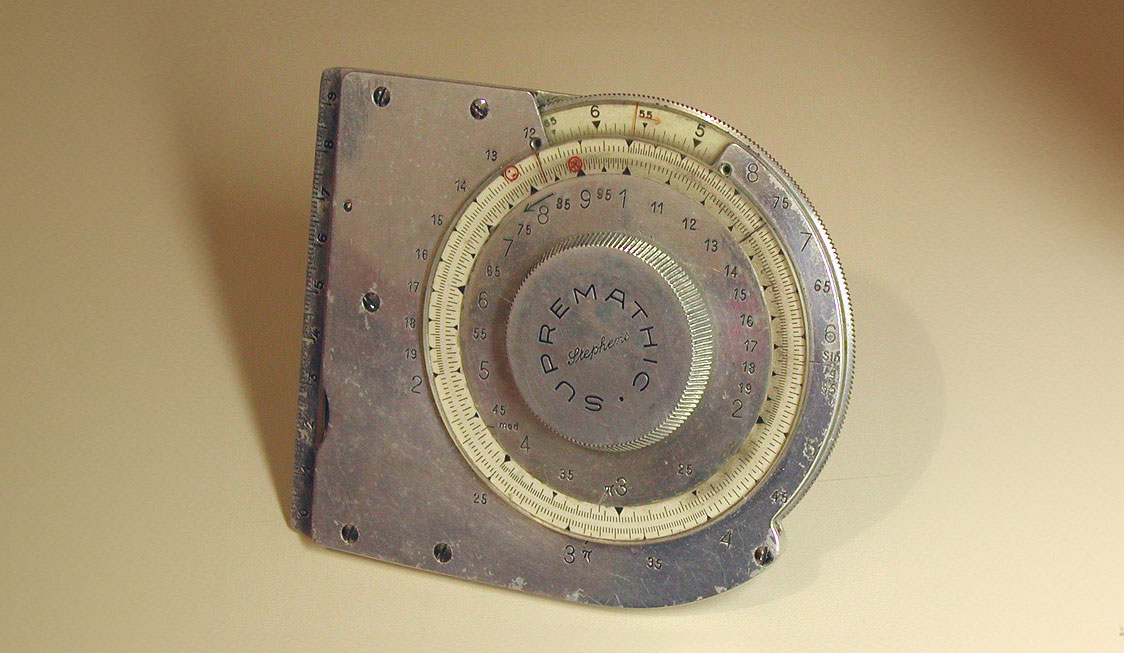
The Stephens Supremathic is a completely different device: clearly logarithmic, definitely circular, but unlike anything I’ve seen before. It is a flat instrument of robust metallic construction, showing numerous fixed and movable scales on both sides. Its mechanism is also intriguing: the knob can rotate indefinitely counterclockwise, but hits a hard stop at its “zero position” going clockwise. Rotating the cursor disc with the knob does not rotate the wheel, but moving the wheel does rotate the cursor. One can only guess how the mechanism does this… it’s a costly device and I hesitate to open the dozen screws holding it together to look inside, lest I discover it can’t be put together without special tools…
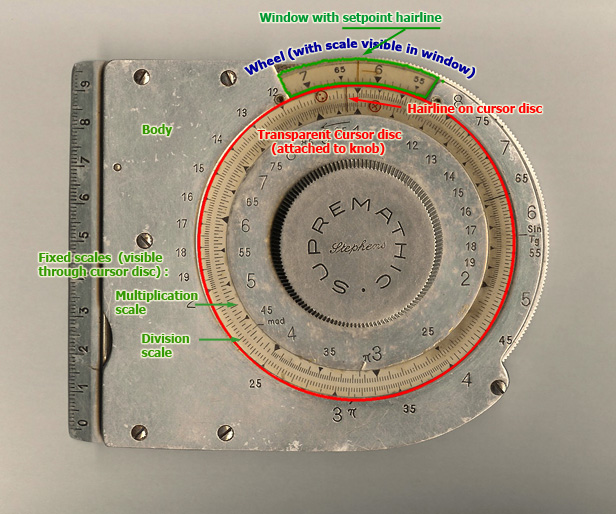
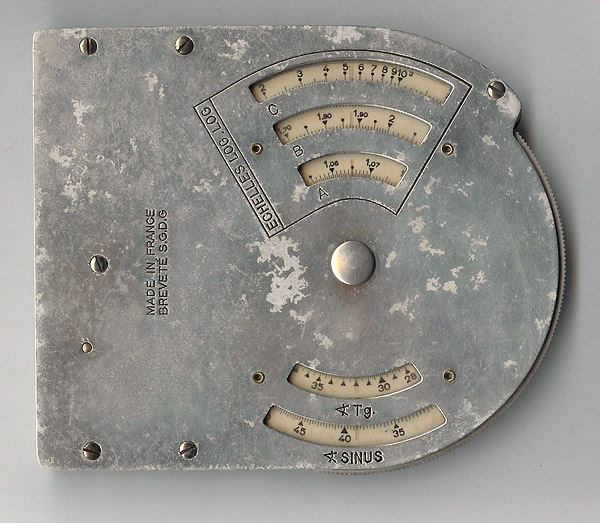
The Supremathic’s front side, which is used for multiplication and division, has three elements: The body, some 10 cm square, with two stationary paper scales whose numbers are engraved in the adjacent metal; the cursor, a transparent disc with a red hairline and a flattish knob to turn it; and a metal wheel with a knurled edge that shows through a window at the top, and bears another paper scale. The back side has 5 scales (glued to the back of the wheel) showing through windows in the body. All this can be difficult to grasp without holding the device in your hand; try this annotated photo and the two below for more insight.
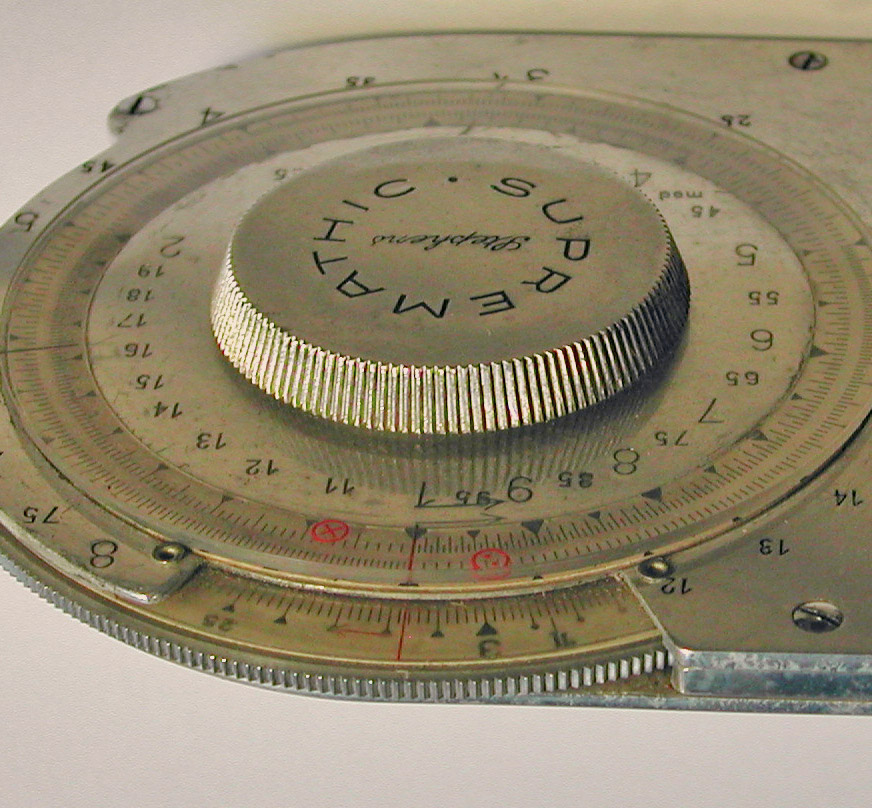
To multiply, say, 6 by 5 you go through a sequence of motions. First, you set the wheel to 6 and bring the cursor to its zero position (photo at left below). Then you rotate the wheel counterclockwise until the hairline on the cursor, which is swept along with the wheel, points to 5 on the multiplication scale (photo at right); the result (3.0, i.e. 30) can now be read on the wheel under the hairline of the top window. This system has the advantage that the results always appear at the same location on the instrument, in this top window.
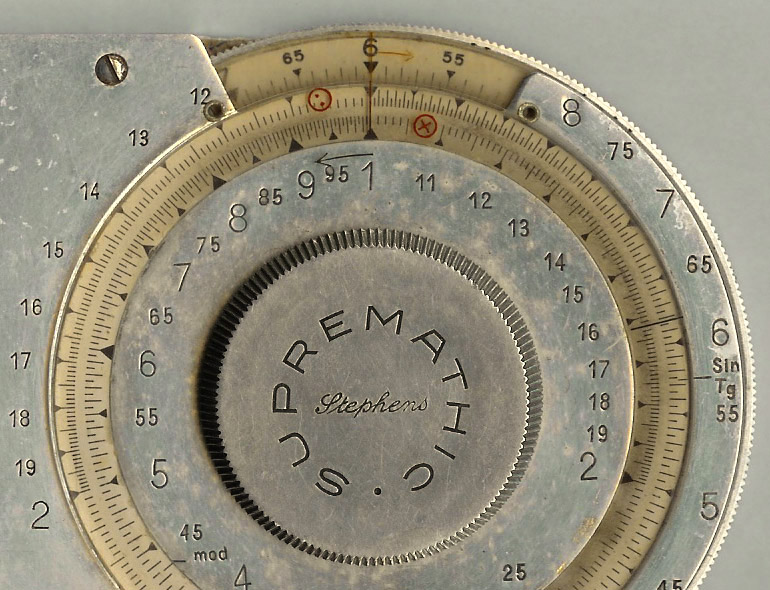
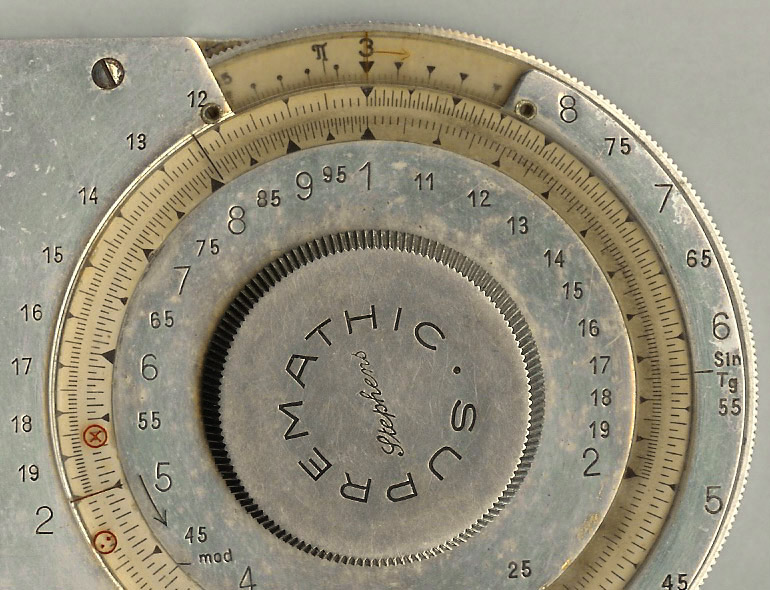
Division uses another scale in a similar procedure; Trig and Log functions use the scales at the back, with the result read at the usual place on the front.
The inventor of this unusual device was Gérard Francis Wittgenstein (1898-1974), a Swiss electrical engineer. Stephens was probably the manufacturer. For details see the JOS article linked below.
Exhibit provenance: eBay.
More info:
- For more information see Wittgenstein and His Calculating Devices, by Heinz Joss, in the Journal of the Oughtred Society, Vol. 10, No. 2, Fall 2001, p. 31-36.
- A scan of the instruction manual (in French) can be purchased from Christophe Méry, at http://machineacalculer.free.fr/notices.htm .