
Battle of the handheld calculators
If you wanted to buy a four-function calculator in the first half of the 20th century, you had a large selection to pick from – all mechanical desktop units weighing 5-15 kilograms. If you wanted one after 1970, you had a large selection of lightweight electronic models, both desktop and handheld. But for two brief decades – the 50s and the 60s – calculators were still mechanical, but the scores of desktop models were complemented by lighter handheld models. Of these, there were only two: the Curta and the Alpina.
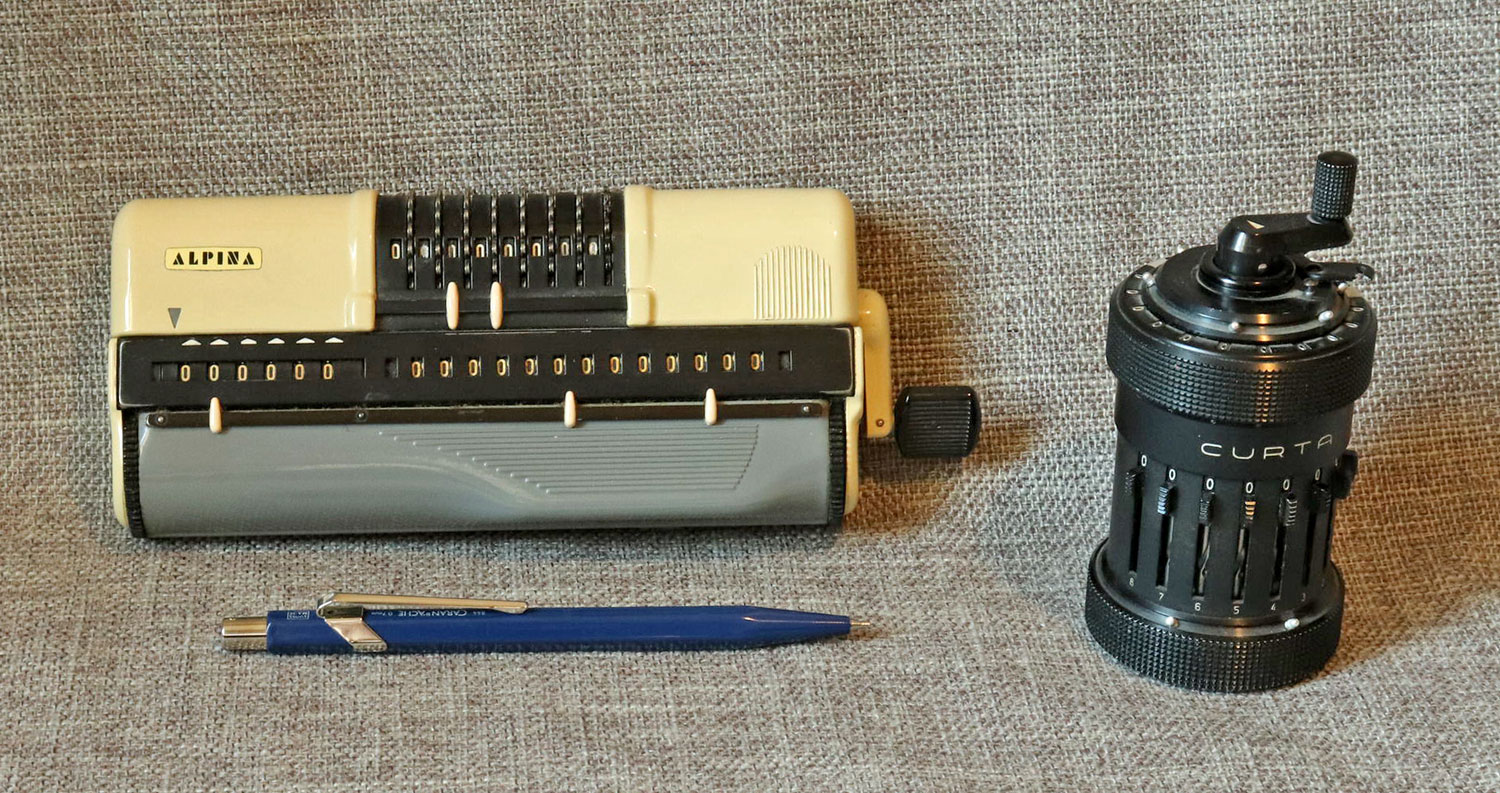
The Curta arrived first, the brainchild of Curt Herzstark, who had developed it while he was an inmate at the Buchenwald concentration camp. After the liberation he founded Contina, the company that produced and sold it starting in 1948. The Alpina was launched in 1960 by a German company of the same name, that was originally in the typewriter business.
Although Alpina clearly meant to compete with the Curta, it did not imitate its competitor the way later computer makers would copy each other’s offerings – the two machines achieve their small size via quite different mechanisms. The Curta uses an ingenious application of the Leibniz stepped drum, where a single central drum is surrounded by the gearing of all the result register digits, hence its cylindrical form. The Alpina is a pinwheel machine, with the (miniature) pinwheels stacked horizontally as in the larger Odhner type machines, dictating its elongated shape.
That said, the two machines both implement the method used in practically all four-function mechanical calculators. They have an input register where a number to be added or multiplied is entered via sliders or thumbwheels and displayed, a carriage containing the result register display and revolution counter display, and a crank that adds the input register content to the result register each time it is turned. The carriage can shift to allow adding the input to different decimal positions, which is what enables multiplication. Thus, to compute the product of 123 X 456 you clear the various registers and enter the 123 into the input register. Then you turn the crank 6 times, move the carriage a notch, turn the crank 5 times, move the carriage another notch, and turn the crank 4 times. The product will now be seen in the result register, and the multiplier (456) will show in the revolutions counter.
The photos below identify the different locations of these parts on the Alpina and on the Curta.

The two machines can do the same four arithmetic operations, with the same input capacity (8 digits), same revolution counter (6 digits), but 11 digits in the Curta’s result register vs. 13 in the Alpina’s (Curta did, however, have a fatter Model 2 with 11, 8 and 15 digits respectively).
Okay, so who wins the competition? Which is the better machine?
The Curta wins, hands down.
Says who? Says the market: from 1948 to 1970, Contina produced a total of around 140,000 Curtas. Alpina produced only some 5600 units, most in 1960-61 and a smaller run in 1970-71.
Says who? Says I. Now that I have both calculators, I can and did test them hands on, to see which one is easier to use. Here is what I found:
- The Curta is 20-30% faster than a handheld Alpina when performing the same sample multiplication. This is not about the speed of the mechanism, mind you – it’s about how rapidly the user (me) can go through the motions. Of course I’m totally unpracticed, but that goes for both machines.
- More important by far: the round Curta fits very naturally in my hand (we are evolved from branch-grasping mammals, after all), and its operation is smooth and effortless; advancing the round carriage around the top is also natural. Operating the Alpina requires you to grasp and execute lateral hand motions that are inherently less precise (see my opinion on round vs. linear controls here). More on this below.
- Clearing the Curta’s registers is done with a single round sweep of the clearing ring, using one finger; the Alpina has two separate clearing wheels that require more fiddling, and with two fingers at a time.
- The Curta is made of precisely machined metal parts inside and out, and the tactile feedback it provides in operation is a delight; whereas the Alpina has a looser mechanical design and is manufactured to lower tolerances that result in a more wobbly feel.
- The Curta (model 1) weighs 244 grams; less than half the Alpina’s 542 grams.
Just to give you a sense of the difference in user experience, consider the following two images of an Alpina with its carriage (the bottom half with all the numbers) in the two extreme positions (as I said, to calculate, you have to move this carriage between these positions one step at a time, and turn the crank in between moves).
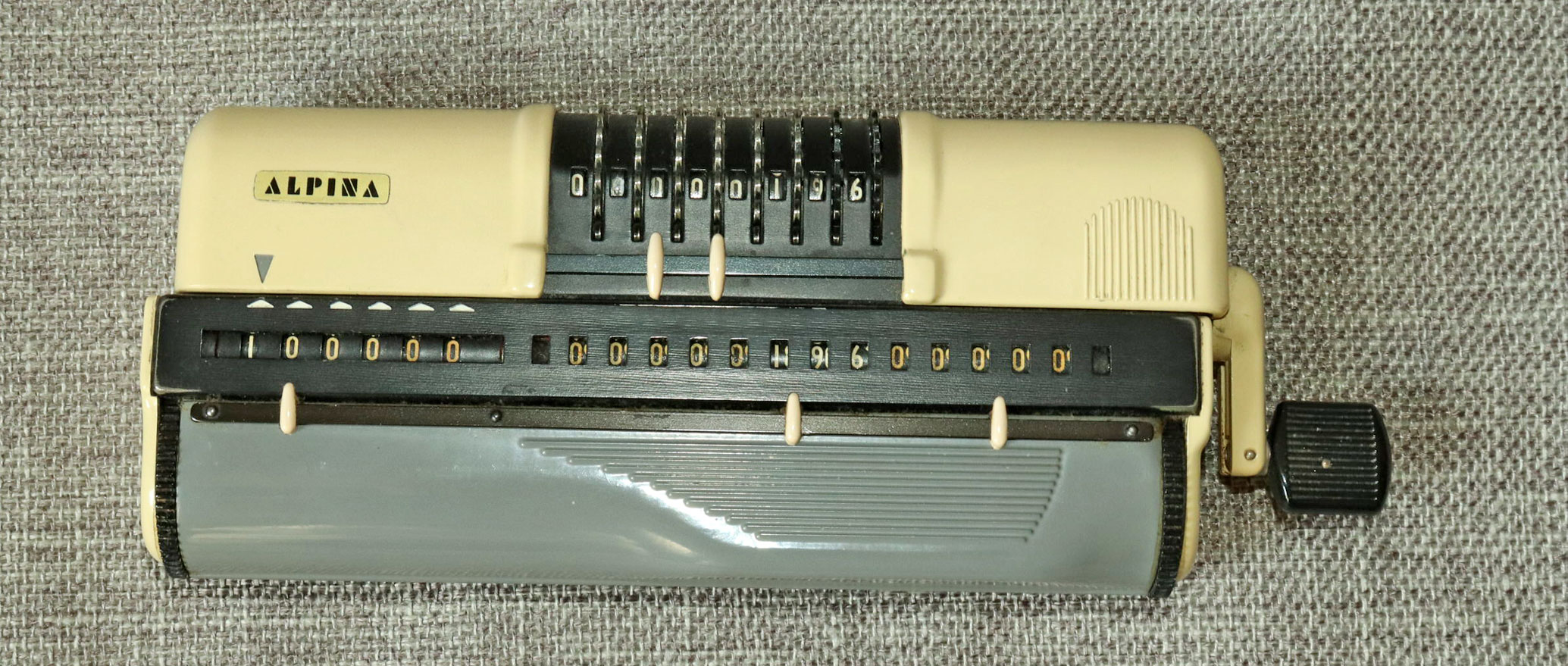
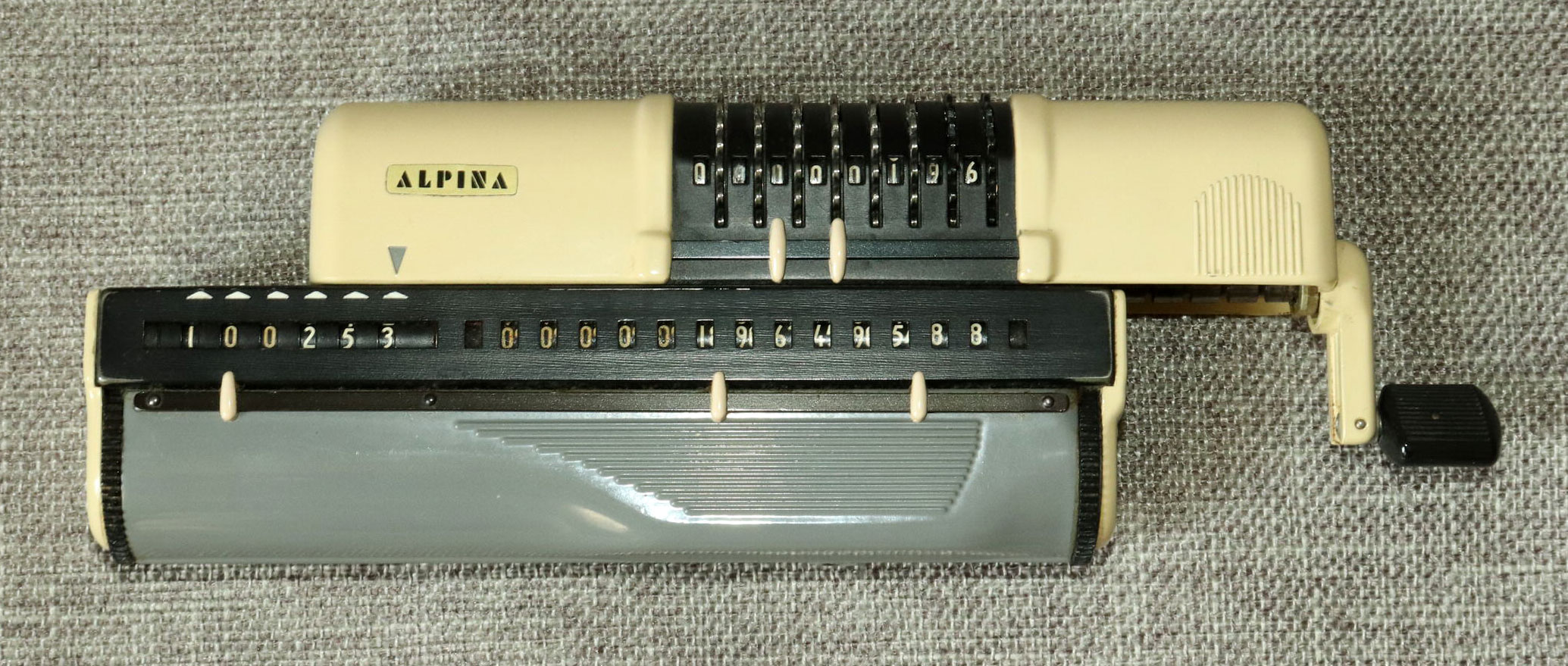
To move the carriage, you need to grab the two halves of the device in two hands, pull them apart sideways and stop at the right click, which is easy to overstep. The action has a clunky feel to it, which is not helped by the slight free play in the mechanism.
And here are the equivalent extreme carriage positions in the Curta:
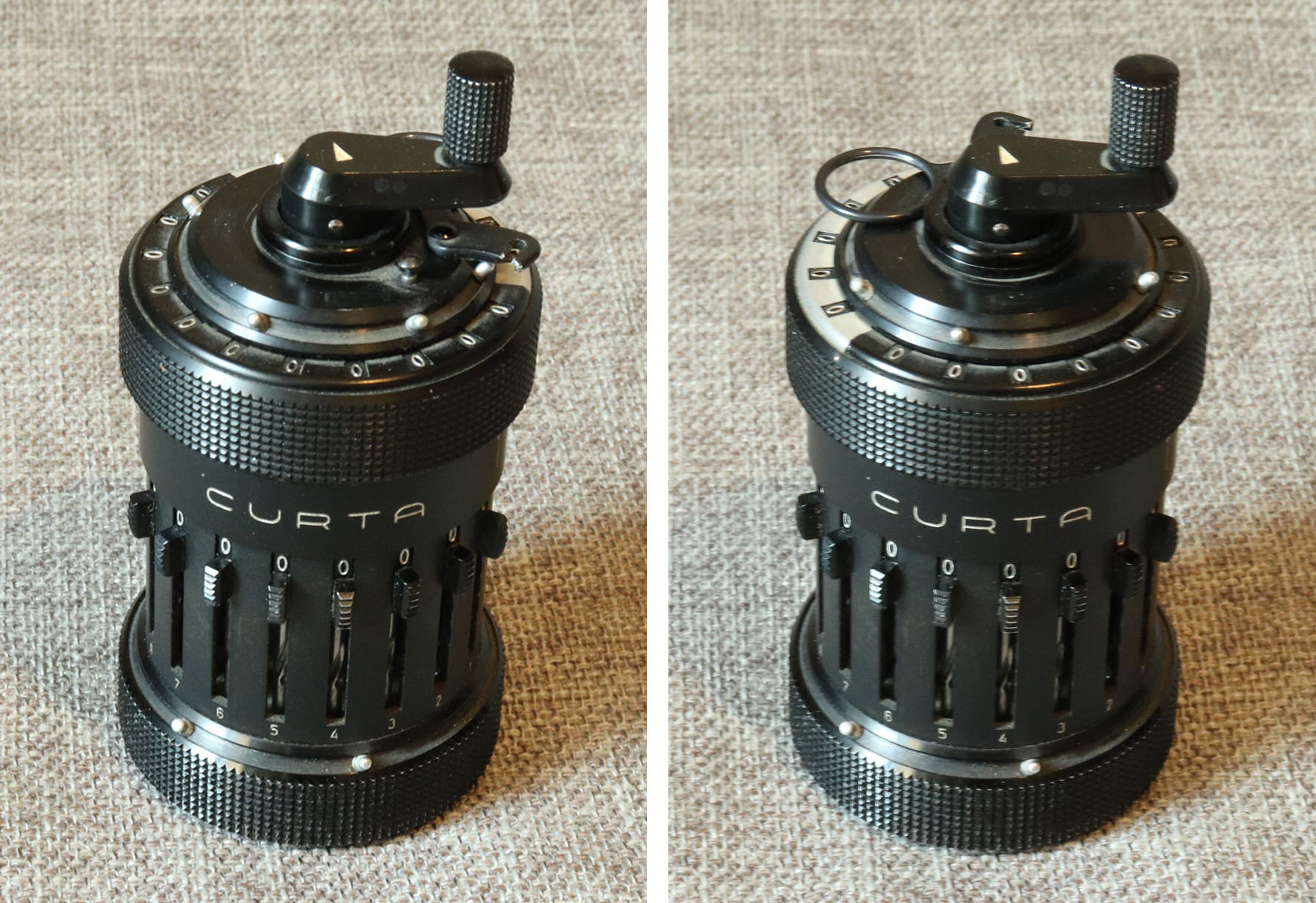
The carriage is the round section with the numerical readouts at the top, and you twist it around with your right hand between thumb and forefinger – a natural motion allowing superior control. And the mechanism has the precision and tightness of a Swiss watch…
Note that the Alpina comes with a truly elegant and convenient desk stand weighing 1.7 kg. When in use, this keeps the calculator put in place, freeing you to use both hands to actually work the machine. This shaves a few seconds from the operation, but of course it defies the “handheld” paradigm.
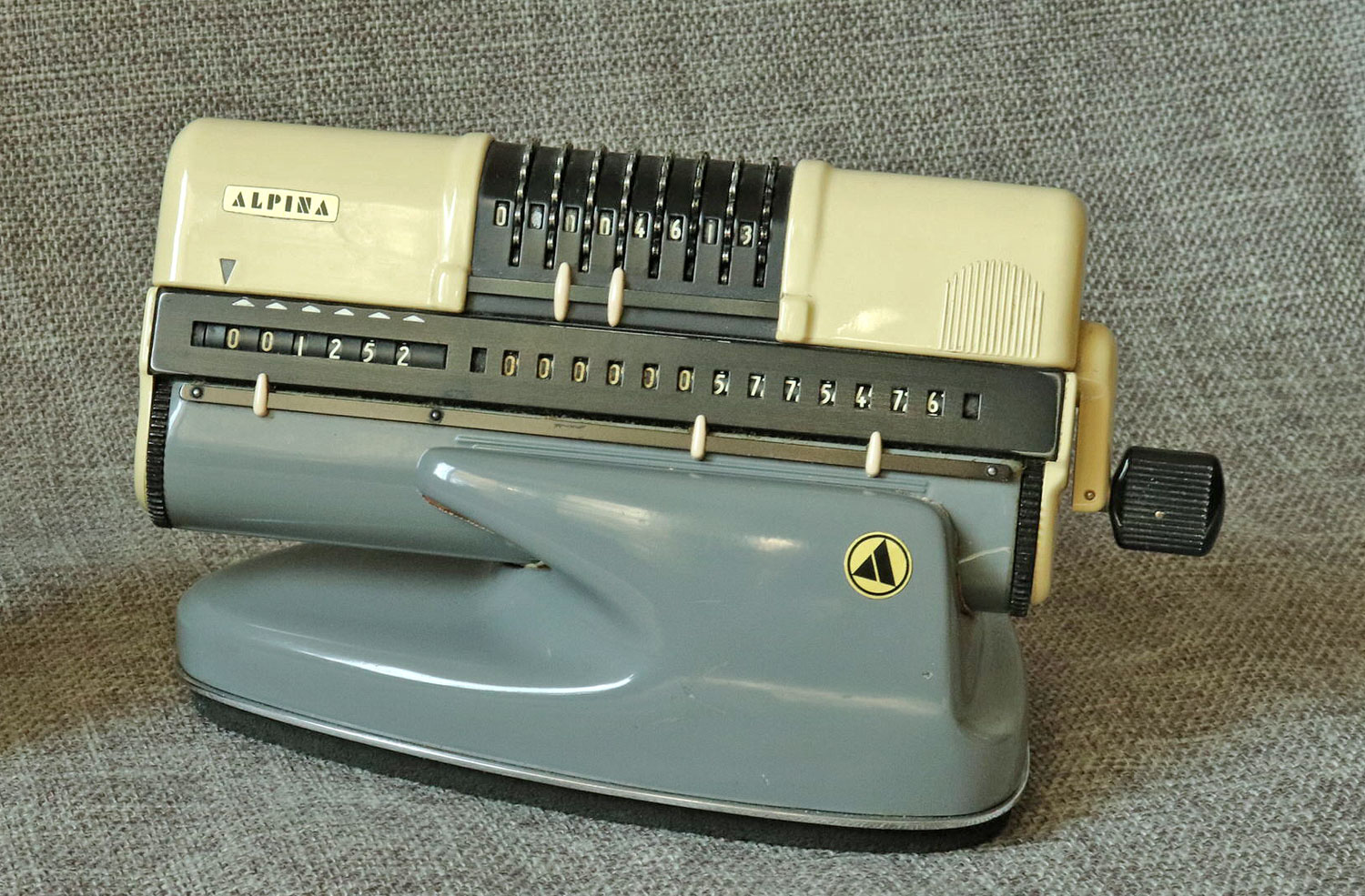
But Since I have an electronic calculator (my good old HP-11C, what else?), I don’t really care about all that: I’m just happy to have both these marvelous and beautiful machines in my collection!
Exhibit provenance:
Got the Curta in an antique store in Jerusalem, and the Alpina on eBay.
More info:
- Stephen Freeborn has a video showing the Alpina’s operation and internal mechanism.
- More on the Curta on this site.
- The Curta Calculator Page: http://www.vcalc.net/cu.htm.