
When A. M. Stephenson invented his credit-card-sized calculator, he had no idea it was credit-card-sized: those plastic cards would not exist until 80 years later.
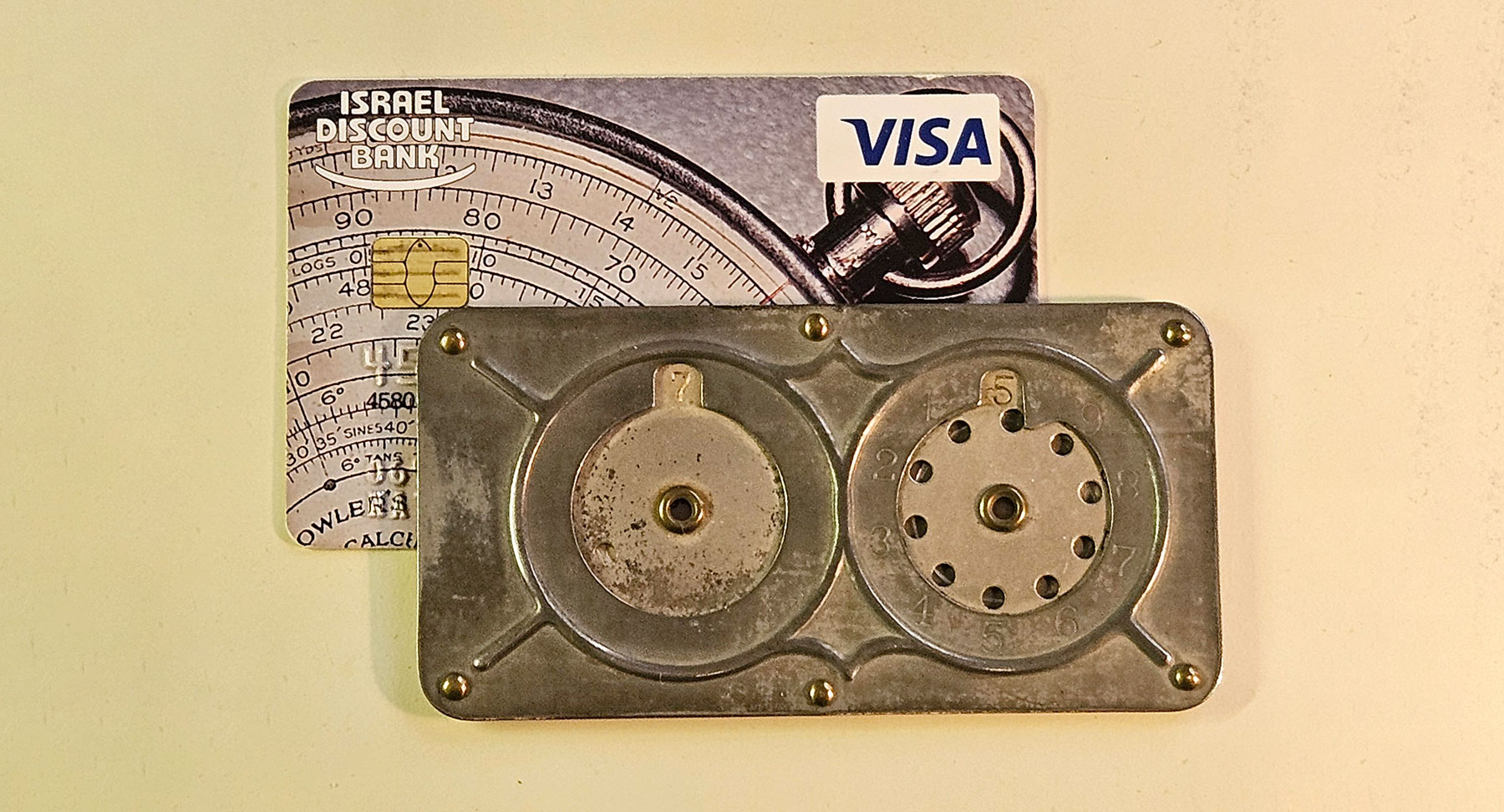
And yet it is close enough to a credit card in area, and only three times the thickness, making it the thinnest mechanical calculator I have. (Oh, and yes, that is my Fowler calculator on my credit card. I was delighted to find that my bank allows you to choose the card’s image…)
Stephenson’s adder is a column adder, meaning you can only add single-digit numbers on it, and those up to a sum of 199 (the left hand dial has numbers from 0 through 19). It was useful for adding numbers in a ledger: you add the units column, note the result, then add the tens columns and the carry from the units, and so on.
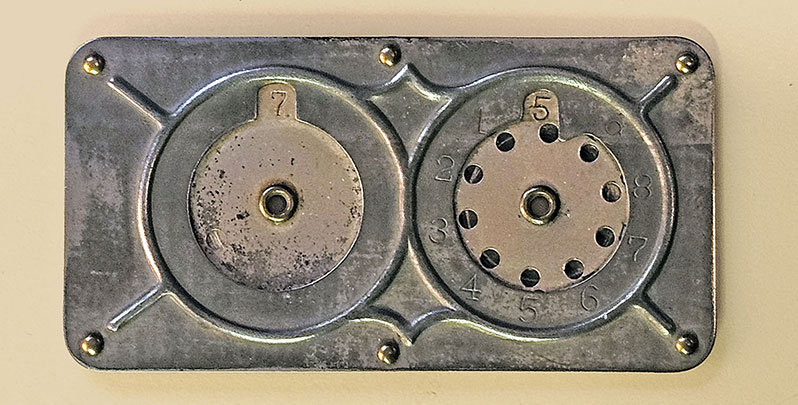
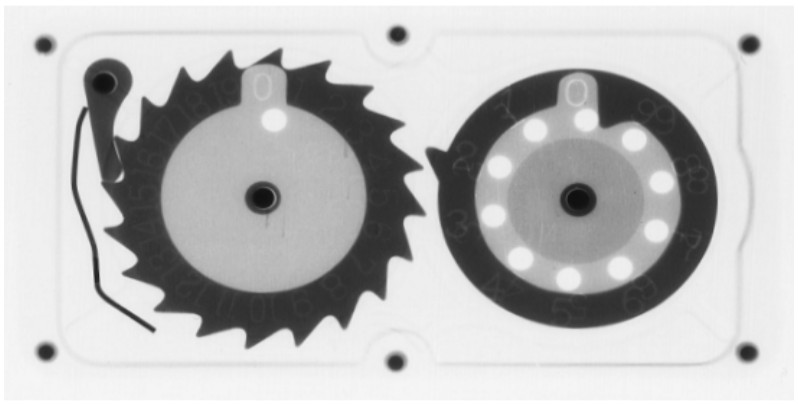
Numbers can only be entered on the units wheel at the right, and the device handles the carry to the other wheel. As you can see above in the X-Ray image (from the JOS article cited below) this is done by a “mutilated gear” mechanism, where the units wheel has a single tooth that kicks the 20-tooth tens wheel a notch at the right time. It is worth noting that the two dials turn in opposite directions, because – unlike more advanced dial adders – the Stephenson lacks the auxiliary gear that would keep them moving the same way. The X-Ray also shows that in addition to the two wheels there is only one more part – a spring-loaded detent that keeps the tens gear from turning too far. With only three moving parts, this was the simplest carrying adder in my collection – until the Ifach adder snatched the title with only two…
Operation is super simple: you clear the device, if needed, by using a stylus to rotate the right hand dial counterclockwise as far as it goes, and the left hand dial until the hole points up; this will show 0,0 in the two cutouts above the dials. Now you enter numbers into the right hand dial, one by one, by sticking the stylus in the hole next to the number, and rotating clockwise until you hit the stop. The accumulated sum shows in the two cutouts.
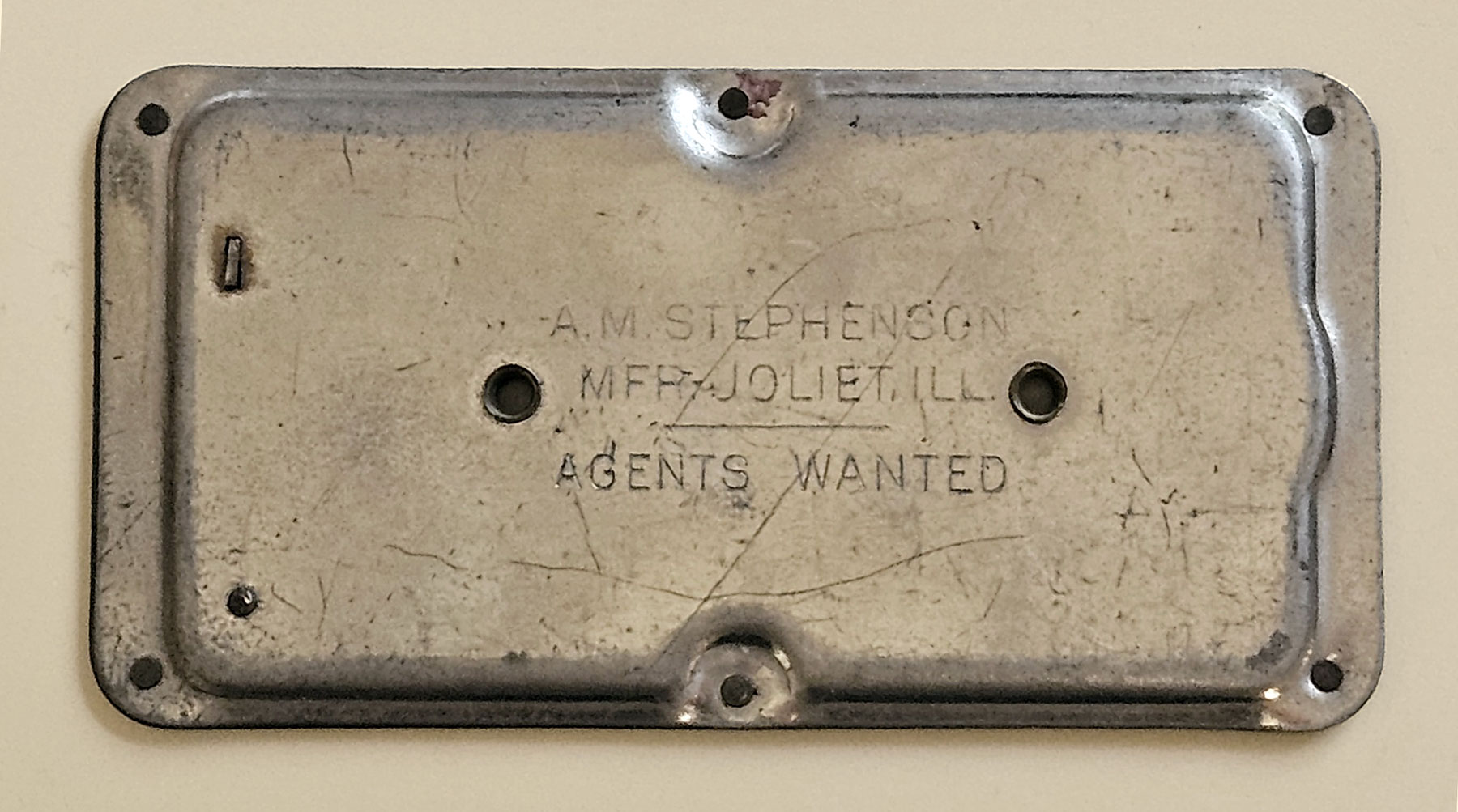
The back of the device is a plain metal plate with the inscription “A.M. Stephenson Mfr. – Joliet, Ill.” – and the line “Agents Wanted”. This shows us that Mr. Stephenson was marketing his device through a network of local agents, rather than in stores.
The man behind this device was Archibald Milton Stephenson (1844 – 1913). He patented his first adder (a four-dial version which was probably never produced) in 1873, and subsequently made the two-dial version in two models, of which the Model 2 is shown here. The Joliet location indicates a production date later than 1895, when Stephenson moved to that town. His adders were often made of brass, with or without nickel plating, but mine is of nickel-plated steel.
Exhibit provenance: eBay.
More Info:
- A comprehensive article by Bob Otnes in the Journal of the Oughtred Society.
- Additional information at Jaap Scherphuis’s mechanical calculators site.