
A fascinating transitional device
It sounds like a joke: What do you get when you cross a Gunter Rule with a Slide Rule? A Sliding Gunter!
Only it isn’t a joke: there is a Sliding Gunter, and it actually is precisely such a hybrid device. Here is one:
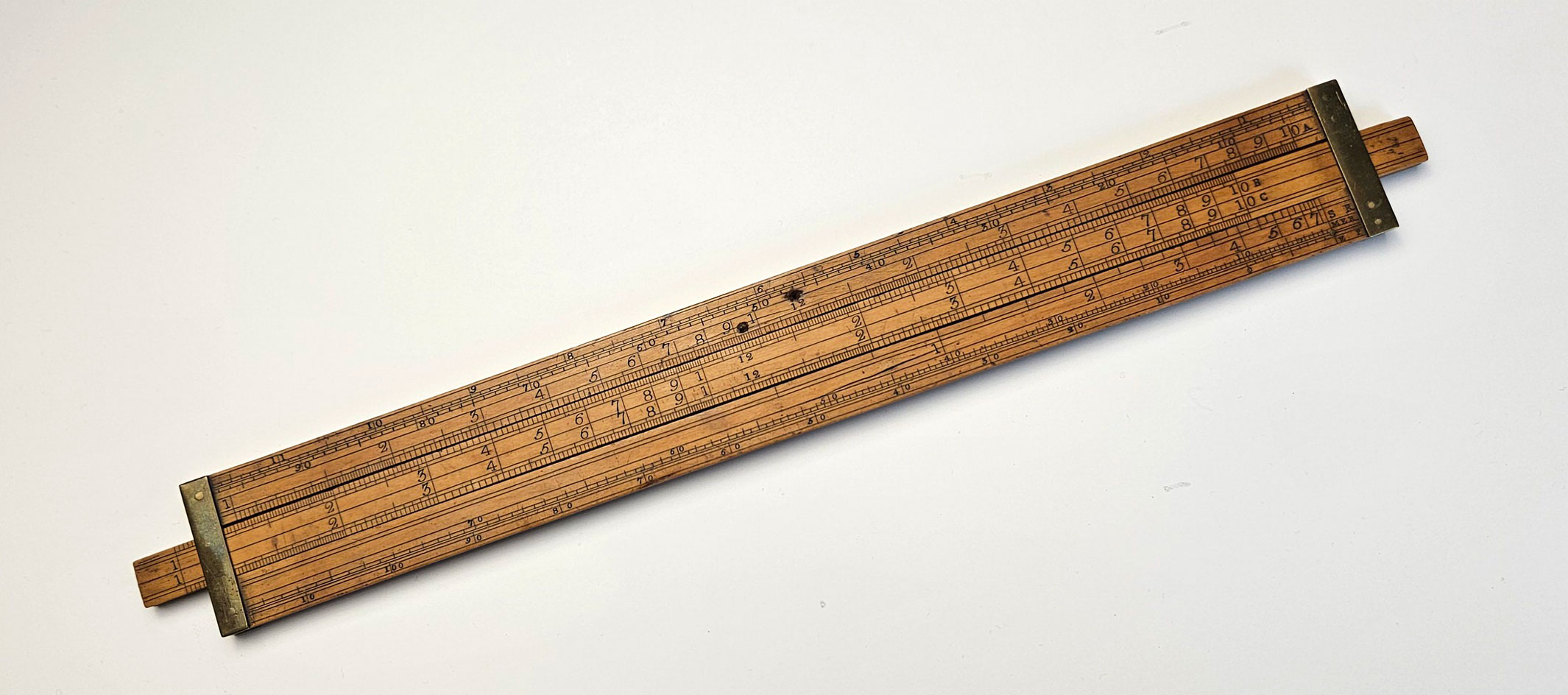
This looks like a slide rule and has a slide running down its middle, but it’s different from the device invented by William Oughtred in 1632.
The generally known story of the invention of the slide rule goes like this: first, John Napier invented logarithms in 1614; then, in 1620, Edmund Gunter put a logarithmic scale on a wooden ruler, the “Gunter rule”; then William Oughtred juxtaposed two such scales, allowing them to slide next to each other to form what we call a slide rule. This did give him a device where Gunter scales do slide… but it was not the “sliding Gunter” that appeared later in the same century.
What’s missing in this story is the fact that Gunter was primarily interested in navigation, and his rule was designed to help mariners, which is why it was used on British ships for the next 200 years. It had one logarithmic scale, which he termed NUM, and at least half a dozen other scales related to navigation at sea. Only the NUM scale is relevant to the invention of the slide rule, and it, like the others, was used with a pair of dividers (a common enough item on a navigator’s desk).
So here is the commonly told progression:
- Gunter rule: a log scale used with dividers, AND navigation scales used with dividers.
- Slide rule: log scales used with a slide, and NO navigation scales.
And you see what’s missing: the “more advanced” slide rule was great for (land-bound) engineers, but useless for marine navigators! Hence the hybrid form, giving us a revised sequence:
- Gunter rule: a log scale used with dividers, AND navigation scales used with dividers.
- Sliding Gunter: log scales used with a slide, AND navigation scales used with dividers.
- Slide rule: log scales used with a slide, and NO navigation scales.
You can see why the Sliding Gunter might appeal to sailors, though for most of their needs a static Gunter rule also worked just fine. Meanwhile engineers and scientists would prefer a true slide rule any day.
Here are the two sides of my exemplar; zoom in to see the detailed scales.
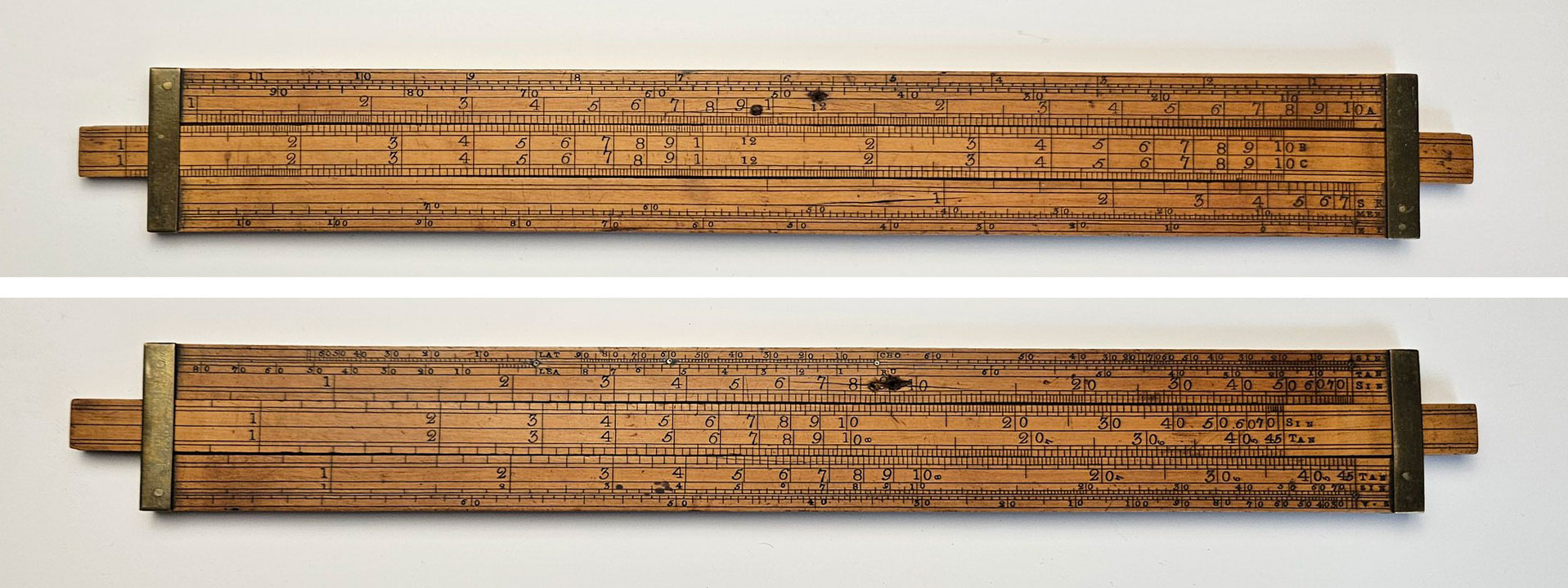
So what are these navigation scales that I keep going on about? Here are the scales on my rule:
Side A (well, the top image… I haven’t a clue which side comes first):
- A linear 12-inch scale – basically a simple ruler
- A, B, C – Three identical 2-cycle log scales, one on the stock and two on the slide
- SR – Sine of Rhumbs, the log of the sine of an angle given in rhumbs
- MER – Meridional Parts in Mercator’s map projection
- EP – Equal Parts (a linear scale to reference the log scales)
Side B (well, the other side):
- LAT – Latitude
- CHO – Chords
- SIN – Natural sines
- LEA – Leagues (1 league = 3 nautical miles)
- RU – Rhumbs
- TAN – Natural tangents
- Two identical (“Artificial”) SIN scales, one on the stock and one on the slide (logs of sines)
- Two identical (“Artificial”) TAN scales, one on the slide and one on the stock (logs of tangents)
- SIN – Additional logs of sines scale
- V·S – Versed sines
That’s a lot of scales, and only the eight which straddle the stator/slide boundary are in any sense related to “sliding”. These are useful for multiplication, division, and basic trig; the remaining dozen are navigation related, and those can only be used with dividers, just like they would on an old style static Gunter. In fact, my Gunter has the same SR, A (NUM), EP, SIN, V·S, TAN, RUM, MER, and CHO scales we see here (and two others that we don’t). This fact, coupled with the usual resistance to change, explains the relative scarcity of Sliding Gunters today – evidently most ship’s navigators preferred to stick with the static Gunters they were used to…
I won’t go into the construction and use of these scales – you can find that here – but I take my hat off to the mathematician who crammed so many useful calculation aids into a handheld device, and designed them without recourse to a computer. A 18th century book agrees with me on this: it says, of the Gunter rule,
The Lines of artificial Sines, Tangents, and Numbers are so fitted on this Scale, that, by means of a Pair of Compasses, any Problem, whether in right-lined, or spherical Trigonometry, may be solved by them very expeditiously, with tolerable Exactness; and therefore the Contrivance of these Lines on a Scale is extremely useful in all Parts of Mathematicks that Trigonometry hath to do with; as Navigation, Dialling, Astronomy, &c.
The fact that this rule still uses dividers is attested to by the presence of the tiny dimpled brass inserts at key points on some scales – points that would be gouged by frequent poking with the needle of the dividers. We see the exact same solution in both the Gunter and the ivory Sector.
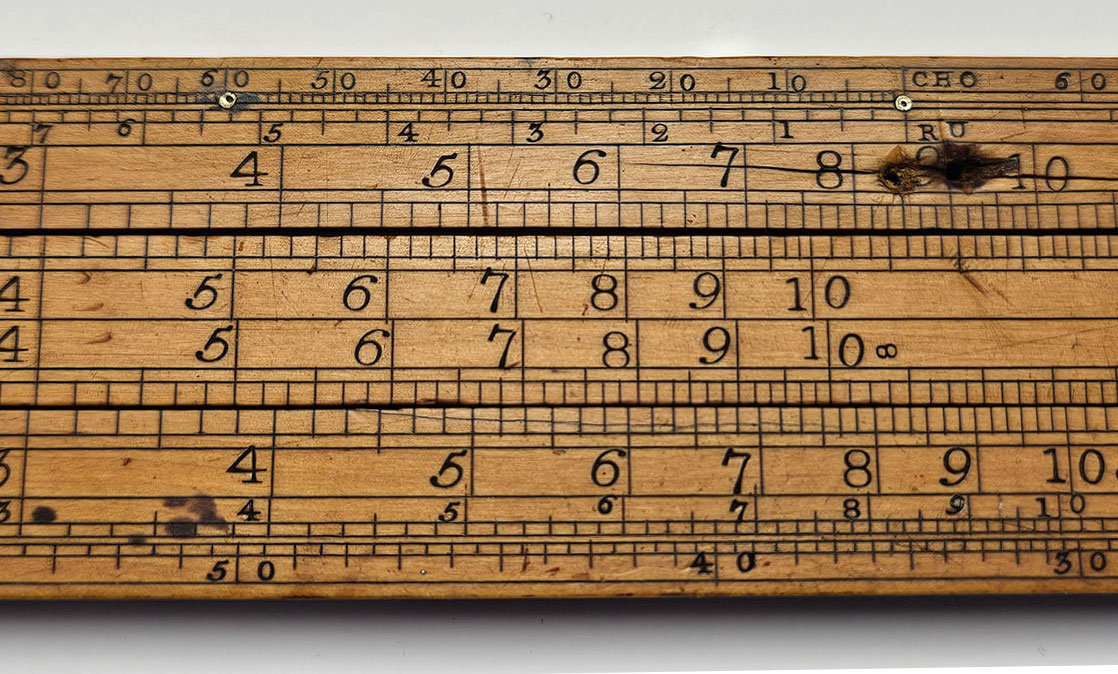
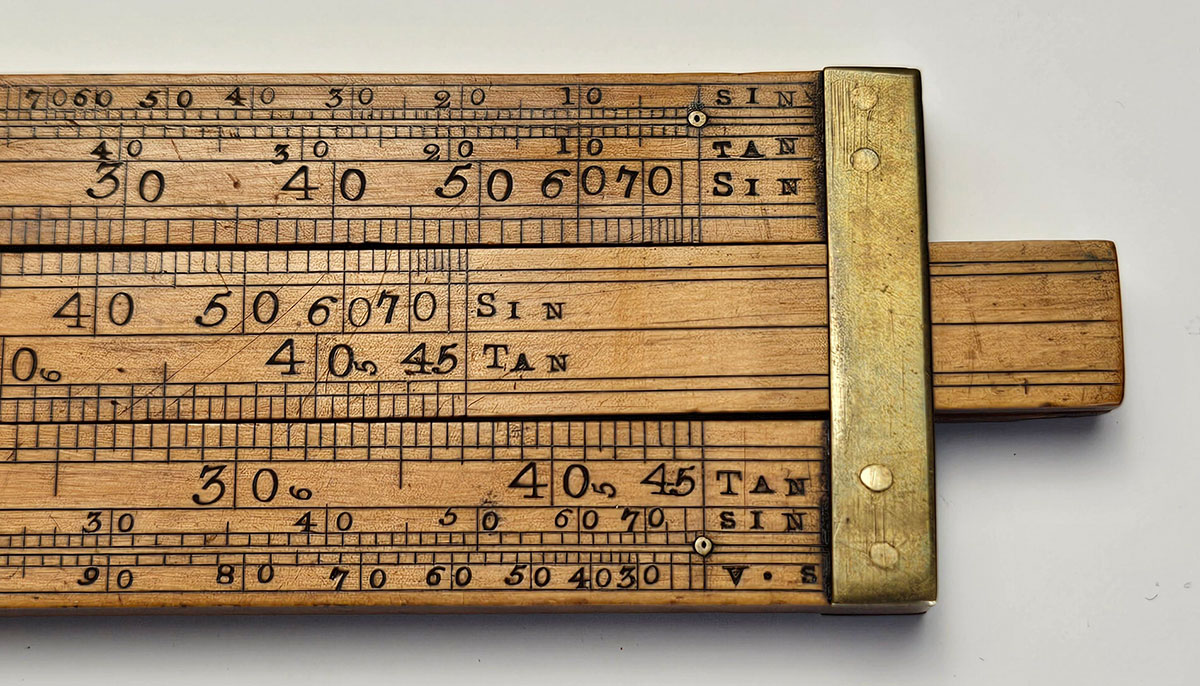
Like many such rules this one doesn’t show a maker’s name, which makes exact dating impossible. We do know that the Sliding Gunter was developed in the late 17th century and was used primarily during the 18th; thus, we can assume a date of manufacture in the 18th century.
And like my Gunter rule, this Sliding Gunter is only a foot long, unlike the more commonly seen two-footers. This halves its precision – a disadvantage at sea – but also its storage footprint – a definite advantage in my apartment…
Exhibit provenance:
Auction of the late Conrad Schure’s collection.
More info:
- T. Wyman, Description and Use of the Sliding Gunter in Navigation, Journal of the Oughtred Society, Vol. 20, No. 2, Fall 2011
- W.H. Rudowski, The sliding Gunter – who was its inventor?, Journal of the Oughtred Society, Vol. 16 No. 1, 2007
- A. Mackay, The Description and Use of the Sliding Gunter in Navigation, 1802. A full scan is available on Google Books.