
A lost precursor of the Gerber Variable Scale
This article was originally published in the autumn 2021 issue of the UKSRC Slide Rule Gazette.
The Gerber Variable Scale (GVS) is well known, and rightly so; it was the first innovation of a very prolific inventor who has revolutionized many industries, and is exhibited in the National Museum of American History in Washington. Then there is the Data Scaler Proportional Rule, a clone of the GVS, produced around 1968 by an ex-employee of Gerber’s after the patent had expired . This one is quite a rarity and I was pleasantly surprised to find one on eBay.
I was even more surprised when I was told by fellow collector Cesare Baj of Como, Italy, that he knows of a third device of this kind, and one pre-dating the other two! He hadn’t seen it – we know of no surviving unit – but Cesare had found a photograph of this device in the book “Ali di legno sul mare” (“Wooden wings over the sea”) by Mario Loffredo. This inventor flew as an officer-observer aboard Italian seaplanes from 1940 to 1943, and he produced the “Regolo a scala deformabile” (ruler with deformable scale) in that timeframe for his own use, and perhaps for the use of a few colleagues. The photograph in the book shows a variable scale that uses an elastic band, like Gerber’s prototype, rather than the triangular spring of the commercial GVS.
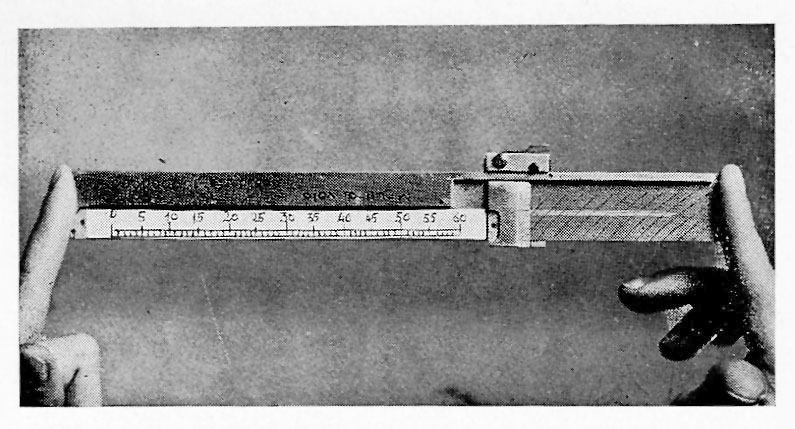
Unlike Gerber’s Variable Scale and its clone, which were general purpose tools for reading, plotting, and interpolating curves, Loffredo’s invention targeted a single specialized application – specifically, indication of the time it would take to cover a specific distance on a map given the speed and the latitude. The key point is that the map uses a Mercator projection, where the scale varies with the latitude. (All flat maps of a spherical planet make trade-offs; the Mercator conserves compass bearings but distorts distances). Thus the flight time depends not only on the airplane’s speed (which would be easy) but also on the latitude it is flying at.
Here is how it was done. The right edge of the cursor has graduations calibrated in latitude, and the stock under it has diagonal lines calibrated in speed. Thus we can move the cursor to juxtapose the current latitude and speed, and then the elastic ruler (shown in yellow in the drawing below) would stretch to assume the correct scale for measuring minutes of flight directly on the map.

Evidently, this ingenious device was a hand-made product that was never commercialized. Rather, it instantiates a quintessentially human trait: we are a tool making animal. These days most tools are bought from a store, but many of us still make our own tools for our specific needs. That is what Mario Loffredo has done, and I am delighted to present the product of his ingenuity to the HOC community today.
I wish to thank Cesare Baj for his invaluable assistance with this article.