
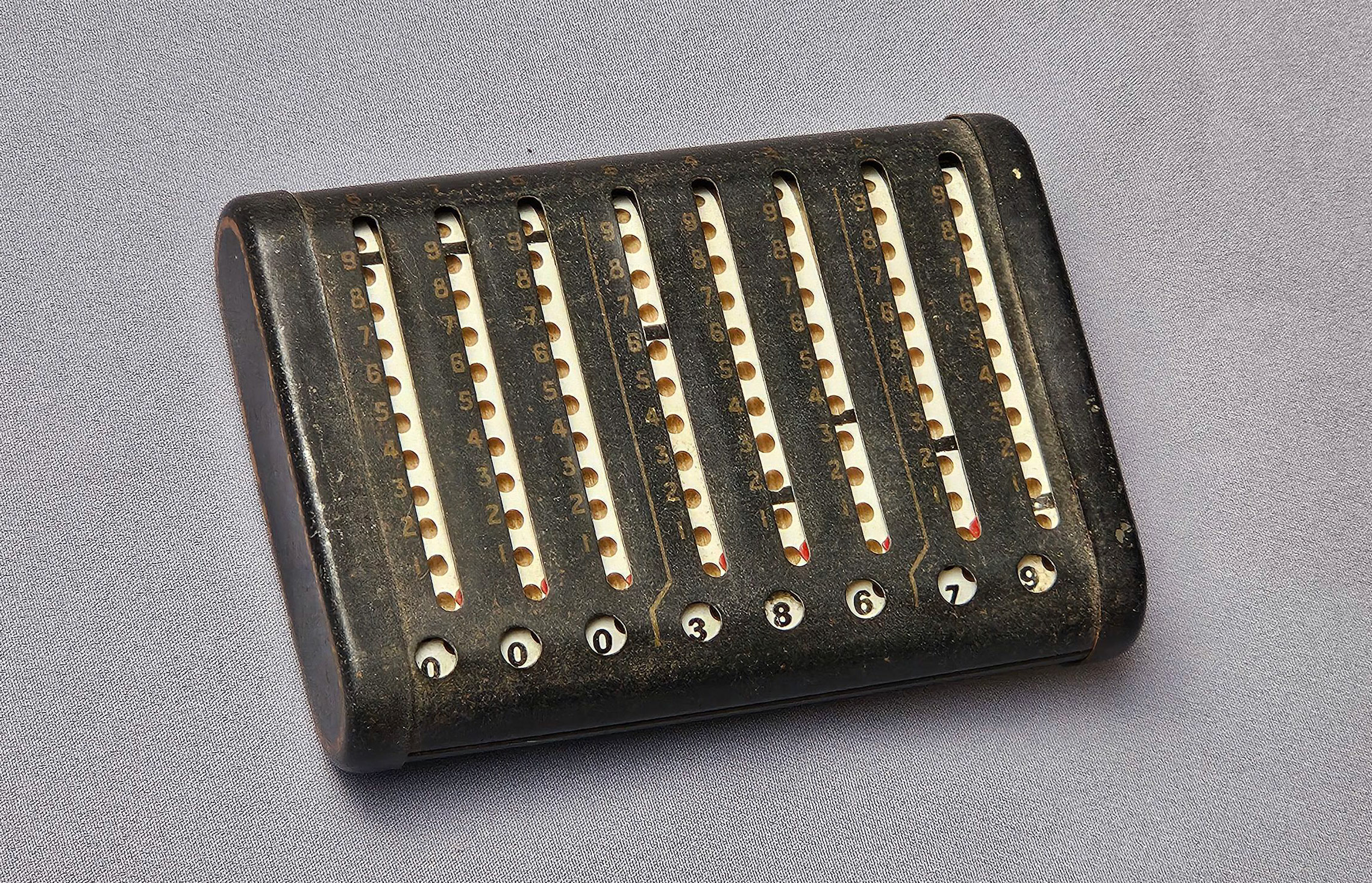
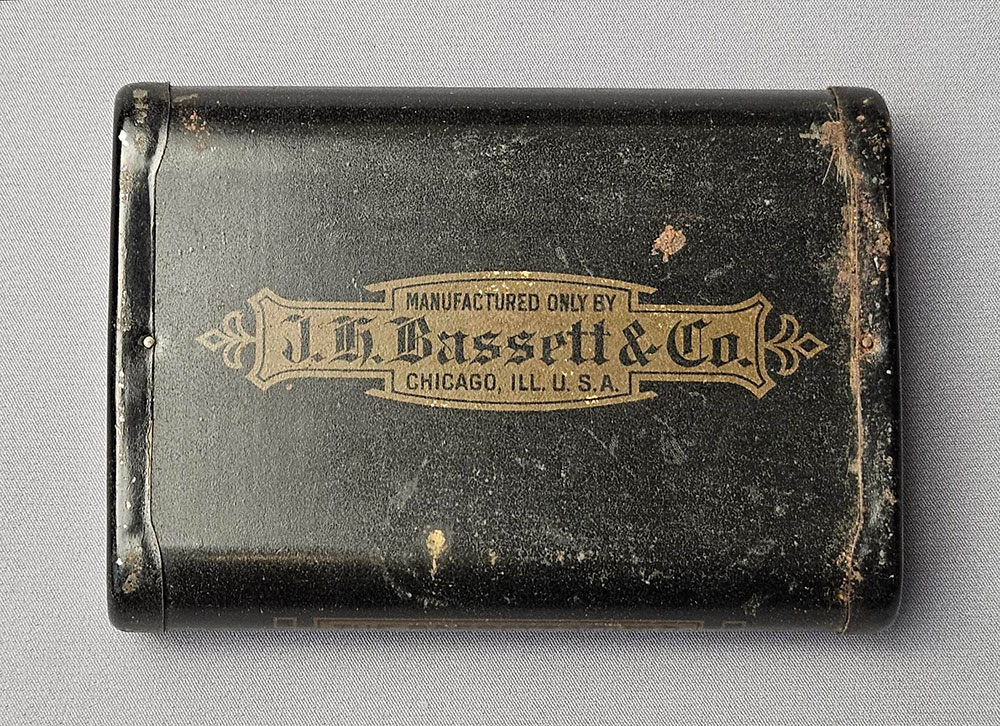
This here is the Bassett adder. It is small – 11×7.8×2.2 cm. It is light – 84 grams. And it is surprisingly usable and therefore a pleasure to use, despite its limitations.
The Bassett Adder was invented by James Hunter Bassett (1888–1932) from Chicago, and was produced from 1909 to the late 1930s. It is a Continuous Band adder: for each decimal place there is a closed band that can be pulled down with a stylus to advance the number shown in the readout window below it. You stick the stylus in the hole next to a digit printed on the case and pull till you hit the bottom; each time you do this the readout increments accordingly.
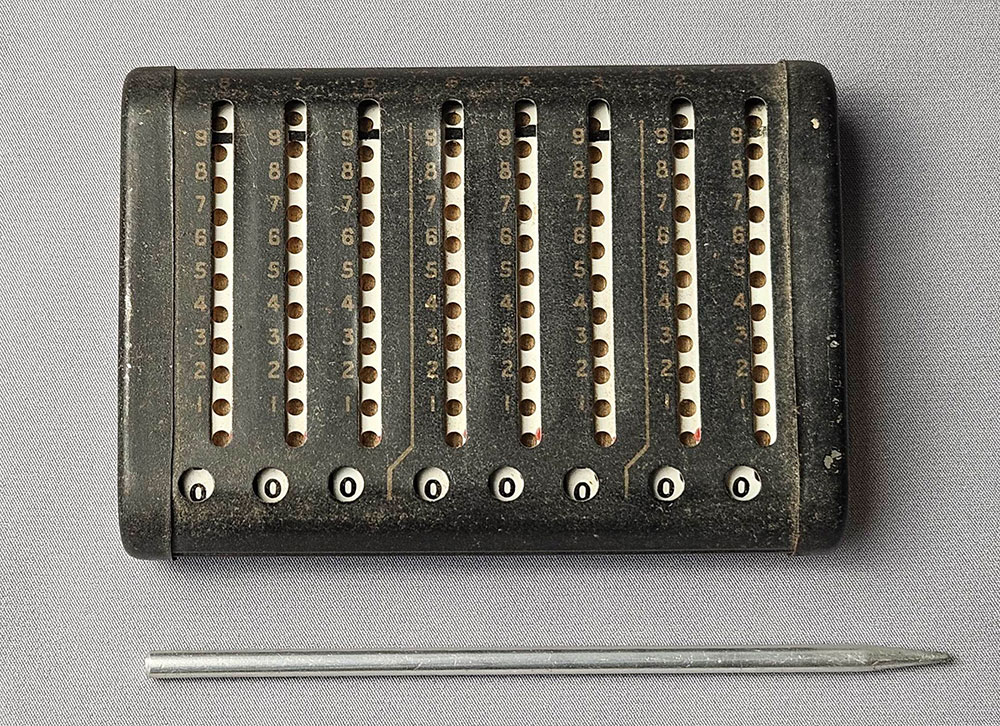
The immediate question this raises is what happens when you cross zero, say when you add 1 to a readout of 9. Some devices, like the similar-looking Golden Gem adder, include the gearing that increments the next higher digit when this happens, effecting a carry. The Bassett does not; when the black stripe on a band goes off the bottom, the readout for that digit reverts to zero, but the next readout stays put. That is, 17+2=19, but 17+3=10. Not good! There are a number of very simple adders like that, which lack a fully automatic carry, like the Totalisateur and the Locke; there are others that have it despite being simple, like the Stephenson. The Bassett is among those that lack this important feature.
Bassett originally made his “Bassett Adder No. 1”, which expected the user to pay attention and increment the next digit manually when required. The device I have here is his next version, where the device helps the user by signaling the need to make a carry. This is done by raising a red flag at the next digit, right under the “1” hole that one needs to pull down.
Here is the sequence for adding 2548+5. After adding the 5 you remain with 2543, but the red flag prompts you to add a 1 to the tens, giving the correct 2553.
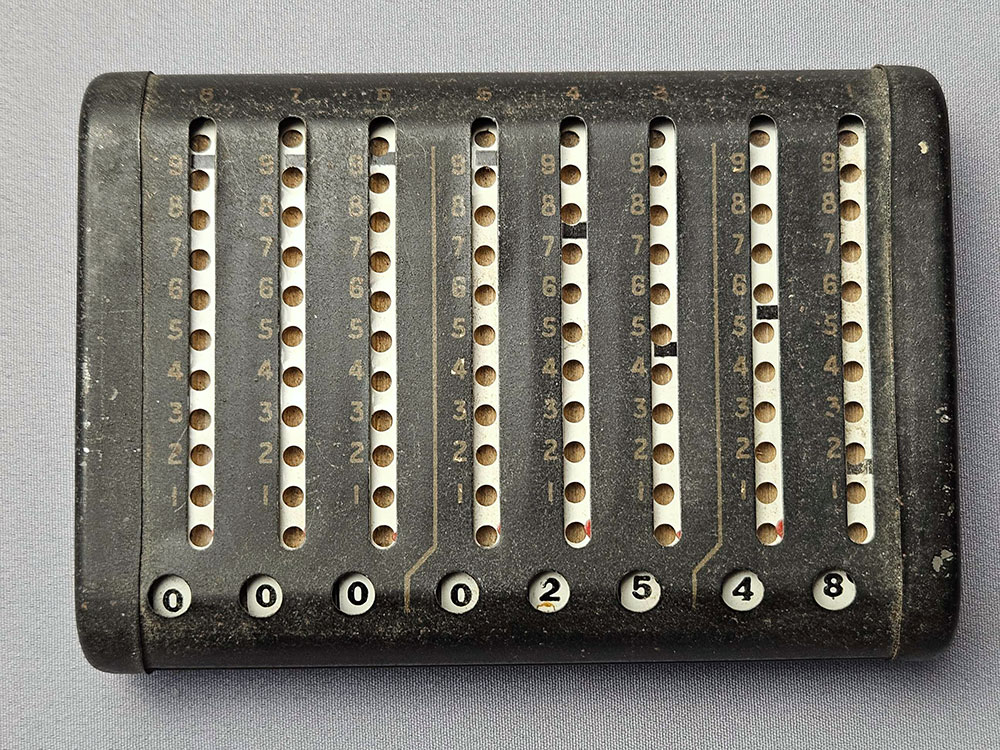
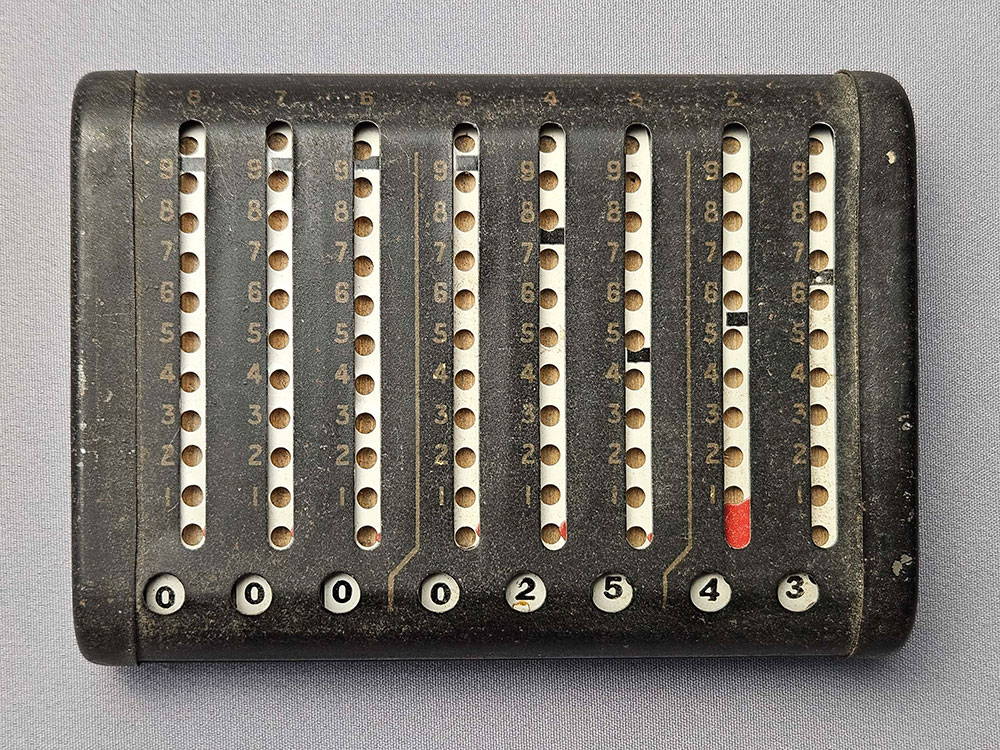
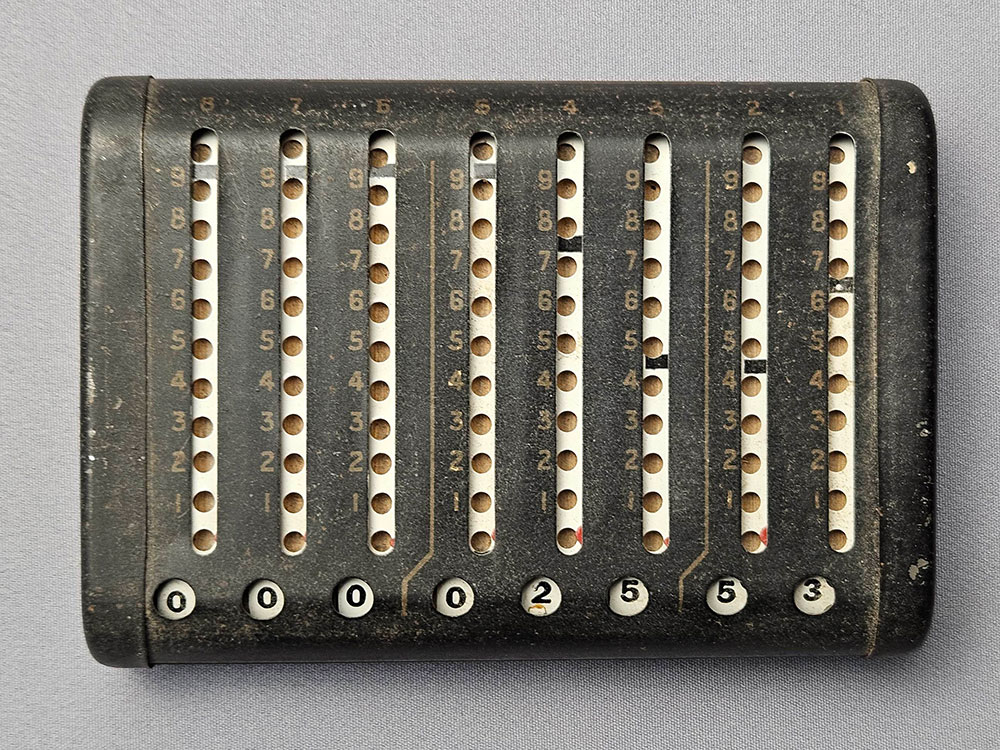
To reset the readout to zero you have to reset each band in turn by placing the stylus in the hole above the black stripe and pulling it to the bottom. This may raise a red flag in the next column, so you start at the units and reset bands going to the left. A bit laborious, if simple to learn.
The construction of this calculator is very simple, and keeps it feather-light without feeling flimsy. The case is made of a thin metal layer – probably tinplate. Inside, the celluloid bands run around a wooden core; in fact they just slide on the wood without any wheels or bearings, yet they move smoothly and the readouts are crisp and readable. A pleasant user experience all around.
Exhibit provenance: eBay.
More info:
- A video from Stephen Freeborn gives a glimpse of the inside construction.
- The instructions sheet for this device. This touts it as capable of subtraction and multiplication, but doing those involves mental arithmetic steps and can be ignored as pure hype (a sin seen in many simple adders).