
Recently I made an unexpected discovery.
I was talking to some students from a respectable college in Tel Aviv, and I showed them on my phone the photo below, which I’d just posted in a new article on this site.
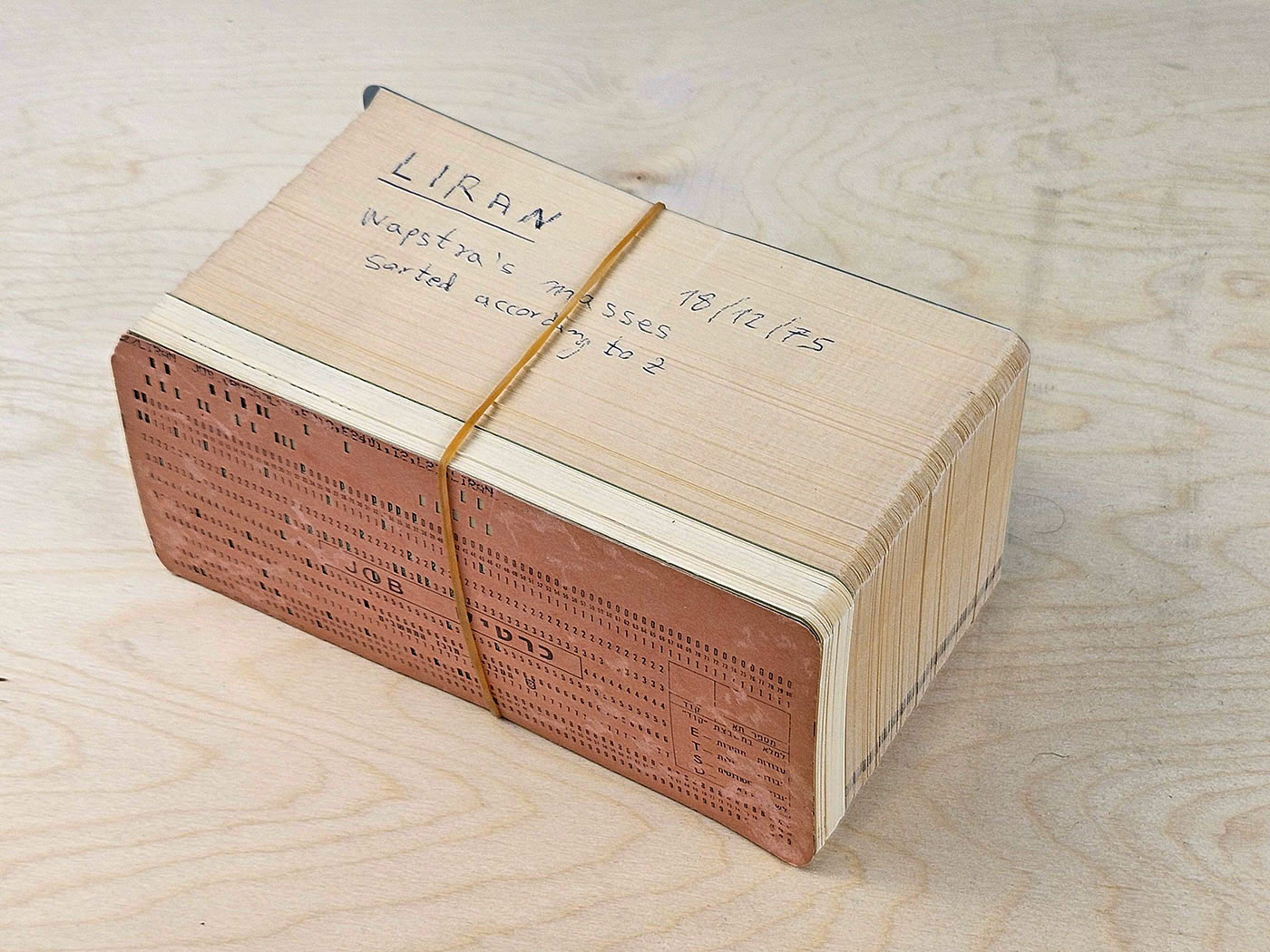
The students had no idea what this was. So I explained that it was a deck of punched IBM cards, which directed a mainframe computer to run a computing job. They were amazed, and asked how the information got into the computer. When I explained about card readers, and returning the next day to get the output of the program on fanfold paper, they were even more amazed. What a thing! Who would have imagined?!…
Hence, my jarring realization: these intelligent young people, who were actually studying information systems, had never heard of mainframes, or punched cards, or batch processing. This was technology that had dominated their chosen professional field a mere 50 years before, and they were completely oblivious of it. It was an obsolete technology, so it held no place in their knowledge. It’s as if technological innovation has an “event horizon” beyond which the past becomes invisible, and today that horizon lies less than 50 years behind us.
Later I considered it, and it occurred to me that this horizon has shifted over my lifetime. You see, when I was their age I knew a great deal about obsolete technologies. Heck, when I was half their age – even before I started high school – I knew a great deal about obsolete technologies. By that age I knew how a steam engine worked, who had invented it and how they’d come to do it; I knew how Stephenson invented his locomotive and how railroads came to be; I knew the fascinating stories of the invention of the telegraph, the steamboat, the telephone, the electric light… and the biographical stories of the respective inventors. And these weren’t 50 year old technologies… some were 150, even 250 years old, and not in my professional field at all (I was in elementary school, remember). My technology event horizon gave me 250 years of visibility – and today’s computing students are unaware of the computers of 50 years ago!
So what’s changed?
This can be a subject for PhD theses, and I’m sure there are many causes; but in my case, I can point out one cause: growing up with books, rather than screens.

Books were a central part of a child’s world in my time (the 1960s, to be specific), because what else was there to do when we weren’t playing out in the streets and open fields? (That’s another thing kids no longer do, but that’s another story.) We had no television, no videogames, no tablets, no smartphones, no social media. We had hobbies like stamp collecting, various crafts – and books. Many of us read voraciously, in childhood and for life, as had our parents before us. I still have shelves full of my childhood books, and some of my parents’ and grandparents’ – you can see a couple of them in the photo. Most of these books are much-thumbed, some falling apart, all of them well loved.
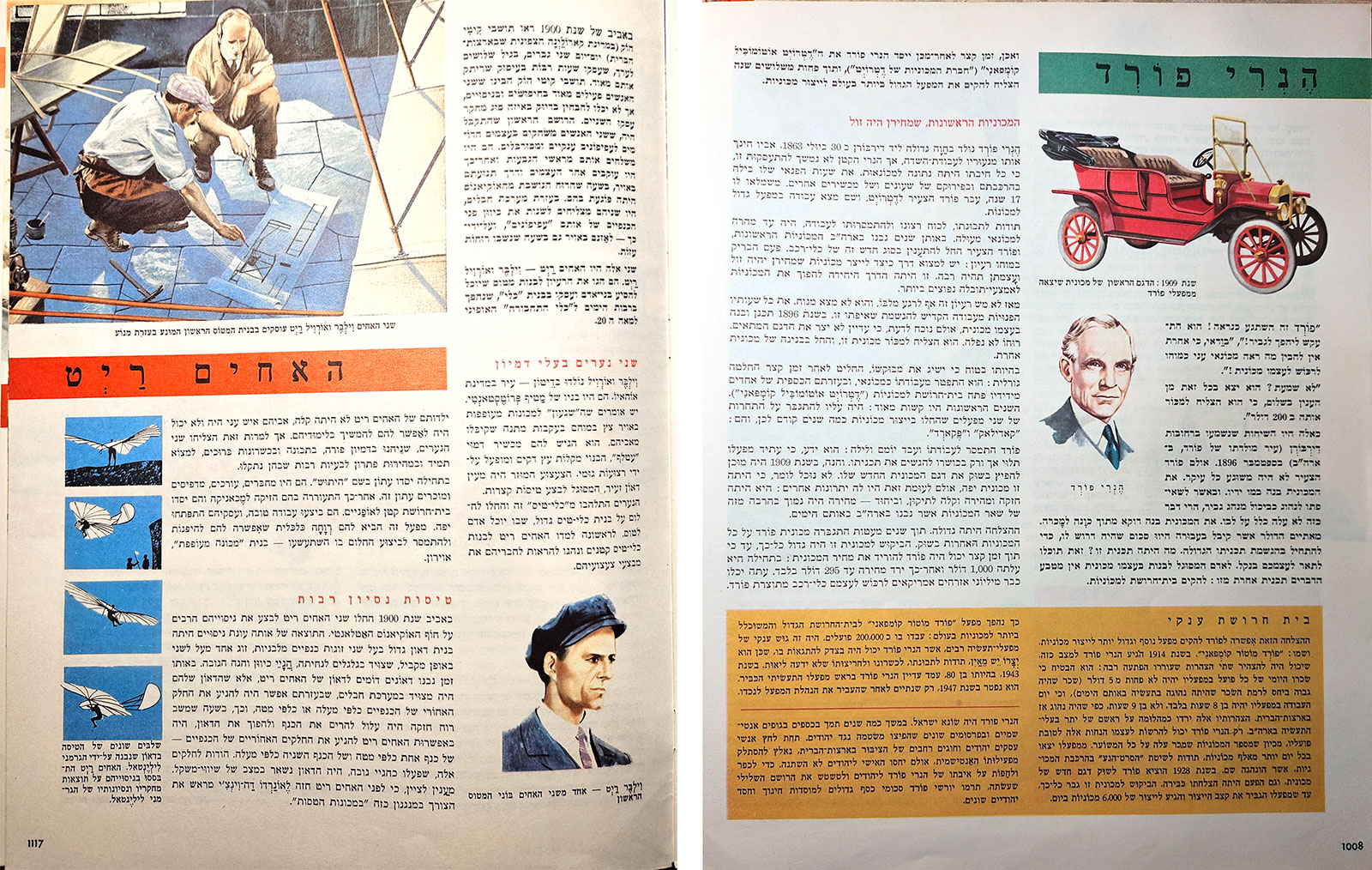
Some of the books belonged to us, received as birthday presents or inherited from parents, cousins and older brothers. Many more were loaned from libraries, which had a prominent presence in schools and in the community. Some books were fiction, some were juvenile adventures (anyone remember the “Famous Five”?) – and some were non-fiction documenting the world around us; technology history – “great inventions” – was a notable sub-genre, and we’re talking about such books that were expressly directed at children. Children’s encyclopedias were also common then, and pulled their weight on the subject too: below are pages devoted to the Wright brothers and Henry Ford, from the popular “Tarbut” (Culture) children’s encyclopedia published in Israel in the 1960s.
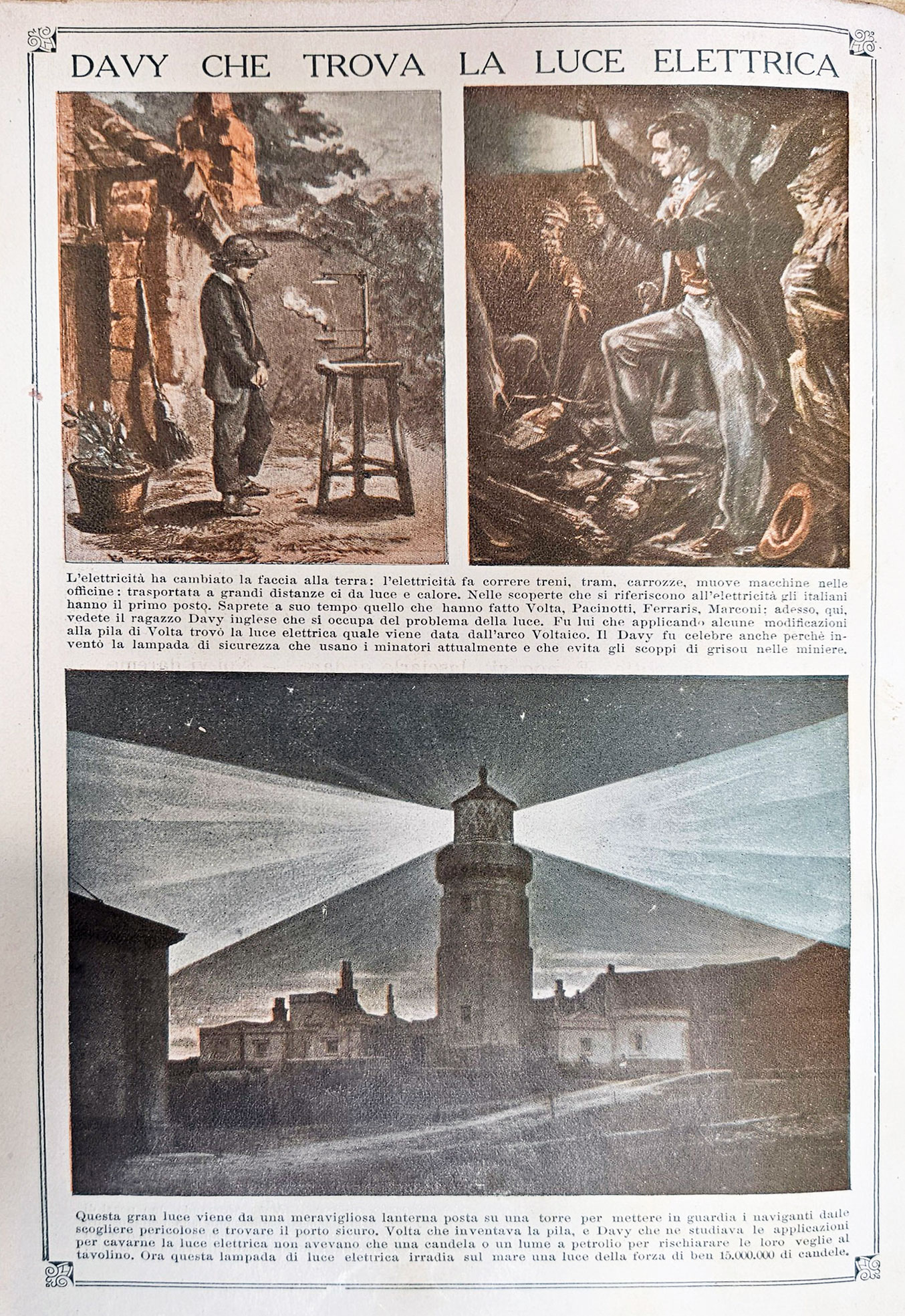
This practice did not start with my generation, either. I have a volume of the Italian “Enciclopedia dei Ragazzi” (Children’s Encyclopedia) that belonged to my Grandmother; published in 1911, it is a potpourri of articles from many fields – poetry, geography, mythology, handicrafts, and more – and history of technology is well represented. Below are two pages, one describing the invention of electric lighting by Humphry Davy (yes, decades before Edison), and the other going in detail into how a steam locomotive works. Note how Davy is depicted progressing from a humble experiment in his boyhood to the later confident demonstration of his miners’ safety lamp as a mature adult, and finally the triumphant glory of the massive lighthouse his inventions enabled; this kind of narrative was often used in these inventor biographies.
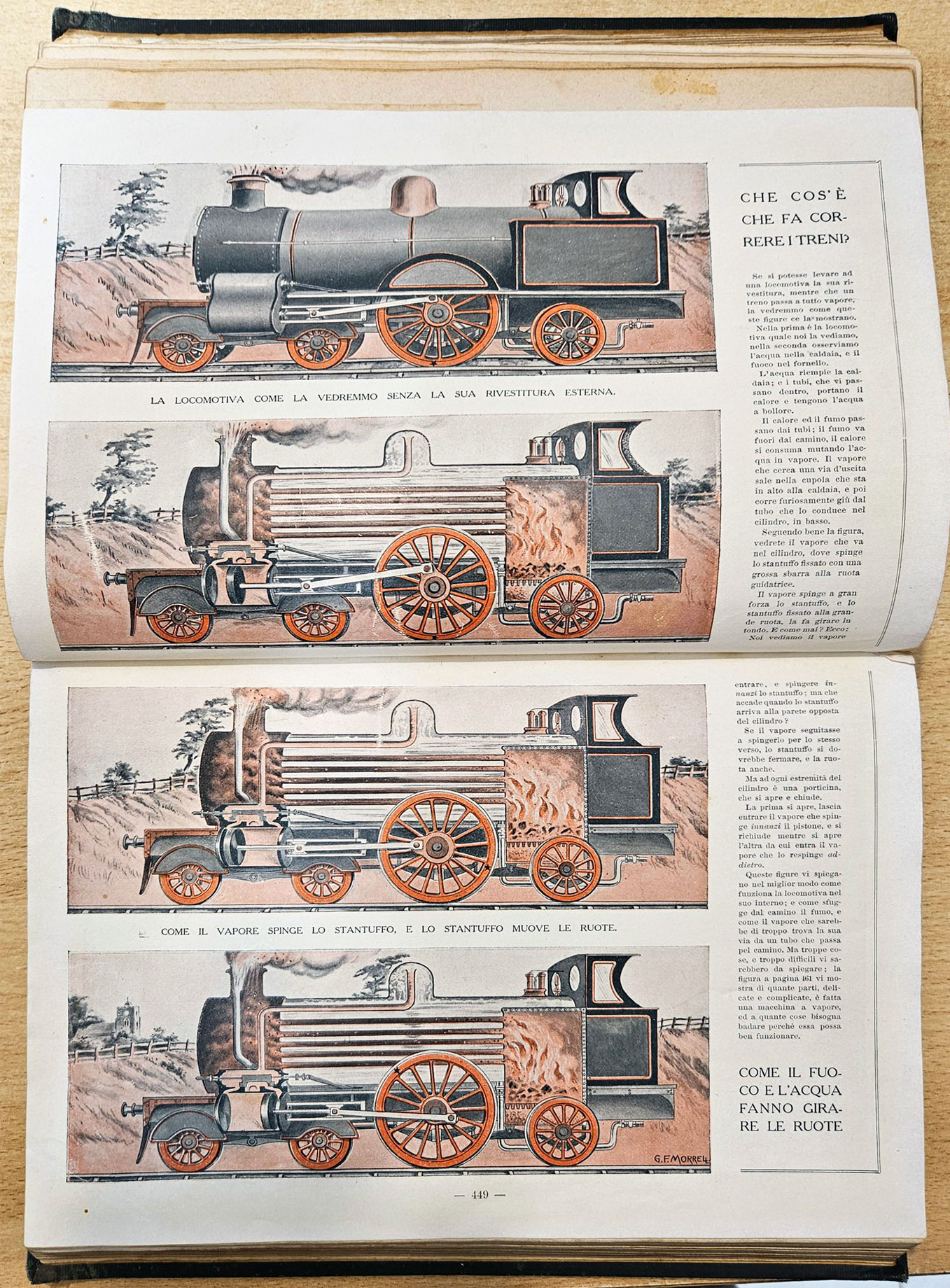
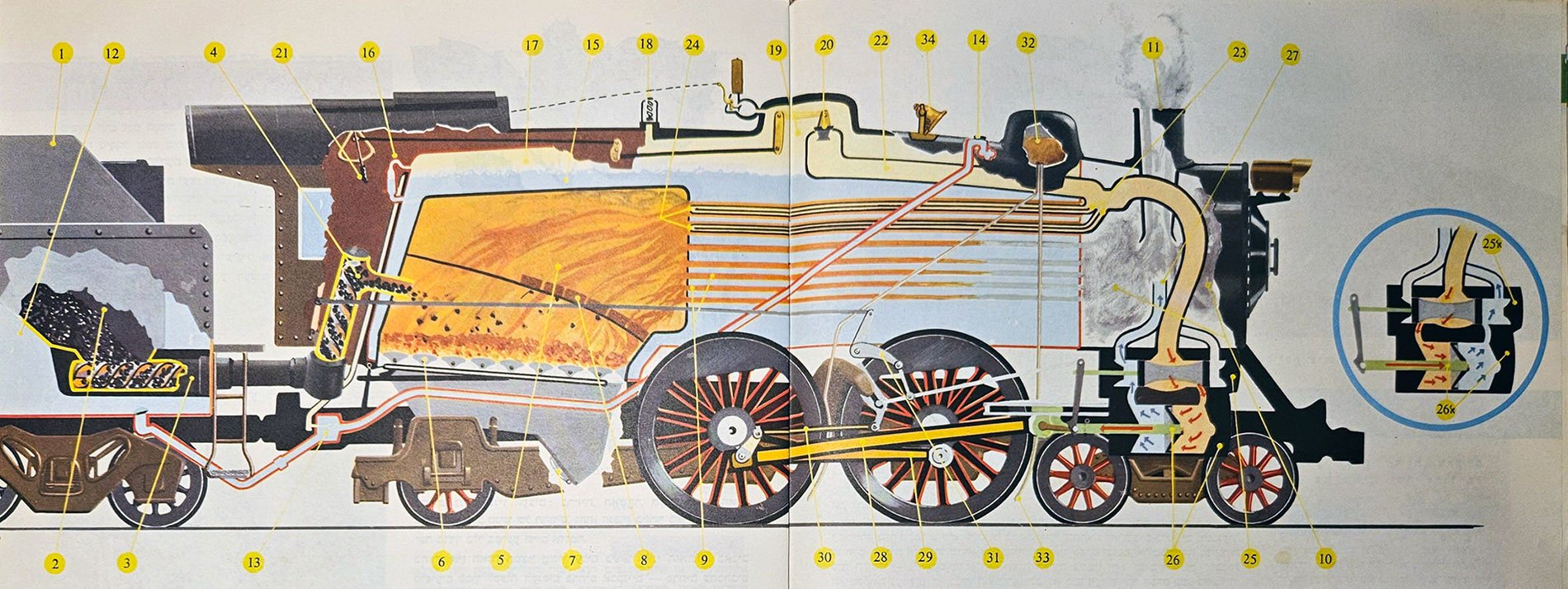
So you see, when she was a child my grandma knew how a steam locomotive works. As did I; the next picture is from that “Tarbut” encyclopedia of my childhood. Today’s children are experts on superheroes and anime, but I doubt they know how any locomotive (steam or otherwise) operates. Of course it isn’t the children’s fault – the adults who educate them, and who write content for them, no longer assume that an understanding of how technological things came to be and how they work is important for a child’s (and hence, an adult’s) education.
What made the books interesting to read was the combination of the technology part – they actually explained how Edison’s phonograph captured that first recording of “Mary had a little lamb” – and the biography, often starting with the inventor as a young kid. I remember to this day why Edison was deaf – there was an illustration of the conductor pulling him by his ear onto the moving train where he had a job as a juvenile newsboy…
And I’m pretty certain some of the stories were oversimplified, or dramatized, at the expense of historical rigor; the Edison deafness cause is disputed among serious scholars, and there must have been other contributors to the process of invention. But for a child reading this, it was enough to educate, and to inspire.
Incidentally, I never thought of the steam locomotive, the telegraph, and so on as “obsolete technologies”. To me they were the foundations of a continuous progress that I enjoyed in the present. Sure, there is something Victorian about this notion of upward progress, but having a historical vision of technology puts older tech in exactly this light: with all respect to Steve Jobs, without Alexander Graham Bell and Guglielmo Marconi there would be no cellphones today. What’s more, when I entered my teens my books and kiddie magazines would encourage me to experiment with steam, electricity, chemistry, telegraphy – making the earlier inventions very concrete.
I should note that the knowledge imparted by books was not limited to the physical sciences… there was “Microbe hunters” by Paul de Kruif, with the fascinating biographies of Pasteur and Koch and so on (perhaps that is why we boomers are more resistant to the fallacies of Anti-vax sentiments?), and there was “Ships & how They Sailed the Seven Seas” by Hendrik Willem Van Loon, with the history of all things maritime, and there was “The shoemaker’s son” by Burnett with the duckling-to-swan life story of H. C. Andersen, and “Madame Curie” by her daughter Eve, and many others. Most of these were popularized biographies, aimed intentionally at young readers and widely read by them. The horizon back then went not only deep into the past, it was wide as well.
And much of it is still with me now, many decades later – quite possibly it played a role in my growing up to become an engineer. At any rate, it made me a better one – better rounded, more widely read, to use a concept that is probably heading for obsolescence too. And there is no equivalent today to take its place – what will you say, that someone is “widely scrolled”?…