
So here, in its cardboard box, you see the IRMO calculator. Mind you, what you see isn’t a linear slide rule placed in the box over a circular one; it’s all one item, with lots of moving parts. As I said: funky!
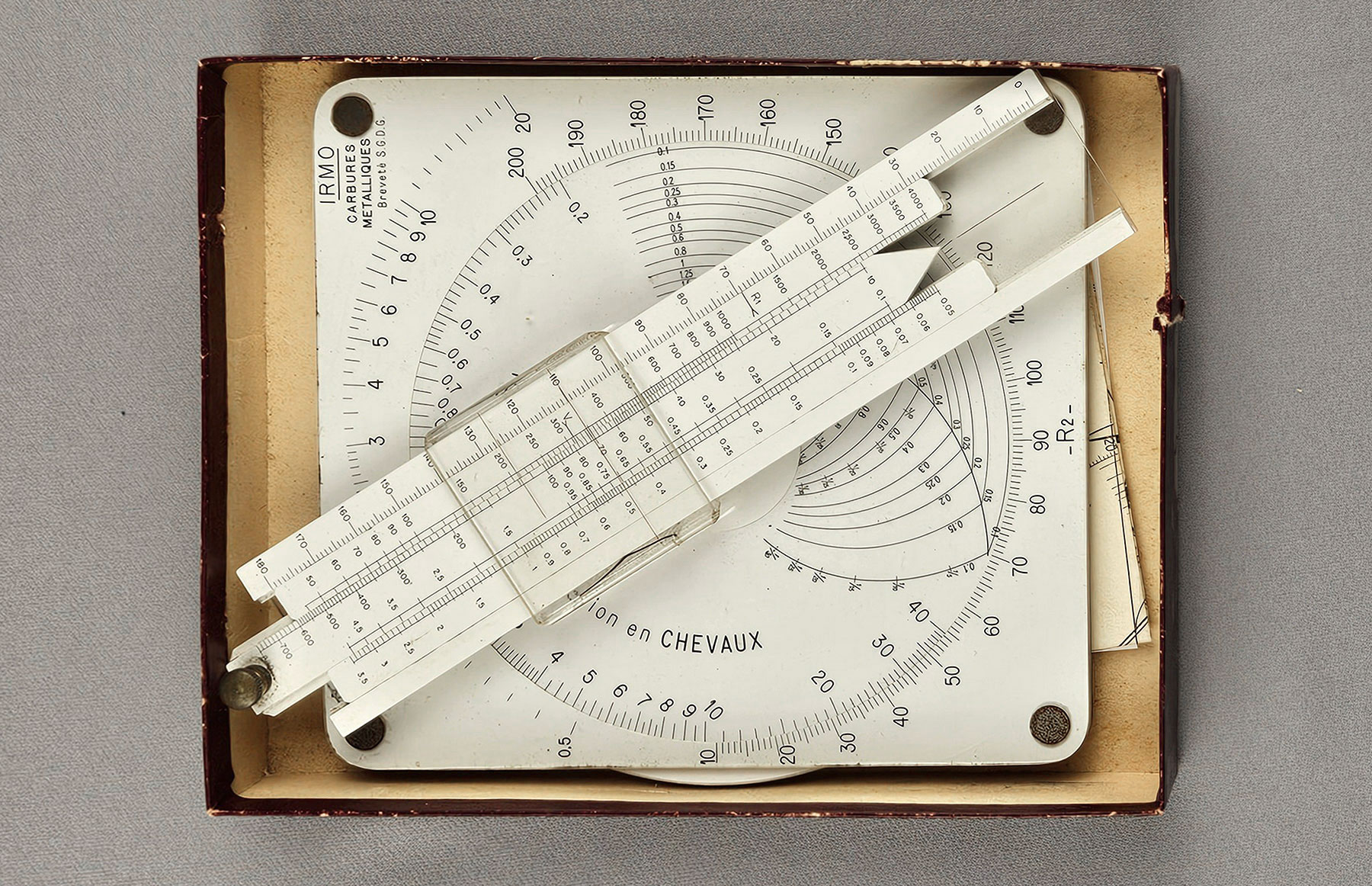
Here are the components of this remarkable device, with reference to the colorized photo:
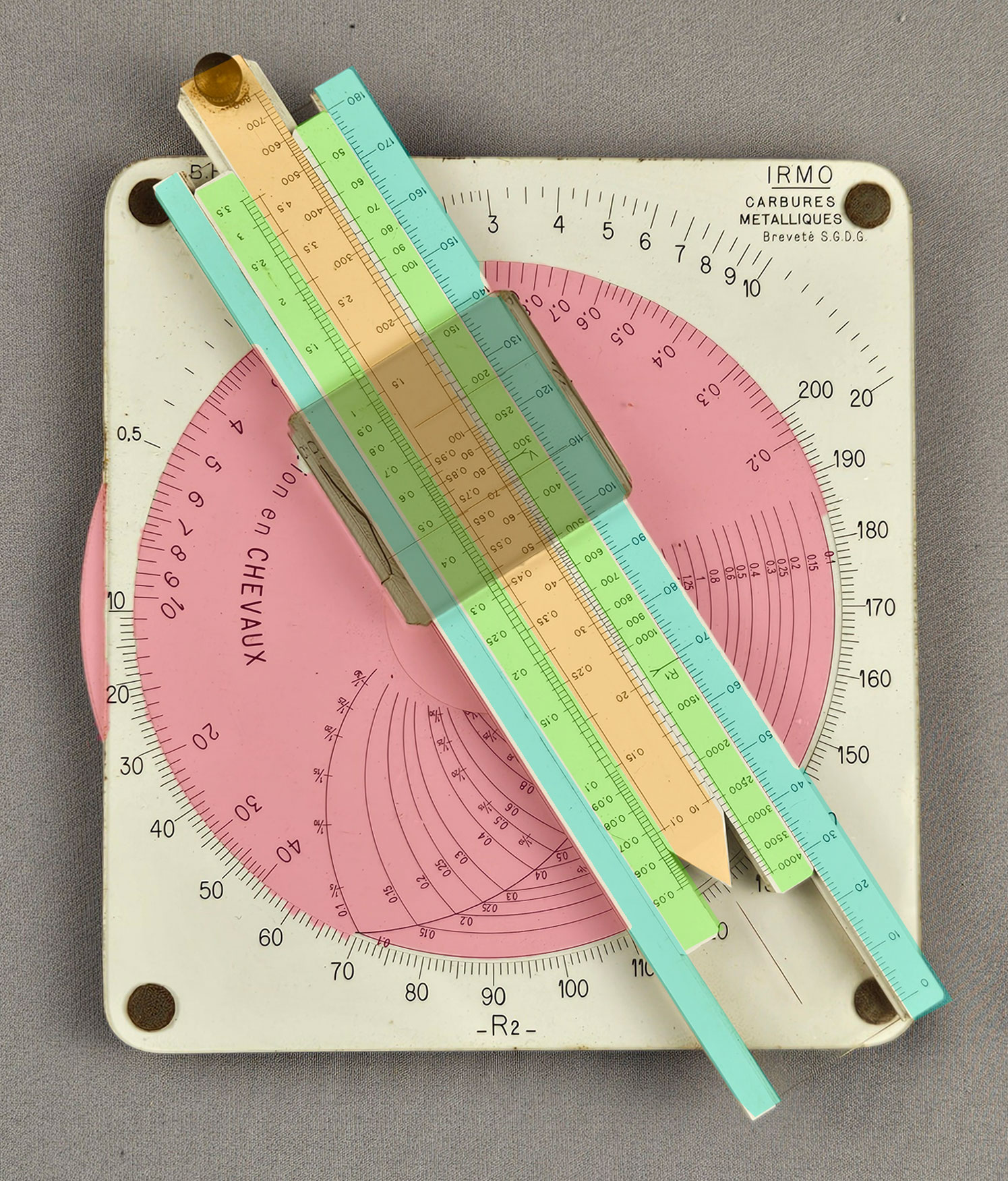
- A baseplate 15.6×14.1 cm in size, made of a white plastic layer with an underlying metal layer, all sandwiched between two clear Plexiglas layers [White in the photo].
- A circular plate that can be rotated by its protruding knurled edge at the left [Pink].
- A linear slide rule whose stator (comprising the two outer rules) rotates on a pivot set in the baseplate. The pivot is not concentric with the circular plate, which calls for a clever design seen in the patent drawing [Blue].
- An intermediate “sliding stator” composed of two rules that slides in a well in the outer stator [Green].
- An inner slide, with a pointy end, that slides in a well in the intermediate stator [Orange].
- A transparent cursor with two hairlines [Gray].
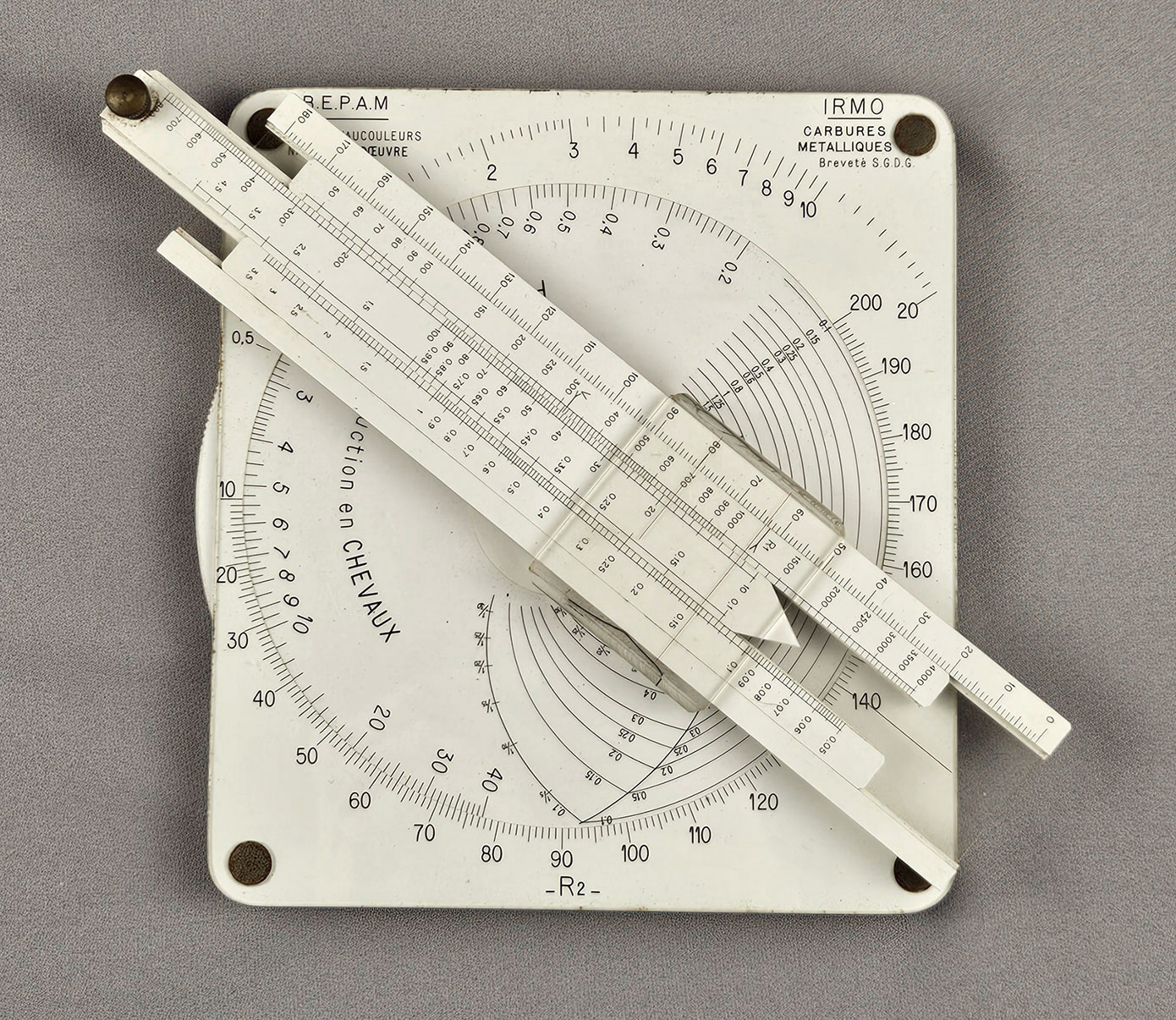
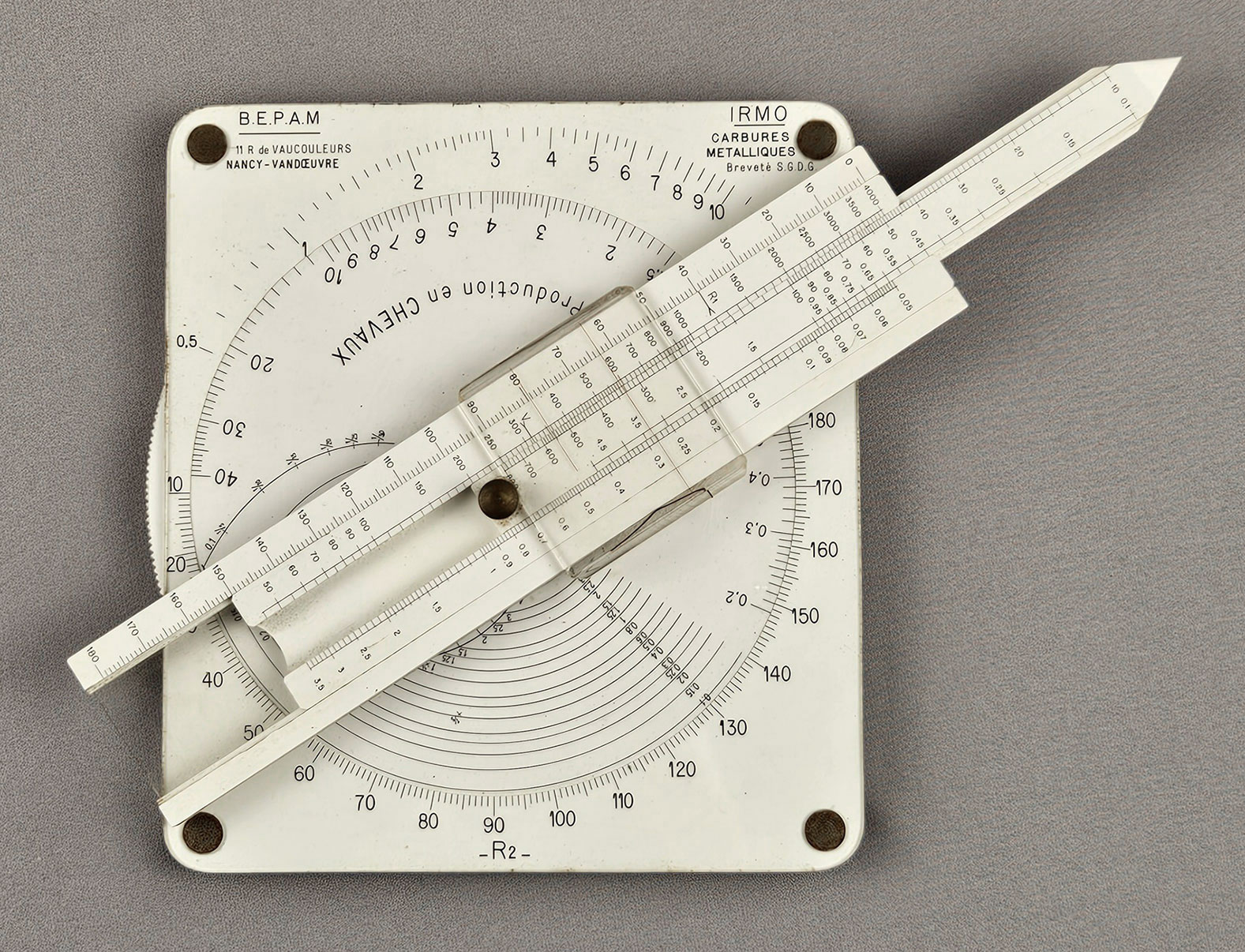
So, five degrees of freedom for setting parameters, and lots of scales and charts to set them on and to read results off. The next two photos, with the device in two random states, show you how the parts can be moved around.
The back of the calculator has a table listing various parameters related to different metals and machining situations:
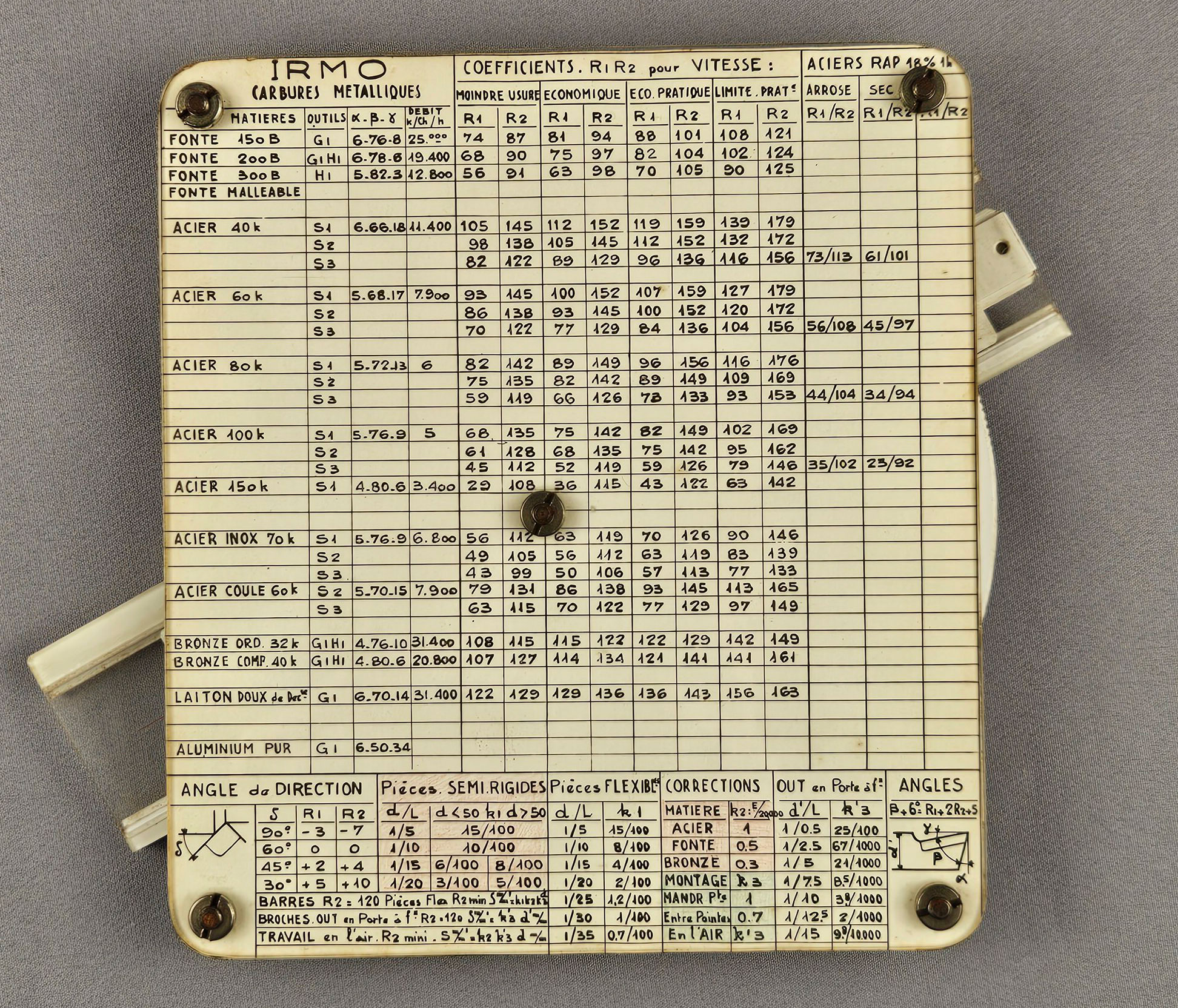
IRMO stands for Indicateur de Rendement pour Machines-Outils, which means Machine Tool Efficiency Indicator. A label identifies it as calibrated specifically for carbide cutting tools. It allows one to improve productivity in machine shops – those utilizing lathes, milling machines and the like. With it, machinists and their bosses could determine optimal machine parameters by effecting calculations involving cutting speed, depth of cut, feed, machine power, and estimated machining time.
I did not attempt to figure out how to use this wonder. I have only a one-page advertising leaflet, but no use instructions. If you’re into machine tools – which I am certainly not, much as I respect them – you may want to have a go at the examples given in the US patent.
This device was invented in 1950 or earlier by M. Roger-Charles-Marie-Émile Grandadam (now, that is one inventor who never suffered a shortage of names!), who was granted a French patent and a subsequent US patent, both in 1955. His invention was produced, or at any rate sold, by BEPAM – which stands for Bureau d’Étude et de Perfectionnement des Ateliers de Mécanique, or Research and Improvement Office for Mechanical Workshops. This organization was based in a suburb of Nancy, but I can find no more details about it. I did find the death record of M. Grandadam, where we learn that he lived a long life from 1912 to 2001.
Exhibit provenance: purchased from a fellow collector.
More info:
- The French patent for this device.
- The US patent for this device.
- The advertising leaflet.
Very nice and rare slide rule! Bravo Nathan!