
A marvel of precision and design
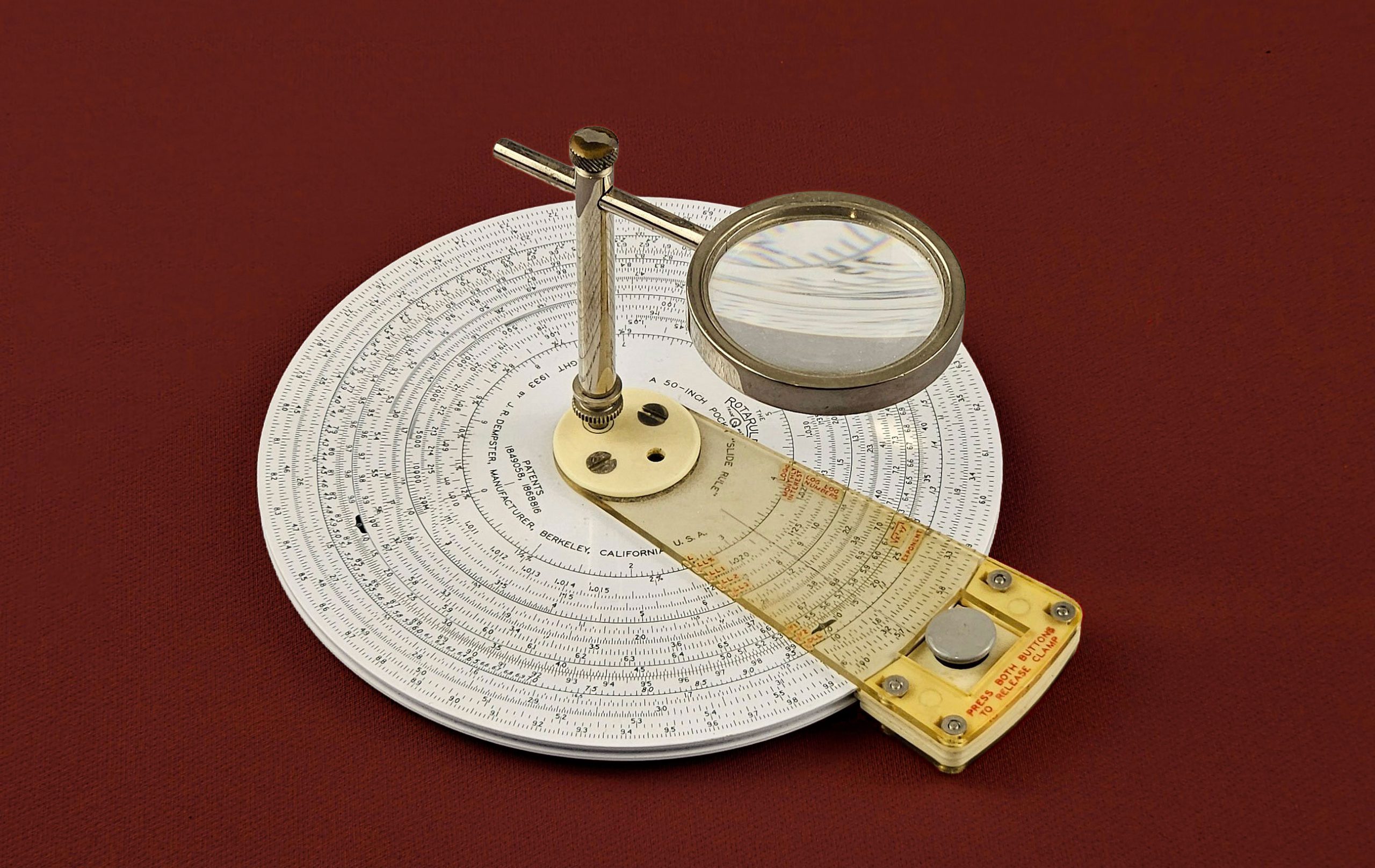
Technically, the RotaRule made by John Dempster is a circular slide rule, one of many such devices made over the years. But that completely fails to capture the “Wow” value of this compact precision calculator. It crams into a device just 13 cm in diameter a pair of logarithmic scales 127 cm long, enough to allow calculation to a whopping four significant digits. And it does this by combining an ingenious design and impressive manufacturing innovations.
The slide rule is composed of an outer disk (actually, a ring) 13 cm across that carries the outer set of scales on each side of the rule, and a concentric inner disk of 10 cm carrying a second set of scales. The disks are made of white Vinylite, a then new PVC copolymer somewhat related to the softer material used in LP music records. Then there is an elaborate radial cursor, and of course the lovely adjustable magnifier seen in the photo above.
My exemplar is the model AA, patented in 1932; it followed a model A from the late 1920s, which had fewer scales. Here are the two sides of my device:
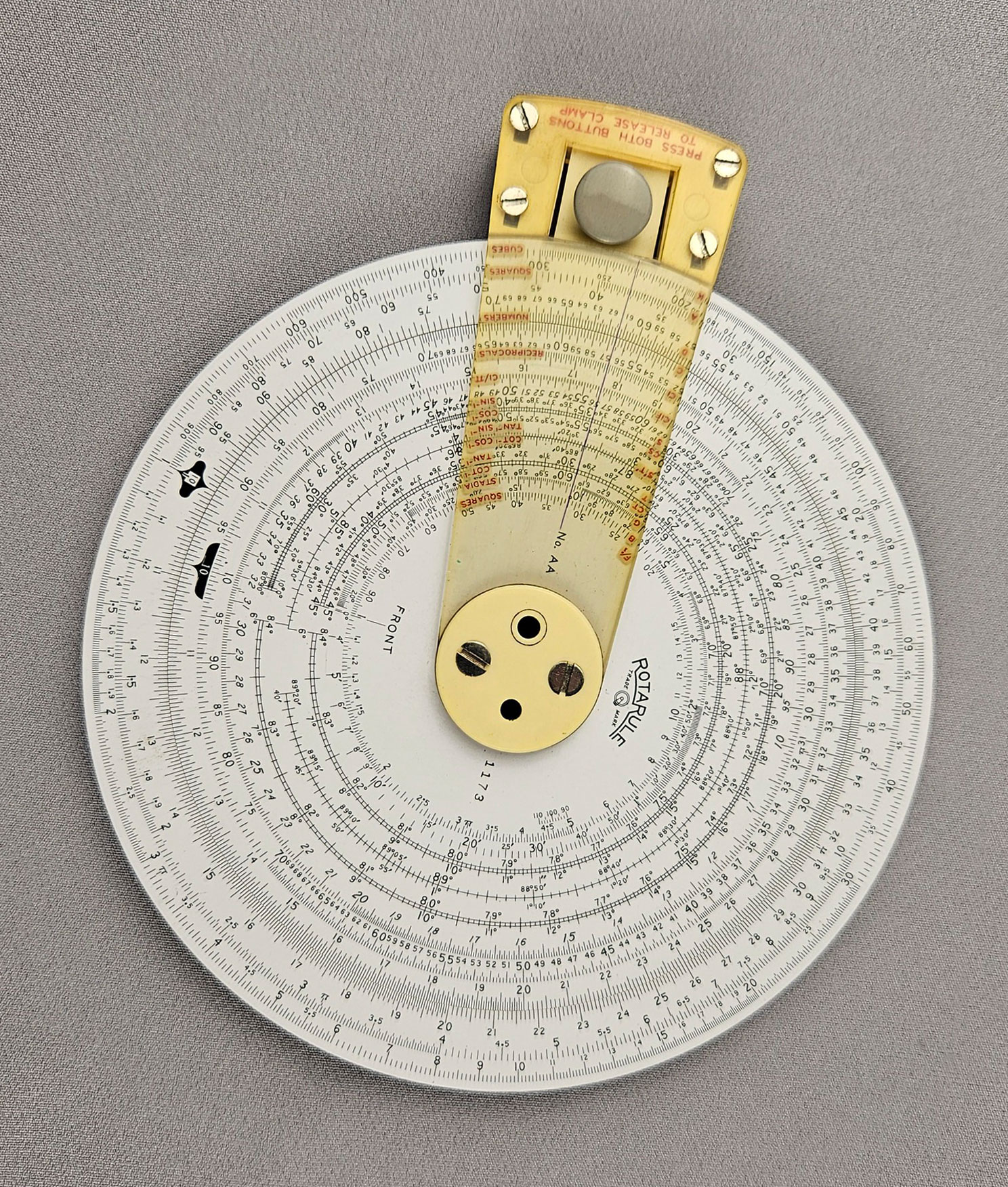
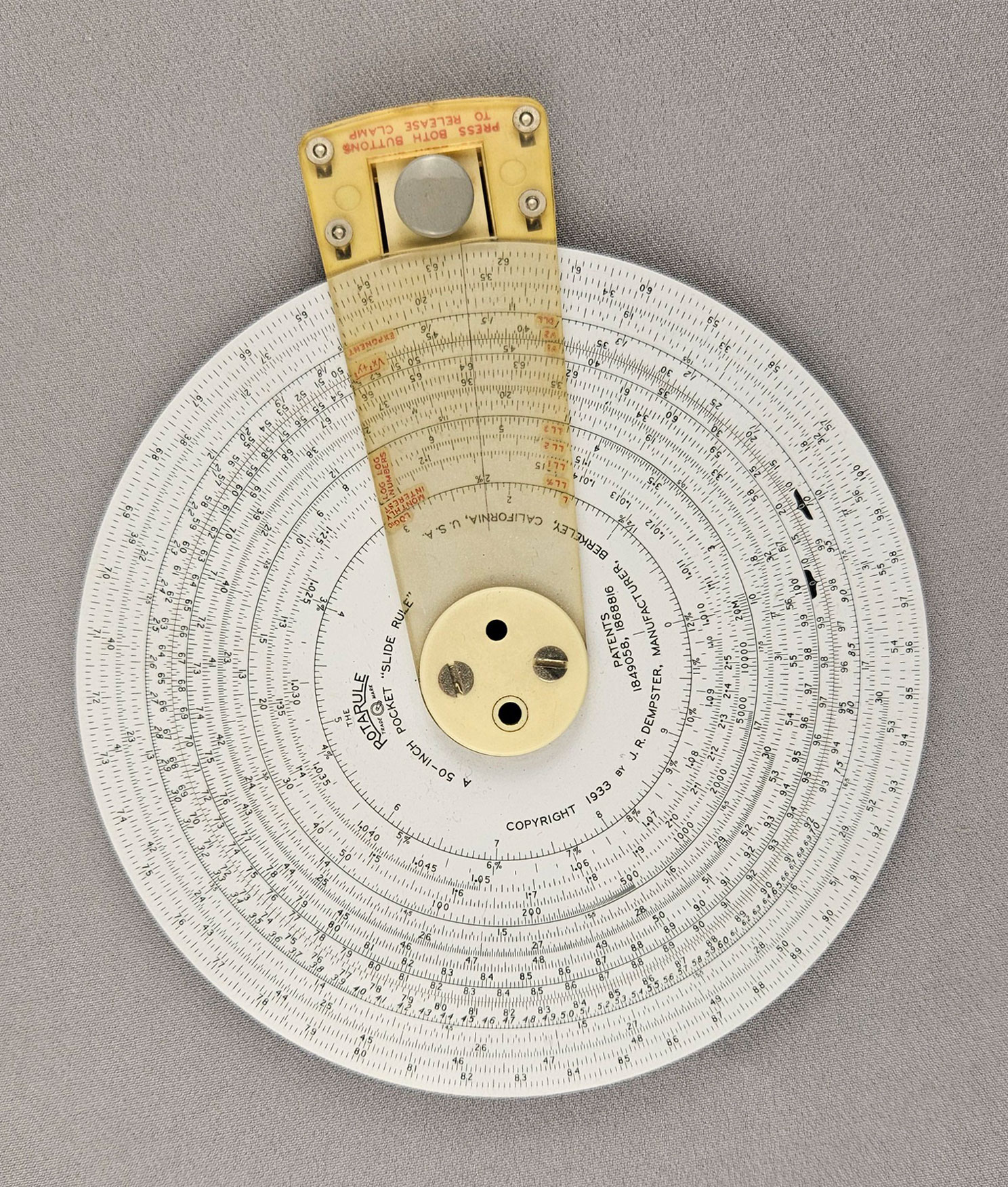
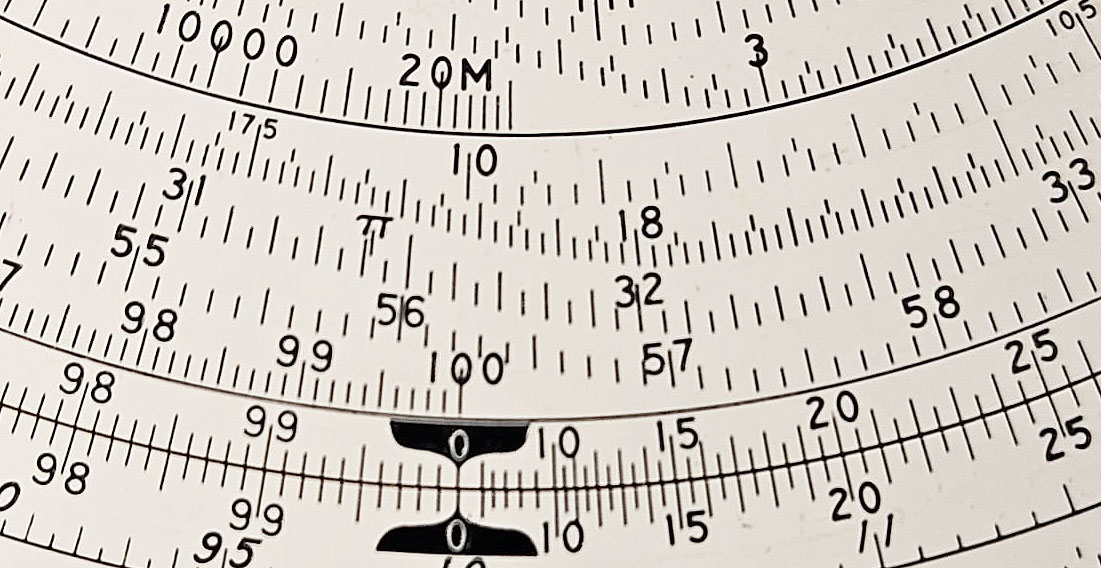
The model AA has 26 scales, including a pair of “Long C and D scales”. These two, on the back side of the rule, each span a 4 turn spiral, giving each that total length of 127 cm. Interestingly, the spiral is composed of four concentric circles that connect at the end of each turn via short diagonal transitions (see photo). For faster multiplication and division at lower accuracy, there is also on the front side a pair of single-turn C and D scales that are a “mere” 33 cm long. And in a nice touch, given the numerous scales, there are red labels on the cursor that identify the scales below them.
All this precision is supported by a superb mechanical design that is beyond anything I’ve seen on any other slide rule. The two concentric disks are not just held in place by the usual tongue and groove at their edges: they can be centered and tensioned to get just the right friction using three tiny equidistant screws at the outer edge, which adjust metal shoes inside the outer disk that push on the inner one. Another hole, marked OIL, can admit a drop of lubricating oil – a concept less familiar today but known to anyone a century ago, where “Singer oil” was in common use for the then ubiquitous sewing machines. Small wonder, then, that the RotaRule rotates smoothly and effortlessly (though it does hiss a bit – a drop of oil would cure that, but I prefer not to experiment there). The photo below shows one centering screw hole on the right and the oil hole on the left.
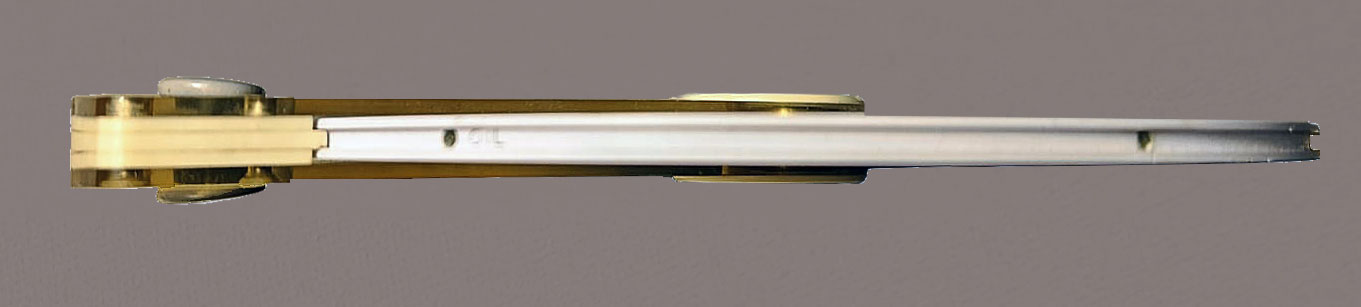
You can get more insight into this sophisticated design from the patent drawings.
The elaborate cursor rotates just as smoothly, because it runs on ball bearings hidden inside the central hub. In fact it moves so freely that a brake mechanism has been added to keep it in position once adjusted. Pressing the two round buttons at its end releases a clutch that otherwise locks it to the outer disk. All this still functions very well today, although the once clear plastic (possibly celluloid) of the cursor has yellowed a bit in the intervening century.
The beautifully made optional magnifier, which can be mounted in a hole in the hub on either face of the slide rule and can be moved in and out radially, allows more precise reading and less eye strain.
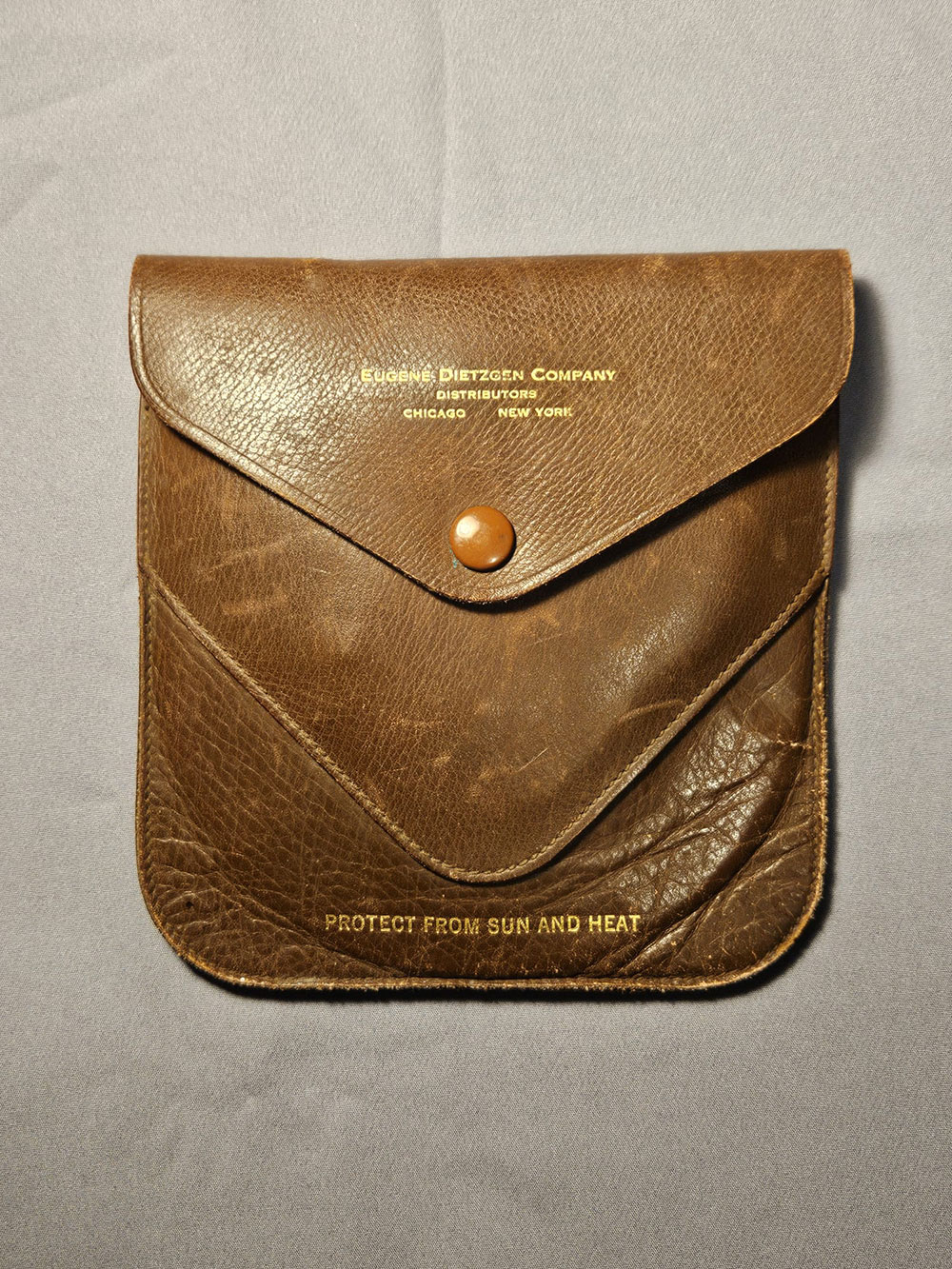
Altogether, some 2500 RotaRules were produced from 1928 to around 1950. Many were marketed by Dietzgen, a major slide rule manufacturer, whose name is stamped on the leather case that mine came in.
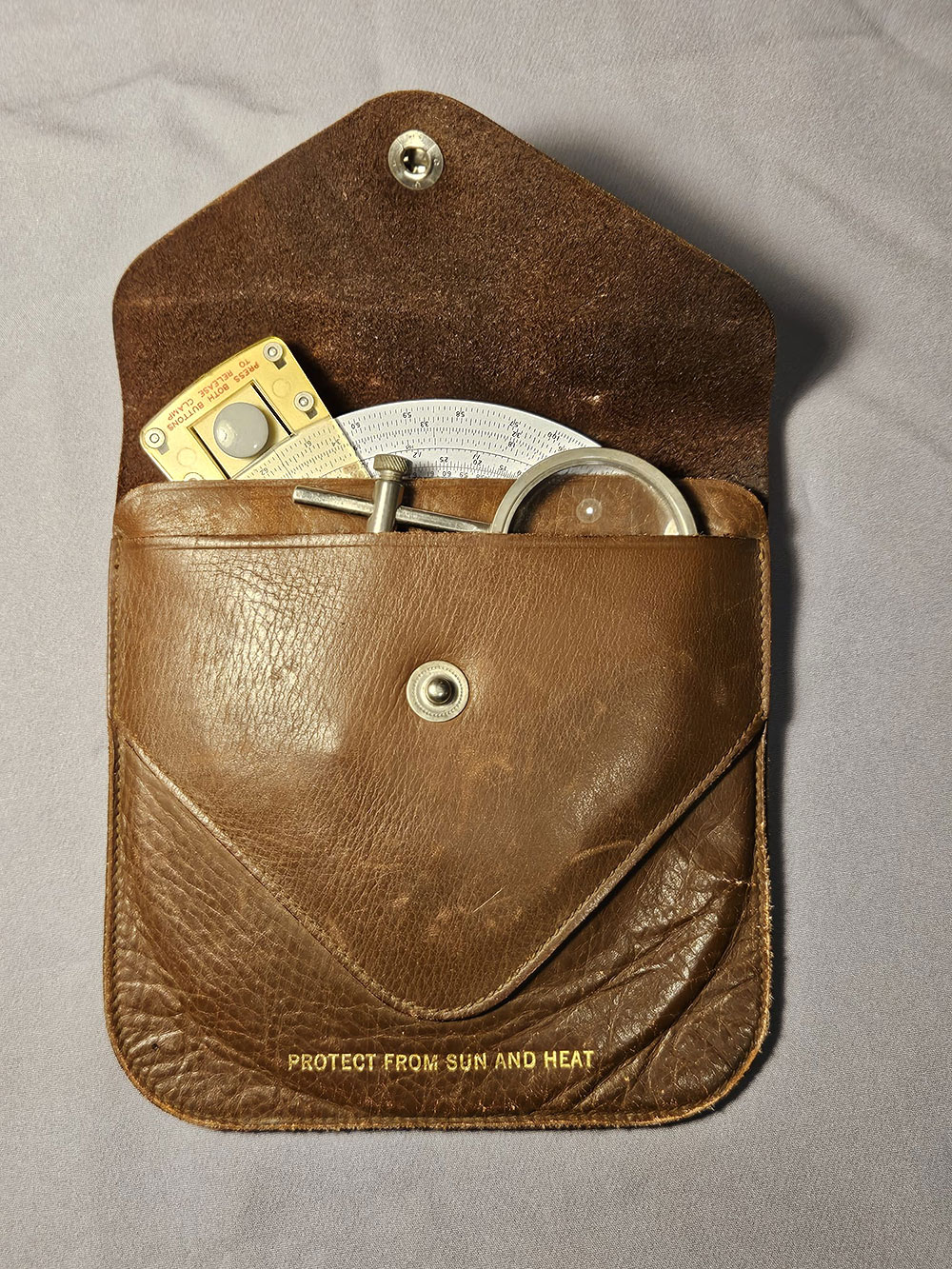

The inventor and manufacturer of this slide rule was John Ross Dempster (1903–1964) of Berkeley, California. He held a Mechanical Engineering degree from UC Berkeley, which he clearly put to good use (the photo shows him in his college days). He produced the RotaRule in a workshop in the basement of his house, with help from his wife Anna and family members (we know that among other tasks, Anna inked the scales and sewed the neat leather cases, which had a special pocket for the magnifier).
Dempster applied his ingenuity to the manufacturing operation as well. He designed and built a special steam-heated hydraulic press that forced molten vinylite granules against metal dies that imprinted the scales and numbers into the disks. Presaging today’s photolithographic processing he created the original artwork on steel masters five feet in diameter, which were then photographically reduced to produce glass plates at the final 5 inch size; these were used to create the final metal dies. All this would be at home in many plants in today’s hi-tech industry, but it was accomplished by one engineer and his family in a basement almost a hundred years ago!
Exhibit provenance: A lucky day on eBay.
More info:
- The two RotaRule patents granted in March and in July of 1932.
- John R. Dempster’s RotaRule Model AA; A Masterpiece in the Art of Slide Rule Design, by Richard Smith Hughes. In Journal of the Oughtred Society Vol. 16, No. 1, 2007 Pg 62.
This article has full descriptions of all the 26 scales, and explains the mechanical design. - John R. Dempster, The Remarkable Dempster RotaRule and the Extraordinary Dempster Family, by Richard Davis. In Journal of the Oughtred Society Vol. 19, No. 1, 2010 Pg 33.
This one has fascinating information about the people and history behind the Rotarule. - A marketing brochure and letter, from the ISRM site.