
Three centuries of slide rule innovation
The iconic slide rule, long identified with the science and engineering professions before the advent of the electronic calculator, had two sliding components that set it apart from an ordinary rule: the slide running down the center of its body, and the transparent hairline cursor (also called runner) that moved over both body and slide. This configuration was so standard and universal in the 20th century, that few of the countless engineers who used it could imagine any other; and yet for most of its 300 years the slide rule had no cursor at all, and when it got one, it looked quite different…

The evolution of the standard straight slide rule, or slipstick as it was nicknamed in its heyday, is an interesting one to follow because the same basic principle evolves through a sequence of progressively more effective designs, culminating in the familiar form that helped us put a man on the moon in the sixties. As a collector interested in the evolution of technology in time, I made an effort to acquire one representative of each stage in this evolution, and have finally secured all but the very earliest (for items pre-dating the 19th century, rarity and price do conspire against the collector!). This article uses photos of the items I have – and one that I don’t – to illustrate the history of the straight logarithmic slide rule and its cursor.
Origins
The first logarithmic calculating rules did not slide at all… they used fixed scales on a wooden rule that allowed distances to be measured and added using a pair of dividers. This “Gunter’s Rule” was the original device introduced by Edmund Gunter in 1620, which remained in use for some two centuries.
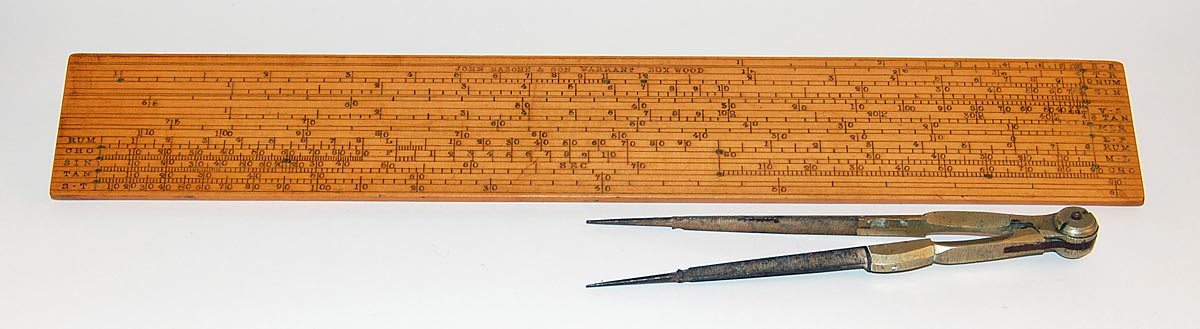
The first slide rule, constructed by William Oughtred in 1622, essentially put two Gunter scales next to each other, so that distances along both could be added directly by sliding the scales against each other. This idea remained for three centuries at the heart of every slide rule made.

Before the cursor
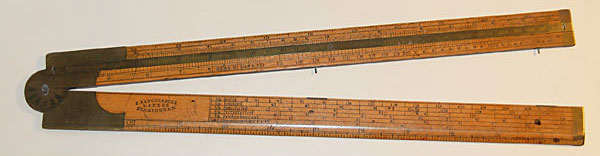
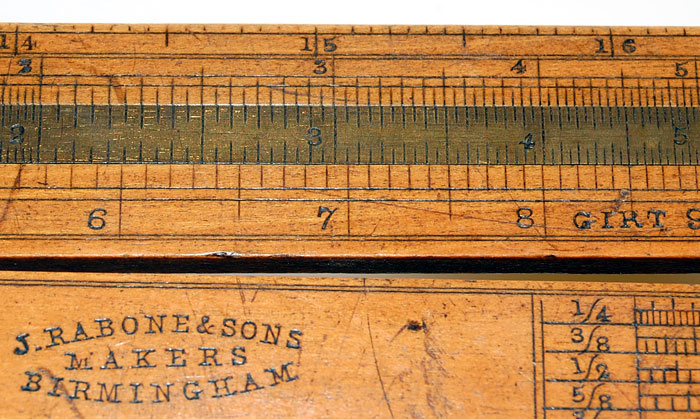
The earliest slide rules took many forms, but by the late 17th century had standardized on a few useful form factors, among them the Coggeshall carpenter’s rule. This instrument had a variety of useful scales and tables on one side and a standard 2-foot measuring rule on the other. The logarithmic calculating function used the narrow slide in one of its legs (For more, see this article).
Another standard form factor was used extensively in Ullage rules, which were used to calculate the excise tax on alcoholic beverages based on alcohol content and liquid depth in barrels of various shapes. The variety of calculations required ran into a problem: to calculate (multiply or divide) or convert between different quantities one needs to move a number on one scale next to another number on another scale. This required the two scales to touch each other, so the equivalent points could be pinpointed accurately. The way to achieve this was to make a wide rule with as many pairs of scales as were required; in particular many sliding interfaces were needed, which was solved by having not one but two slides, with scales on both sides, for a total of eight interfaces (compared to two on the Coggeshall).

Engineers, meanwhile, needed to do the generic calculations of multiplication, division, and square roots; and for that purpose James Watt, the inventor of the steam engine that powered the industrial revolution, devised about 1790 a simple and convenient slide rule called the “Soho” (after the location of Watt’s workshop in Birmingham). This rule had four scales, two on the body (the fixed part) and two on the central slide. The top three of these are two-cycle logarithmic scales (running from 1-100) and the bottom one is one cycle (1-10). This allowed one to multiply and divide with reduced accuracy on the top two scales, and to do squares and square roots on the bottom two when they were aligned properly. One couldn’t, however, multiply with the greater accuracy that the single-cycle scale would allow were there a matching one sliding above it, on the slide, which is curiously lacking. The slide carries two identical scales, wasting one interface.
Watts’s design spread soon to the continent. The Soho rule shown here is a beautiful exemplar, having been made by the renowned Gravet-Lenoir workshop in Paris near the middle of the 19th century.

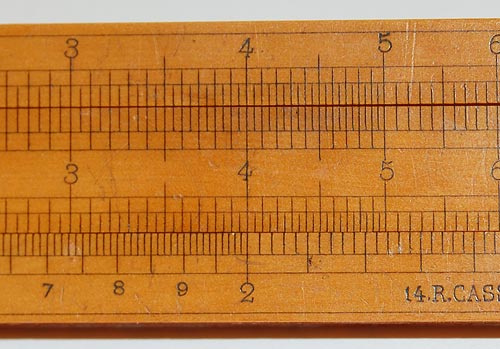
The reason for the odd scale arrangement on the Soho rule is that unless the scales on the slide were identical, there would be no way to move across the slide from the top to the bottom scales. To do that, you’d need a cursor, a sliding member that traces a perfect perpendicular line across the rule; and the cursor had yet to be invented. This innovation is what we will examine next.
The first cursor
Who invented the Cursor (or, as it was sometimes called, Index, indicator, or Runner) is debatable. There is mention of some form of cursor devised by Isaac Newton in 1675, and another is described by Frenchman Philippe Mouzin in 1837. The earliest cursor I’ve seen myself is on the slide rule designed in Britain by John Robertson in 1775. This massive rule has numerous scales, one slide, and a brass cursor that is a simple rectangle that can slide along the scales, providing the perpendicular line with its straight edges.
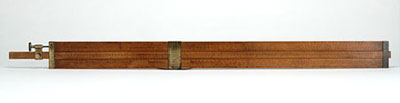
I don’t own one, but I’ve been shown it by master collector Bob Otnes, and can show you a picture kindly provided to me by the National Museum of Scotland of a sample in their collection.
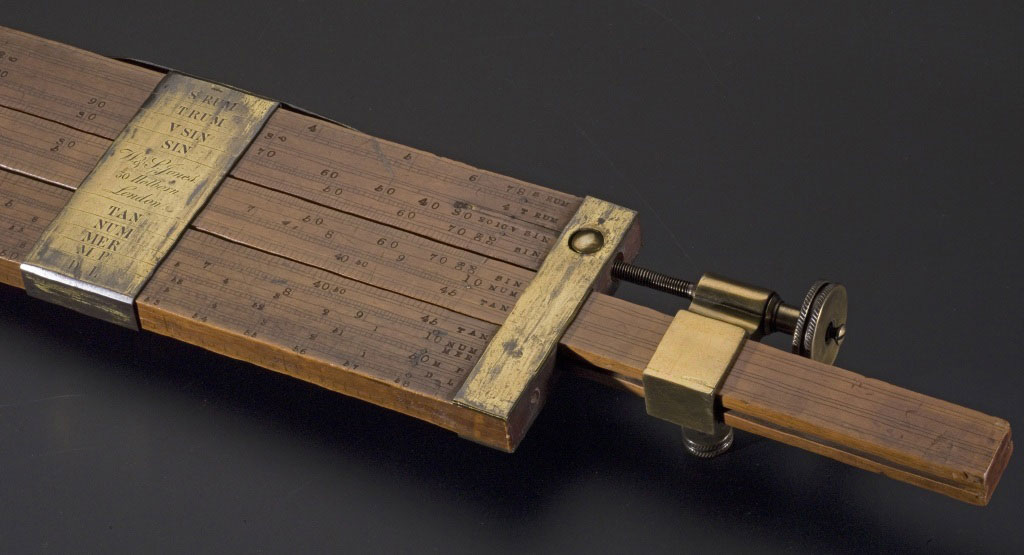
With Robertson’s cursor you can move between the various scales at will (and keep track which is which, given the legend on the cursor itself). That such a useful idea was left out of the Soho design that came years later is probably due to the fact that before the industrial revolution each inventor would devise his own instrument, and the dissemination of new ideas was limited. This would change in the 19th century.
Mannehim’s innovation
The cursor came of age in 1851, thanks to a French artillery officer, engineer, and later professor of mathematics called Amédée Mannheim. Mannheim devised a slide rule with two two-cycle log scales and two single cycle scales, and added a brass cursor to allow moving between them. He may not have invented the cursor, but he had the practical streak in him that allows some inventors to influence the real world. He took this design to the Tavernier-Gravet firm – the successor to Gravet-Lenoir – and had them produce it as a standard item in their product line. You can see my exemplar of this rule below.

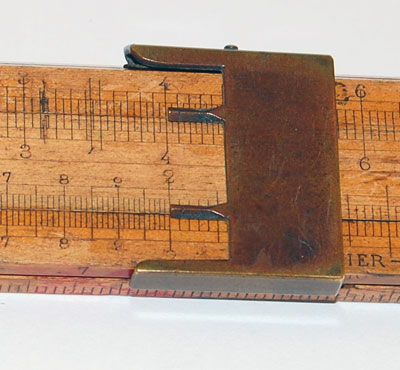
The “Mannheim slide rule” was extremely effective, and became a standard configuration produced by numerous makers well into the following century. The cursor was of the “Chisel” type, with two fingers jutting to the left of the sliding rectangle; the thin tips of these fingers would point at the scales. This allows the user to see the numbers on the scales, which might be hidden by the cursor’s body in the Robertson design. The only issue is that with this form you can’t use the chisel tips close to the right edge of the slide rule, as that would require sliding the cursor right off the rule!

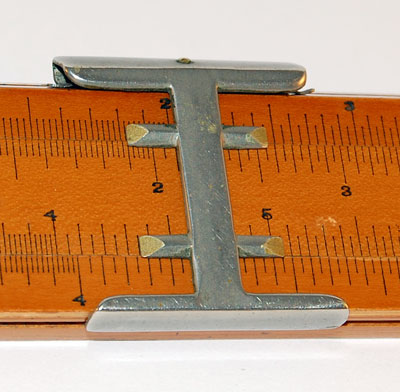
The solution to this issue is quite simple – put chisel tips at both sides of the cursor! This way, you can use either pair of tips in the middle of the rule, and use the appropriate pair when close to either of the rule’s ends.
Here we see this in a Mannheim rule probably made in France for resale in the UK by Jackson brothers of Leeds around the turn of the century.
From Brass to Glass
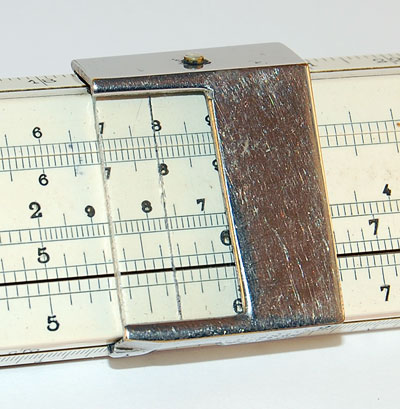
The chisel point cursors were good, but it took little time for makers to figure that a glass pane would provide even better visibility. By 1905 Tavernier-Gravet was offering its Mannheim rules with a choice of glass pane cursor or original chisel version; the one in my collection is from 1911 (note the arrival of the celluloid layer that now carries the scales). This one is actually not a traditional Mannheim slide rule but a “Regle Beghin”, a variant with its two top scales “folded” to place the 1 in the middle.

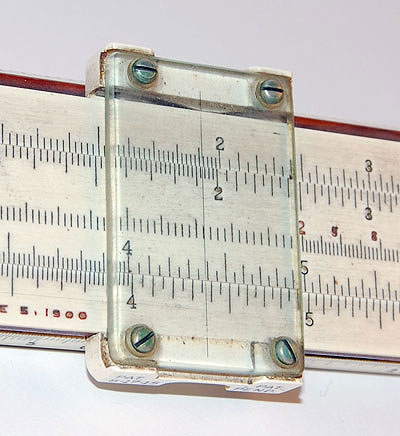
This Tavernier-Gravet glass cursor left a lot of metal in view; other vendors soon went further to extend the glass to the entire surface of the cursor, as you can see in the Keuffel & Esser 4053-3 which was introduced in 1915.
This type of cursor is practical and convenient, and has therefore remained in use, with minor variations, for the rest of the slide rule era (up until Hewlett-Packard introduced the electronic scientific calculator in 1975). The only significant change it has seen was a switch from glass to clear plastic sometime in the fifties.

The Duplex rule
Meanwhile it became obvious that it would be nice to use both sides of the slide rule for calculation, and the way to do this was invented by William Cox in 1891. His open-frame configuration allowed the slide to be visible from both sides of the body. For this to give maximum utility he needed a way to move between scales on opposite sides, and this he achieved by making the cursor – the all-brass version, originally – wrap around the entire rule, with the chisel points on both sides aligned to each other. The specimen I have is a model 4070, produced by K&E to Cox’s patent starting in 1901.
This idea, promoted as the “Duplex slide rule”, was easy to generalize to any cursor format, and as early as 1901 K&E offered the same rule in a more expensive glass-cursor version, again with aligned hairlines on both sides of the rule. The one in my photo, model 4061, is a pocket 5-inch variant.


Et cetera, et cetera
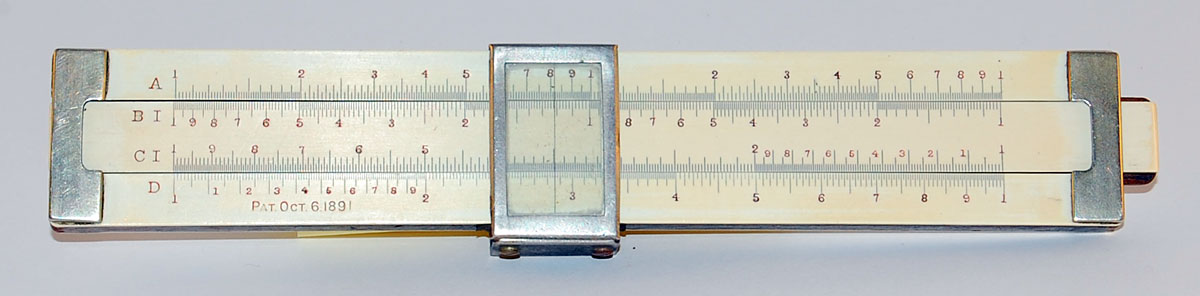
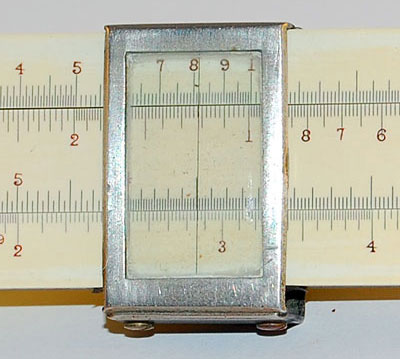
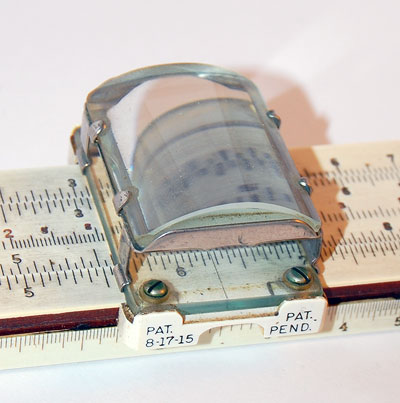
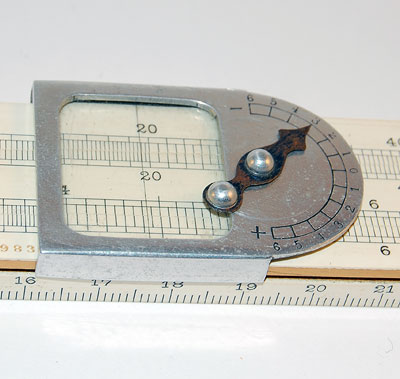
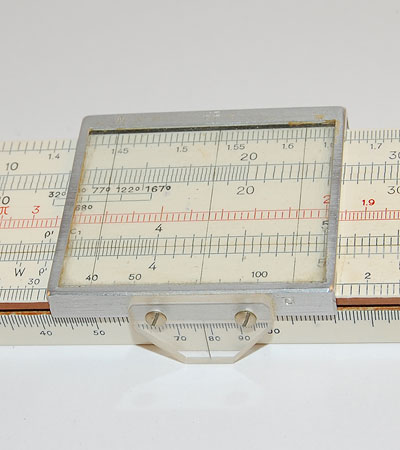
By 1900 we have all the optimal form factors for a straight slipstick: the one-sided rule with glass cursor derived from the Mannheim, and the two-sided duplex invented by Cox. From then on, all that was left to do is introduce better materials, notably plastic, and add more and revised scales, which could number upward of 30 on the largest duplex rules. Of course, ingenuity and experimentation continued to play their hands as makers tried to improve the cursor with various tricks; here are three photos of some diverse 20th century cursors.
Exhibits’ provenance:
With the exception of the rare Robertson slide rule, all the photos in this article are of items in my collection; they originate in various countries, and their acquisition varied from Garage Sales to Flea markets to the ever-useful eBay.