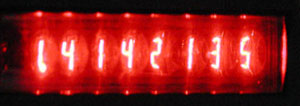
Numeric displays of yesterday
The invention of the Liquid Crystal Display was great news for portable electronics manufacturers (and users). Suddenly you could run a device with a numeric display — notably, watches and calculators — for months and months on a tiny coin-sized battery, or even on a small solar panel. LCDs were also inexpensive — a true Win for one and all.
There was only one big loser: Beauty.
The first widely used numeric display that actually showed changing number shapes was the Nixie tube, which was invented by Haydu Brothers Laboratories. This company was then acquired by Burroughs, who productized the invention in 1954 as the Nixie (the cute name is said to derive from “NIX-1”, for Numeric Indicator eXperimental #1).
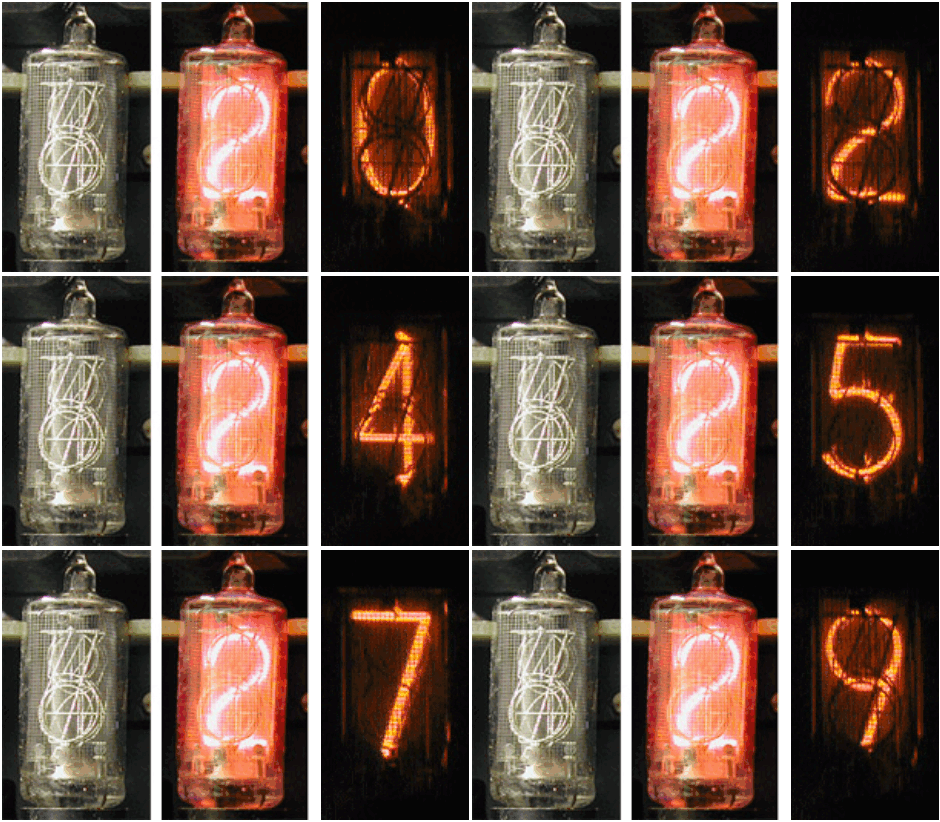
These lovely displays placed ten digit-shaped wires in a neon-filled glass tube, and when you applied the required high voltage to one of them, the wire would glow in a gentle orange color. This meant that different numbers had a different distance from the viewer; they “moved” back and forward when you advanced the digits sequentially, as in an electronic counter or timer.
In their heyday in the 1960s Nixies were used in electronic desk calculators (including the first one, the Sumlock Anita), Frequency counters and other Lab equipment. They required a lot of electronics to drive them, but that was OK… a calculator was an expensive proposition back then. The price went down as integrated electronics advanced in the next few years, but by then the invention of cheap, reliable LED displays had rendered Nixies obsolete. These days they’re having a revival as people incorporate them into “retro” digital clocks, to satisfy the nostalgia for that soft neon glow.
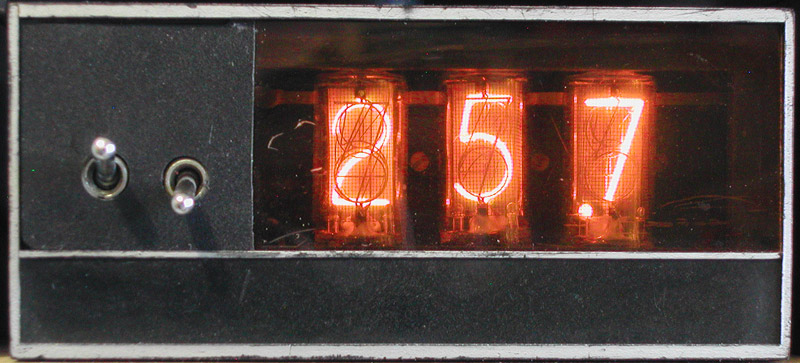
I, for my part, found me a broken Digital Panel Voltmeter module which I repaired and converted to a digital thermometer for my den, shown below. Now I can enjoy the glow from a past century whenever I want. This photo shows the device’s innards -– two boards crammed with SSI chips for a functionality that would fit in a single LSI chip today (and a power supply, complete with a 110V line transformer, to feed them all!)
The next advance was seven-segment LED displays (top photo). The first ones were tiny, and required molded plastic lenses to enable easy viewing; but they made the first pocket calculators possible. Soon afterward larger digits were introduced and used in alarm clocks and all sorts of industrial and lab equipment. The numbers were blocky, to be sure, but to their credit, they were also beautiful: LED displays were usually placed behind a red filter, which made the intense red numerals shine from within a dark space.
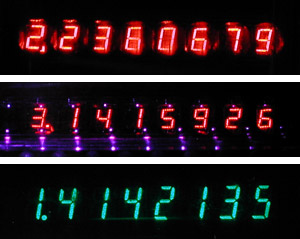
The prettiest implementation of this was the line of Sinclair calculators that used a deep purple filter, whose occasional highlight complemented the red light (middle photo above).
In the same period there were also calculators with Vacuum Fluorescent displays (VFD). These employed a seven segment structure but different physics, and glowed in a bluish-green color, as pretty as it was easy on the eyes (lower photo).
And then arrived the inexpensive gray-on-gray LCD display — drab, colorless, and with a much lower contrast than any of the above. With its tiny power drain it took over everything, which makes perfect practical sense. All the other displays shown above come from devices which require either a mains supply, a frequent overnight charge, or the wasteful replacement of disposable batteries. Meanwhile, LCD-based calculators just run, and run, and run.
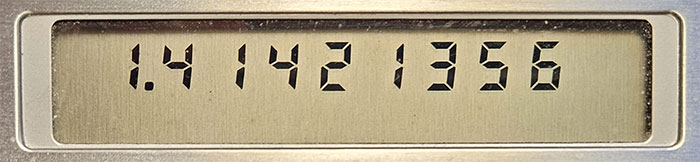
But I miss the Beauty.