
Two Coggeshall variants compared
This article was originally published in the Journal of the Oughtred Society, Vol. 20, No.2.
The first widely used standard form for a logarithmic slide rule is the two-foot, two-fold design devised by Henry Coggeshall around 1677. This was made in many variants by numerous makers, and is relatively easy to come by even today. The one in my collection was made by John Rabone and Sons of Birmingham in the later part of the 19th century, and is seen here:
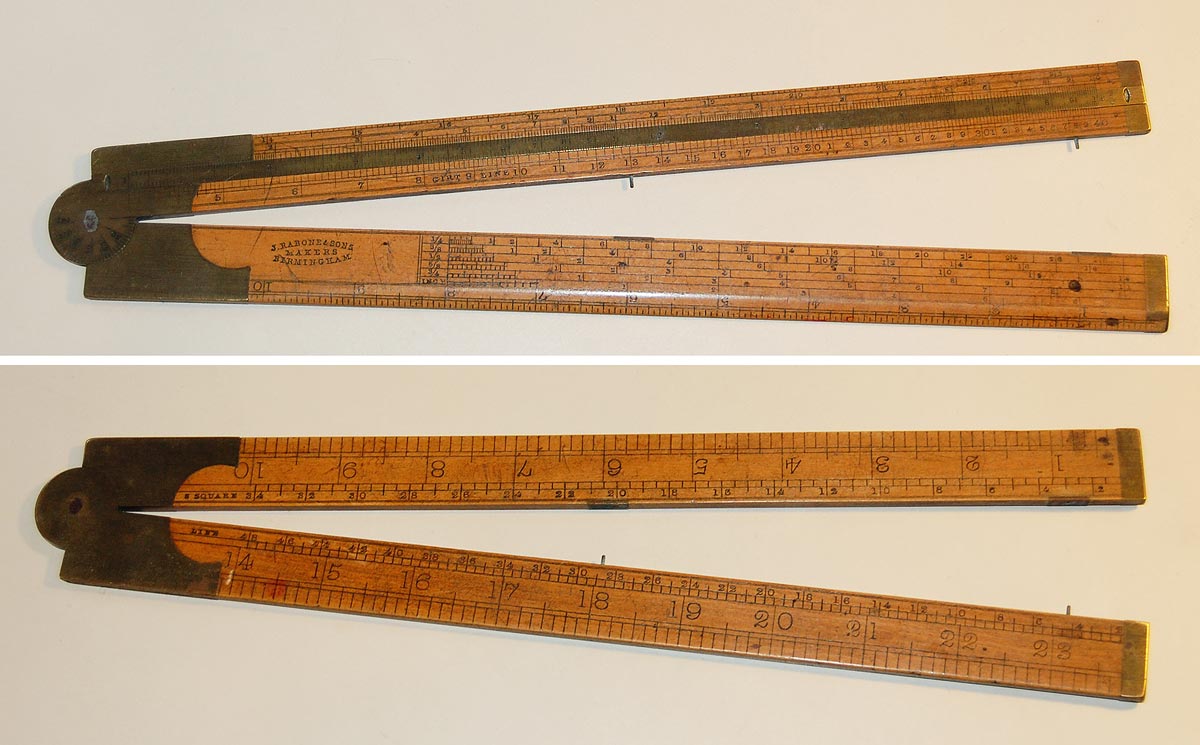
A possible cause of this form factor’s success is the adding of an incremental change to a widely used and useful tool of the time, the two-foot joint carpenter’s rule. This linear rule was retained on the back of the slide rule, while a narrow brass slide with a logarithmic scale is embedded in one leg of the front side. The rest of this side adds computational capabilities with other scales and tables of relevance to the woodworking profession. A carpenter had to pay a little extra to get a tool he already needed — a measuring rule — with the calculator unobtrusively thrown in.
Recently I have been fortunate to acquire a slightly different implementation of the same functionality. This rule, made by W. Ransley of Stangate, London, also has a narrow slide in one leg, but it folds to a mere nine inches rather than twelve. The slide rule is somewhat less precise, being shorter, but possibly more convenient to carry around; yet as a folding carpenter’s rule it still extends to the full two feet, a standard that was evidently considered important. This is accomplished by having a second hinge and a tapered six inch long third leg, which makes the Ransley a two-foot, three-fold (or 2-3) Coggeshall rule. Here it is:
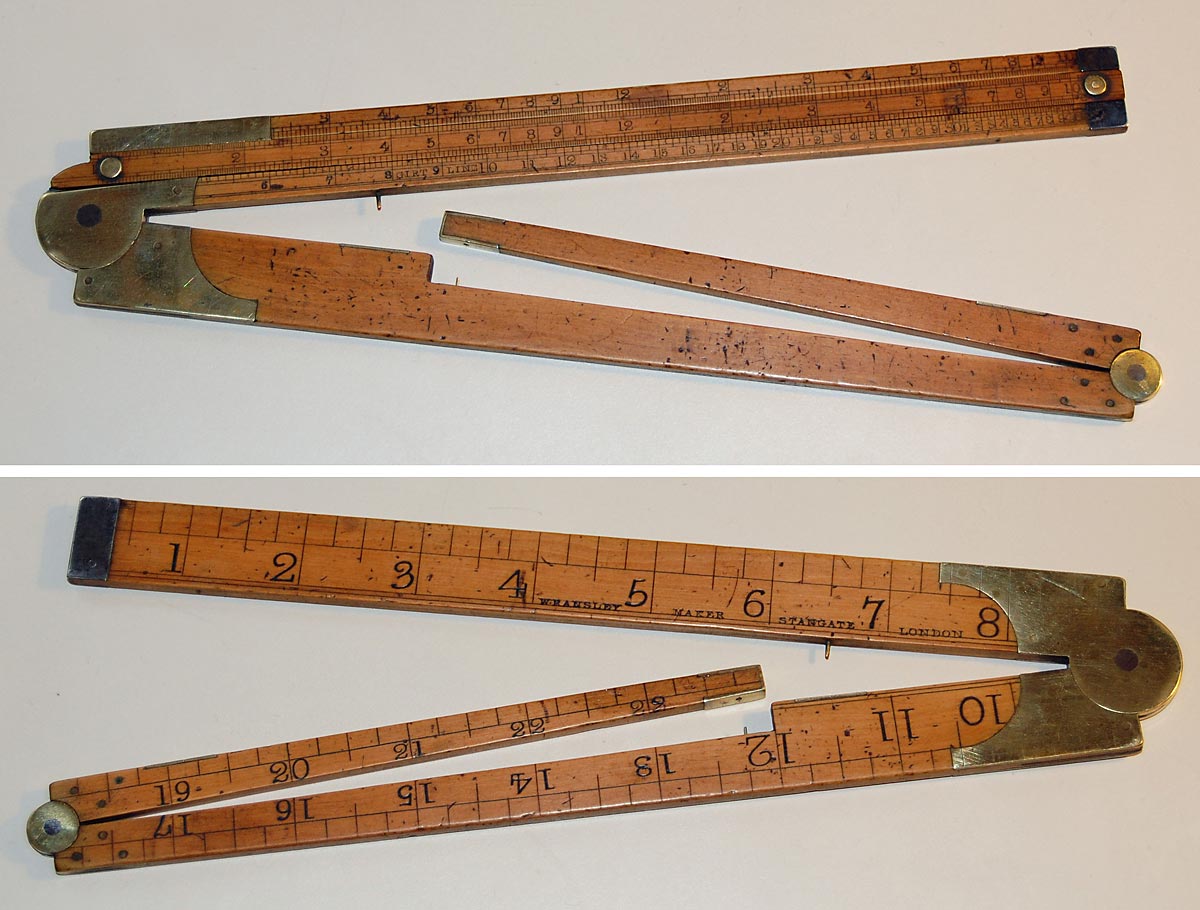
Both these slide rules bear the standard Coggeshall scales: three two-cycle logarithmic scales running from 1 to 100 above and on the slide and a 4–40 “Girt line” below the slide, which is used in calculating the volume of timber (“girt” is a quarter of the circumference of a round log). The larger rule also has room for a dozen additional scales of various uses (see here), whereas the small one has only the 2-foot linear scale on the back; the area on the second leg that might have carried more scales is “broken” by the third leg and has been left blank.
This 2-3 rule is highly unusual. In many years of collecting — and constantly monitoring eBay auctions and other sources — I have not once seen one like it, and only one other tool from W. Ransley, about whom I could find no more information. Peter Hopp’s definitive volume on joint slide rules does show photos of three other rules in this format by other makers, referring to them as “amongst the nicest and rarest of joint rule”.
Why, then, is the compact 3-fold form factor so rare, where the 2-fold Coggeshall is all too common? One can only speculate, but a comparison of the two rules shown here helps.
One’s immediate impression from handling and moving the two is that the 2-fold one is sturdy, with a nice heft, and tight motion at the hinge. The 3-fold rule, by contrast, feels almost flimsy in the hand, with a slight but noticeable wobble at the smaller hinge. Admittedly, they are from different makers, and probably of different age (if I had to guess I would date the Ransley earlier than the Rabone rule, which can be dated to the last quarter of the 19th century); this may account for different standards of quality and preservation. Nevertheless, the smaller rule has narrower wooden parts, with less purchase for the hinges, making the assembly inherently less robust. As a carpenter’s rule, when open, the 3-part construction is rather less dependable, and if I were a carpenter, I would certainly prefer the more rugged competitor any day (check out the two extended rules side by side in the image below to see what I mean). The fact that a longer logarithmic scale is more accurate, and that the wider rule accommodates all those additional scales, would only reinforce this choice; while the difference in price — the 3-fold rule was no doubt more expensive due to the higher mechanical complexity — would have been the clincher.
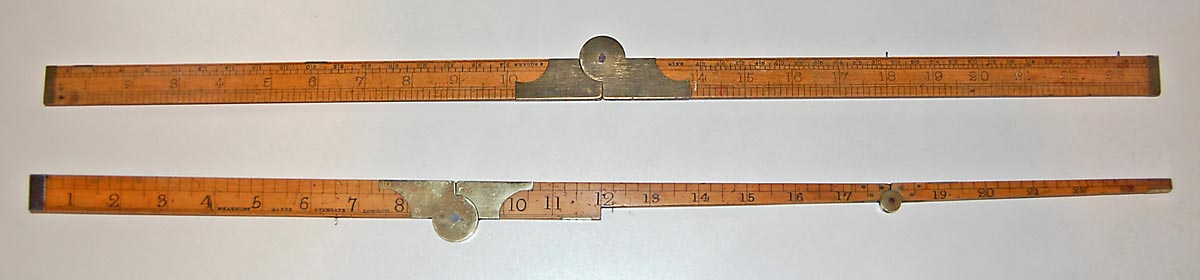
Then there is the matter of survival. My Rabone 2-fold rule, with wide legs and an unbreakable metal slide, could easily survive to appear on eBay today. The Ransley rule had a thin wooden slide that was eminently breakable (mine has been broken and repaired at some point). The delicate construction is prone to misalignment — the hinges on my sample are in fact slightly warped where they enter the wood. So even if some were sold, they would be far less likely to reach us today.
The bottom line: the cute 2-3 may have appealed to a rich gentleman taken by the novelty of the construction, but anyone in its real target market — a serious carpenter or other craftsman — would unhesitatingly (and wisely) choose the time-proven, frill-free, reliable 2-2 rule that could stand the abuse of a busy workshop for many years — and that could then survive to reach my collection in fine shape. Luckily for me, W. Ransley’s attempt at miniaturization somehow made my collection as well… barely.
Exhibit provenance:
Both slide rules came from eBay sellers in the UK.
More info:
Peter M. Hopp, Joint slide rules: Sectors, 2-foot 2-fold and similar slide rules, Hexagon Press, 2009. Available here.
I believe you will find the earliest Coggeshall rules were in the linear slide rule format, no hinge. I have one of these, two two-foot linear scales held in parallel by brass straps, easily taken apart. The earliest Coggeshall period literature speaks to these early rules.
Fascinating, I did not know that!