
A 19th century take on exobiology
I was delighting in browsing the treasure of used books in Wonder Book & Video, and my eye fell on an old hardcover book.
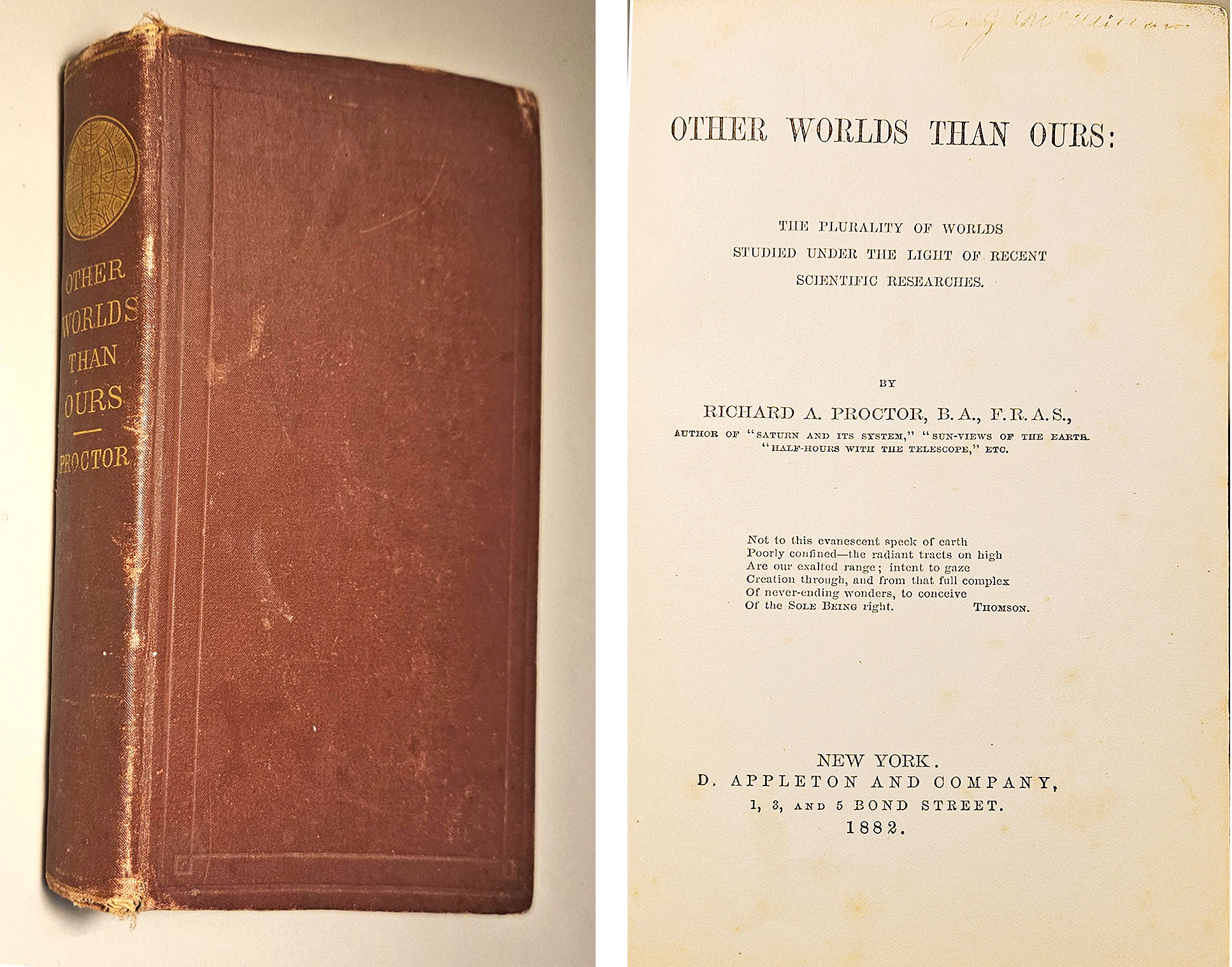
I took it off the shelf on a whim, opened it, and saw the title page, which declared it to be…
Other worlds than ours, by Richard A. Proctor, B.A., F.R.A.S. The subtitle explains what it is about: The plurality of worlds studied under the light of recent scientific researches.
Flipping the pages I realized that the book was not only about distant planets – it was about the alien creatures that might be living on them. It was a Victorian book about Exobiology! I would have known that immediately, had I known that the phrase “Plurality of Worlds” was once used to refer to inhabited ones, but I didn’t at the time. Anyway, you can bet I bought the book, and when I read it, it afforded me a fascinating look into the mix of science, religion, fact, conjecture and intellectual pursuit that made up the bleeding edge of astronomical philosophy 150 years ago. That was an exciting time, when the old, descriptive “natural philosophy” gave way to the current paradigm of the exact sciences, based on innovations in measurement and technology; a time when astronomy was transforming into cosmology.
If I expected a quaint but silly exposition, I was quickly disabused of the notion. The book is not about fantastical lunar beasts and martian supermen; it is about geology and physics, about chemistry and spectroscopy and scientific deductions from the available data. Proctor certainly reached many wrong conclusions, because his data was limited by the technology and observations of his time; but his analysis is deep and rational, and the scientific community that inspired him was extensive, composed of pioneers like Herschel (père et fils), Leverrier, Messier, Kirchhoff… respected names I would encounter a century later while studying physics myself.
I enjoyed reading this blast from the past, and below I share for your enjoyment a few samples that may capture why I did. This is not an attempt at giving a comprehensive summary – I picked the more instructive, amusing, at times even bizarre tidbits from each chapter, starting with chapter 1, titled…
What our Earth teaches us
This chapter in the book looks to life on Earth for proof that other stars harbor life. It summarily rejects the simplistic argument that if Earth is populated then other “orbs” must also be: “An analogy founded on a single instance has no logical force”. In fact, it adds, the Moon’s evident barrenness means that of the two cases we can observe directly, only 50% support life!
Instead, Proctor analyzes the diversity and distribution of Earth creatures. He points out that “If we range over the earth, from the arctic regions to the torrid zone, we find that none of the peculiarities which mark the several regions of our globe suffice to banish life from its surface. … Around mountain-summits as in the depths of the most secluded valleys, in mid-ocean as in the arid desert, in the air as beneath the surface of the earth, we find a myriad forms of life.” The basic idea is that life can adapt to any environment, however unlikely we may find it; “If fishes could reason, how could they believe that creatures can live in comfort in that element [dry land – NZ] which is death to them?” – and so, we must think beyond our comfort zone. The argument made here is very similar to what we say today – we use more exotic lifeforms than fish, like vacuum-resistant tardigrades and heat-resistant denizens of deep sea vents, but the idea is the same: alien creatures, or space-drifting microbes, may well tolerate conditions we find unthinkable.
What we learn from the sun
This chapter looks into the sun, not because it could harbor life – a view the author calls “bizarre and fanciful” – but because understanding its role in enabling Life on Earth may help us understand the role of other suns in their own planetary systems.
Spectroscopic data allowed Kirchhoff and others to identify various “earthly” elements in the sun, and speculations ran pretty wide of the truth we know today. One prevalent view, refined by the two Herschels among others, was that sunspots were holes in a layer of solar clouds, themselves made of vapors from a metallic ocean on a solid solar surface. And Proctor points out that if distant suns have similar elemental composition (sensible enough), then they too must have planets of the same composition, and “then the mind is immediately led to speculate on the uses which those elements are intended to subserve. If iron, for example, is present in some noble orb circling around Sirius, we speculate not unreasonably respecting the existence on that orb —either now or in the past, or at some future time — of beings capable of applying that metal to the useful purposes which man makes it subserve. The imagination suggests immediately the existence of arts and sciences, trades and manufactures, on that distant world”.
Oops… Yes, this last part is… hmmm… But in other passages he is much more modern. Consider the problem of the source of the sun’s energy:
“The question … suggests itself—Whence does the sun derive those amazing stores of force from whence he is continually supplying his dependent worlds ? We know that, were the sun a mass of burning matter, he would be consumed in a few thousand years. We know that, were he simply a heated body, radiating light and heat continually into space, he would in like manner have exhausted all his energies in a few thousand years— a mere day in the history of his system. Whence, then, comes the enormous supply of force which he has afforded for millions on millions of years, and which also our reason tells us he will continue to afford while the worlds which circle around him have need of it — in other words, for countless ages yet to come?
“Now, there are two ways in which the solar energies might be maintained. The mere contraction of the solar substance, Helmholtz tells us, would suffice to supply such enormous quantities of heat, that if the heat actually given out by the sun were due to this cause alone, there would not, in many thousands of years, be any perceptible diminution of the sun’s diameter. But, secondly, the continual downfall of meteors upon the sun would cause an emission of heat in quantities vast enough for the wants of all the worlds circling round him; while his increase of mass from this cause would not be rendered perceptible in thousands of years, either by any change in his apparent size or by changes in the motions of his family of worlds.”
This is totally wrong, but it is Science – the rational application of hypotheses and comparison of their calculated implications to observations. Without Nuclear Physics, the real answer would have to wait…
The inferior planets
This refers to Mercury and Venus, being inside the Earth’s orbit.
Proctor dismisses Vulcan, because of “the great doubt in which the existence of this planet seems enshrouded”. As for Mercury, its proximity to the Sun and short year suggest that “all forms of vegetation in Mercury must differ in a very striking manner from those which exist upon the earth, because their structure has to be adapted to much more rapid changes of temperature. And the existence of a totally distinct flora suggests at once the belief that animal life on Mercury must be very different from what we see around us”.
Considering the unknown axial inclination, rotation, cloud cover and atmospheric density of Mercury, Proctor analyzes at length multiple scenarios, using both observations and theory to conclude that in some scenarios Earth-like life would survive easily, while others would challenge it. In one scenario “Mercurians” live comfortably in two cooler polar zones, and travel the searing land between them through tunnels! Meanwhile the lower gravity he computes from various observations means that “The creatures which seem to us most unwieldy—the elephant, the hippopotamus, and the rhinoceros, or even those vast monsters, the mammoth, the mastodon, and the megatherium, which bore sway over our globe in far-off eras—might emulate on Mercury the agility of the antelope or the greyhound”. Indeed, civil engineering operations would be far easier, and result in grander structures, than we have here on Earth (hence the tunnels mentioned above).
Venus receives extensive and very undeserved (as we now know) praise. It “bears a more striking resemblance to the earth than any orb within the solar system”. In fact, we are told, “Had Venus but a moon as the earth has, we might doubt whether, in the whole universe, two orbs exist which are so strikingly similar to each other.” For a hellhole with a sizzling surface and sulfuric acid clouds, this is high praise indeed!
Incidentally, the lack of a moon is no big deal because “It is as the chief regulator of the tides that the moon befriends us most usefully, [but] Venus has no need of lunar tides” – its proximity to the sun provides solar tides that must be “perfectly well adapted to subserve all the purposes which our tides render us”. And Proctor, ever the scientist, calculates the magnitude of the Venusian tides on the Venusian oceans – “assuming that she has oceans such as those
which exist upon the earth”.
Furthermore, calculating from the (very wrong) then prevailing estimate of the planet’s axial tilt, Proctor makes far reaching predictions of its climate. For instance, in the polar regions, “unless the skies are lit up with auroral splendors, an intense darkness prevails during the polar winter, which must add largely to the horrors of that terrible season. Certainly, none of the human races upon our earth could bear the alternations between these more than polar terrors and an intensity of summer heat far exceeding any with which we are familiar on earth”. But he doesn’t lose hope: the axial tilt may turn out smaller after all, in which case “if her inclination should at all resemble the earth’s, there is every reason to believe that her physical habitudes also resemble those of the earth. In this case, the argument from analogy, presented in the opening
chapter of this work, seems to force upon us the conclusion that she is inhabited; while we may believe, though perhaps with less confidence, that a close resemblance subsists between the creatures which people her surface and those with which we are acquainted”.
Mars, the miniature of our Earth
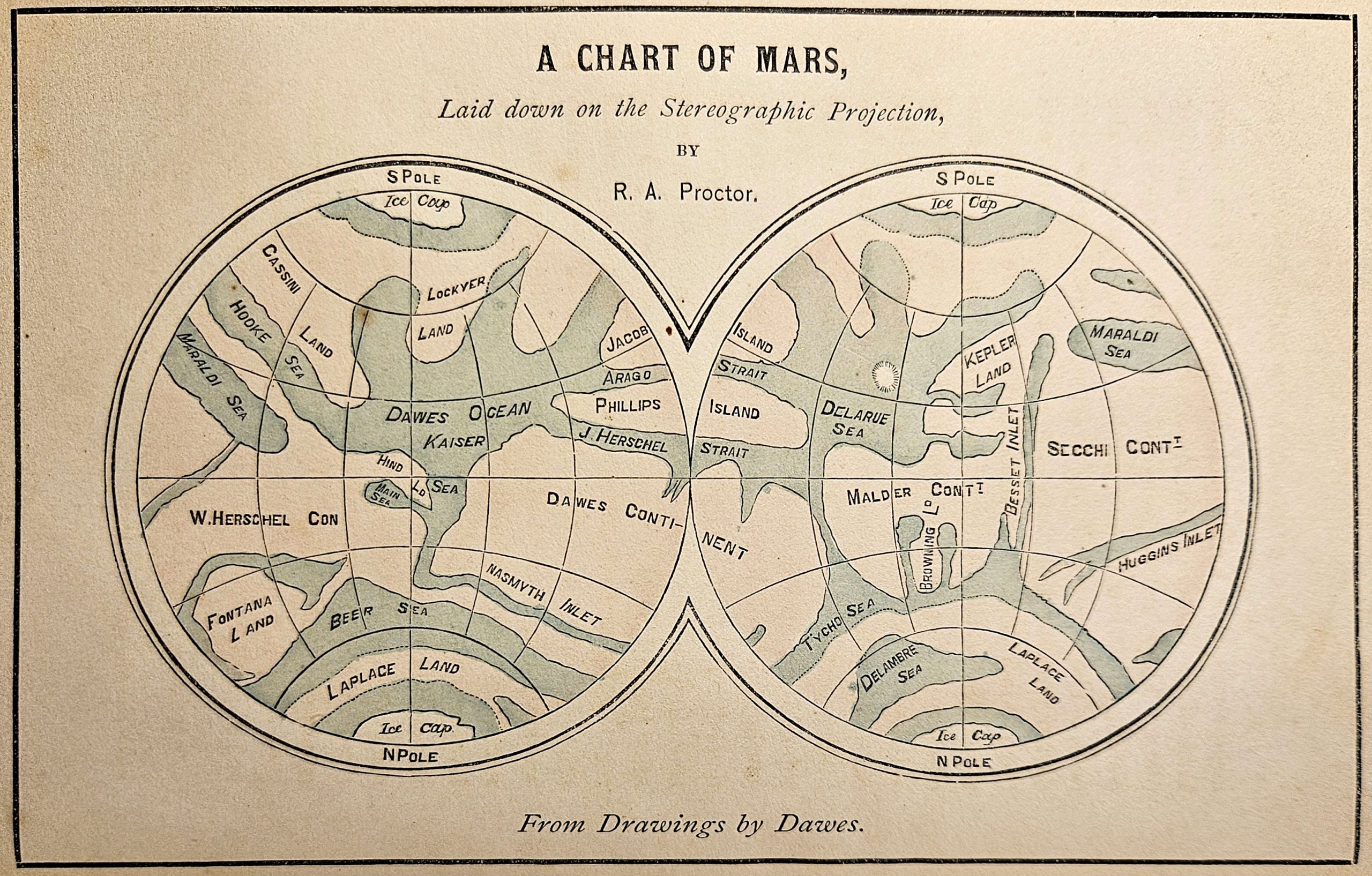
The chapter on Mars has a detailed map of the red planet, and it shows no canals! In fact nowhere in this book is there any mention of canals on Mars. At first I thought this is a question of timing, but the book is dated 1882, five years after Schiaparelli’s observation of those “canali” (although eight years before Lowell would misinterpret these as engineered “canals”). Still, as an astronomer Proctor certainly knew about Schiaparelli; an article from 1888 (which I found after some diligent Googling) quotes him saying that “No one who has ever seen Mars through a telescope can accept the hard and unnatural configurations depicted by Schiaparelli”. He also pointed out that the “canals” might be rivers, because they would have to be at least fifteen miles in width to be seen from Earth. Wayda go, Mr. Proctor – especially given how many of his contemporaries failed to apply such worthwhile skepticism and fell for the bogus canals.
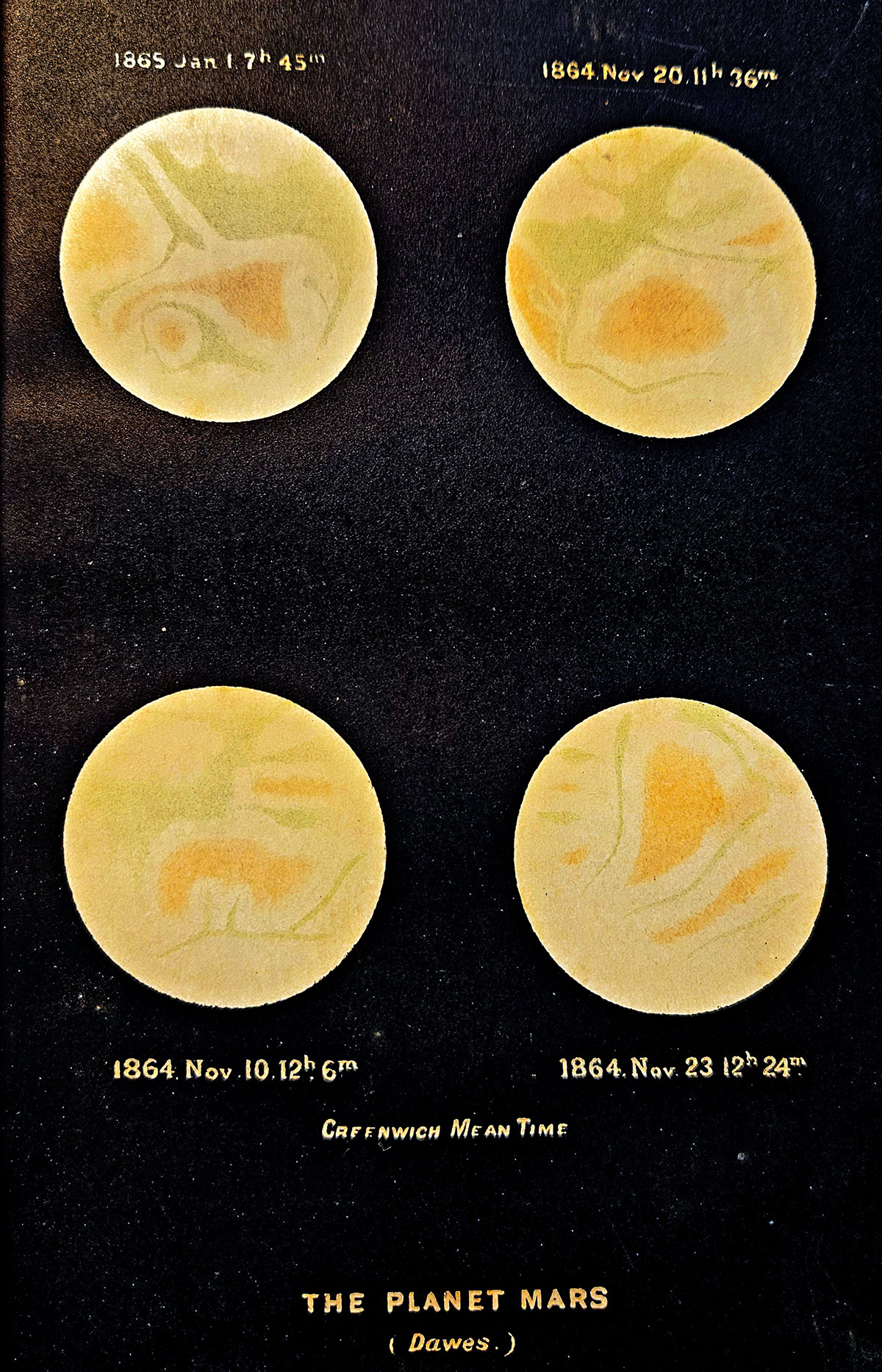
Proctor tells us that he received from Mr. Dawes (that would be William R. Dawes) “no less than twenty-seven drawings of Mars, the choicest specimens of a very large series, that I might chart the planet from them”. These were the basis of the above map, and as we see Dawes has been rewarded with an ocean and a continent there. Four of his drawings are shown in the color plate seen here. These were even fuzzier before I gave them some color enhancement; considering the fact that Mars could at best be seen with the available telescopes as a blurry round blotch, they must consist of equal parts of actual imagery and wishful thinking. Nevertheless, such images and maps were very eagerly accepted before space probes set the record straight.
In a footnote we are told that John Browning made a globe of Mars from Proctor’s map and from it photographed stereograms of Mars, which were evidently circulated as a set accompanied by a booklet of “remarks” contributed by our friend Proctor. I managed to find them online and saw 3D renditions… of a blurry spherical blotch. As we say today – Garbage in, Garbage out…
Armed with his images, his map, and the erroneous interpretation that they show seas and oceans, Proctor sets out to examine the prospects of life on Mars. And he is very Gung-ho about it: “The planet Mars … exhibits in the clearest manner the traces of adaptation to the wants of living beings such as we are acquainted with” – i.e. not merely life, but what today we’d call “life as we know it”. There follows a lengthy discussion of Mars’s climate, as deduced from the changing “veil” which covers parts of it and from its white polar areas, and reinforced by spectroscopic data. Speculation turns fast to certainty: “We have seen that there are oceans on Mars; we know that clouds and vapors rise from those oceans and are wafted over his continents; and, finally, we have learned that snow falls on the Martial polar regions”. And then the leap: “Thus the Martial lands are nourished by refreshing rainfalls ; and who can doubt that they are thus nourished for the same purpose as our own fields and forests—namely, that vegetation of all sorts may grow abundantly?”
Next we get “The mere existence of continents and oceans on Mars proves the action of forces of upheaval and of depression. There must be volcanic eruptions and earthquakes, modelling and remodelling the crust of Mars. Thus there must be mountains and hills, valleys and
ravines, water-sheds and water-courses. All the various kinds of scenery which make our earth so beautiful have their representatives in the ruddy planet”. And then we get to the final lesson of the chapter: “Surely, if it is rashly speculative to say of this charming planet that it is the abode of life—if we must, indeed, limit ourselves to the consideration of what has been absolutely seen—it is yet to speculate ten thousand times more rashly to assert, in the face of so many probable arguments to the contrary, that Mars is a barren waste … untenanted by living creatures”.
Of intelligent Martians there is no explicit mention, but there is a hint: when our astronomers have a good observing night, we are told, then it must be a fine day for the Martialists – since it means that their planet is not obscured by cloud cover…
Jupiter, the giant of the solar system
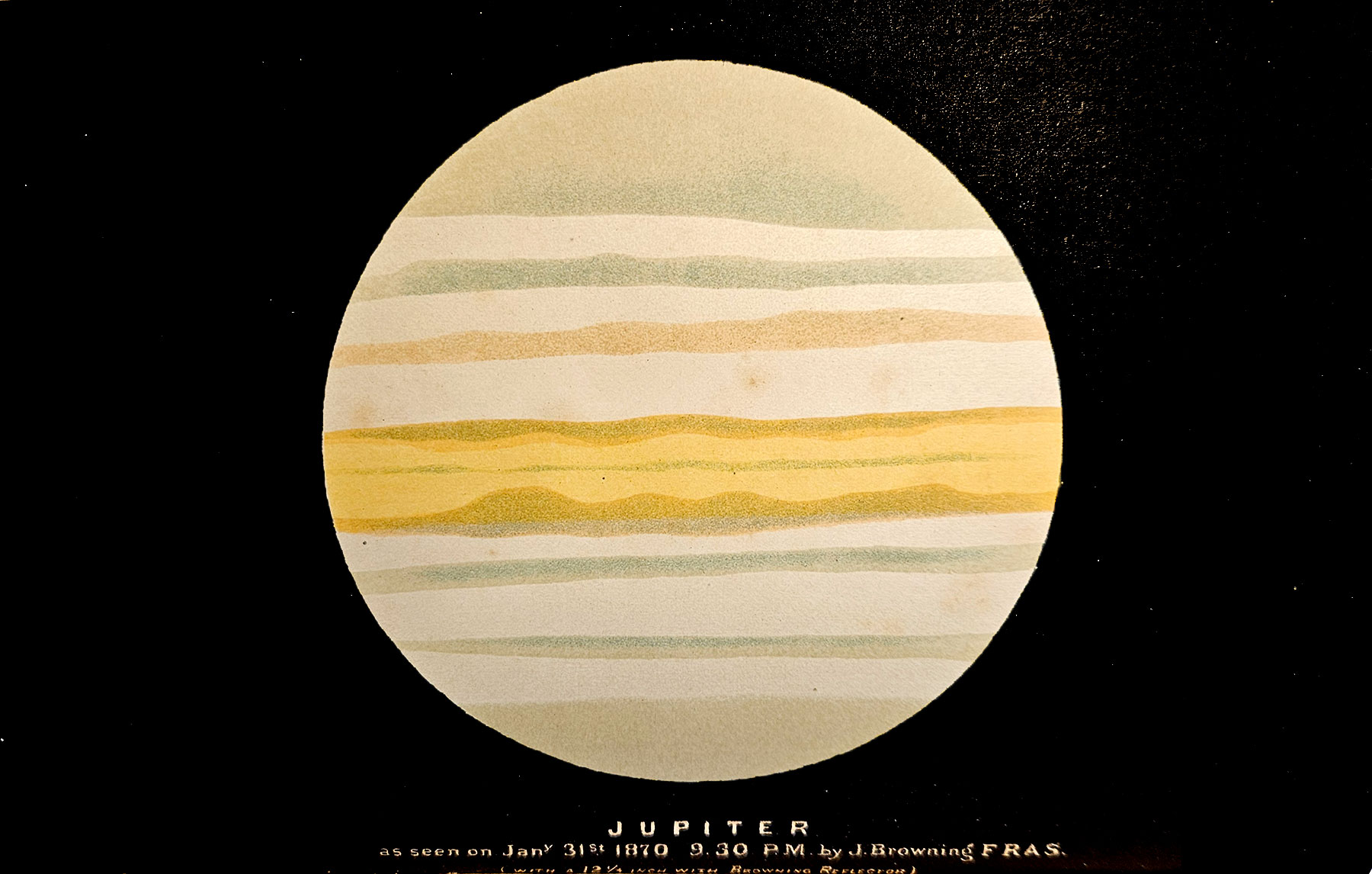
After Mars got such warm praise, you might expect the gas giants to be left in the cold…. but no. Jupiter receives the warmest introduction yet: it is “the prince of all the planets, the orb which, of all others in the solar scheme, suggests to us conceptions of the noblest forms of life”. Why so? because “If bulk is to be the measure of a planet’s fitness to be the abode of living creatures, then must Jupiter be inhabited by the most favored races existing throughout
the whole range of the solar system”. Indeed, “The very symmetry and perfection of the system which circles round Jupiter have led many to believe that he must be inhabited by races superior in intelligence to any which people our earth”. After all, we Earthlings only have one moon…
Before you point out the ridiculousness of these arguments, note that Proctor hedges his bets: “We know that the sun, which surpasses Jupiter in weight and volume even more than Jupiter surpasses the earth, is yet not the abode of life, so that mere size and mass must not be held to argue habitability”. Okay, that’s better.
There follows a long discussion of Jupiter’s physical and astronomical data, much of it quite accurate, interspersed with a variety of biological predictions, all of them not so. The “Jovials” are shown by one researcher to be giants, because the dimmer sunlight would require them to have larger pupils, hence larger eyes and a proportionately larger body; but Proctor speculates that they must rather be short, because the large gravity would crush a heavier body. Both theories are presented with meticulous calculations of the actual heights based on the known parameters.
The two opposite conclusions lead Proctor to reject both, and to very sensibly assert that “We must not measure the inhabitants of other worlds according to the conceptions suggested by the forms of life we are acquainted with upon earth. We must admit the possibility that arrangements, as different from those we are familiar with as the constitution of the insect is from that of man, may be presented amid the orbs which circle round the sun”. That sounds closer to our current thinking. And then he cautions against going too far: “We need not imagine, as some have done, that the inhabitants of Jupiter are bat-winged, or with others, that they are inveterate dancers, [or that they are] pulpy, gelatinous creatures, living in a dismal world of water and ice with a cindery nucleus … It is sufficient to recognize … that the beings of other worlds are very different from any we are acquainted with, without endeavoring to give shape and form to fancies that have no foundation in fact”.
Next we are treated to a lengthy discussion (this is a Victorian book!) of the climate zones on Jupiter and of the motions of the Sun and planets as perceived by any Jovicolae, “unless their eyesight is much inferior to ours”. Also discussed is the impact the four moons would have on the visibility of the stars, and the claims of some writers that they would replace the latter with great luminous splendor. Instead, we are assured that while “it might seem that all but the brighter stars would be quite obliterated”, in fact the greater distance from the sun (compared to our own moon) would ensure they are too dim to have a serious effect “in dimming the lustre of the stars”. Whew!…
Speaking of climate, consider this surprising passage: “We can conceive the existence of vapors in the air which might keep away from the earth’s surface the greater portion of the sun’s heat, and yet, by preventing the escape of the remainder by radiation into space, might leave the general warmth of the air around us as great as it is at present. But it cannot be doubted that such an arrangement would injuriously affect the whole economy of evaporation and its consequences, winds, rains, clouds, mist, with their consequences, so important for the welfare of terrestrial races”. This is a conjecture about global warming – which Proctor assumes is keeping Earth temperatures just right, but promptly generalizes to other planets. An example he gives as an effective planet-warmer, attributed to John Tyndall, is of a layer of air saturated with the vapor of sulphuric ether (diethyl ether, then newly discovered to be a surgical anesthetic).
A lengthy discussion is devoted to the Jovian atmosphere, in an effort to estimate its thickness and structure. Proctor has many ideas for new observations, but laments that “In these days, however, nine-tenths of those who are fortunate enough to possess fine telescopes prefer either to leave them idle, or to employ their powers in making observations, at great pains and labor, which are not worth the paper on which they are recorded.” A serious indictment, this, which brings to mind the competition for observation time on our modern telescopes…
The frustrating lack of data, then, leaves Proctor to speculate at length on the “peculiarities” of Jupiter, notably its low density and the rapid dynamics of the colorful bands it presents. He ultimately admits that Jupiter is “still a glowing mass, fluid probably throughout, still bubbling and seething with the intensity of the primeval fires, sending up continually enormous masses of cloud, to be gathered into bands under the influence of the swift rotation of the giant planet”; and he sadly accepts the conclusion that the giant planet is at present not a fit abode for living creatures.
And then he looks to the four known moons of Jupiter – these must be the abode of life, since “on this view, and on this view only, we find a raison d’être both for the planet and for the system which circles round him”. That’s Victorian confidence for you – the very stars must have a purpose comprehensible to us humans, the crown of creation… However, since the Galilean moons could only be seen as dots of light, all he can do about them is try to establish that Jupiter radiates light and/or heat to them, like the sun does for us, leaving the rest to analogy.
And there is one surprising omission: neither the text nor the two pictures of Jupiter in the book show the feature most familiar to us today: the Great Red Spot. This massive storm has been observed since at least 1831, but the knowledge was kept rather low key until the first photograph of the planet was circulated in 1879, after our book was first published.
Saturn: the ringed world
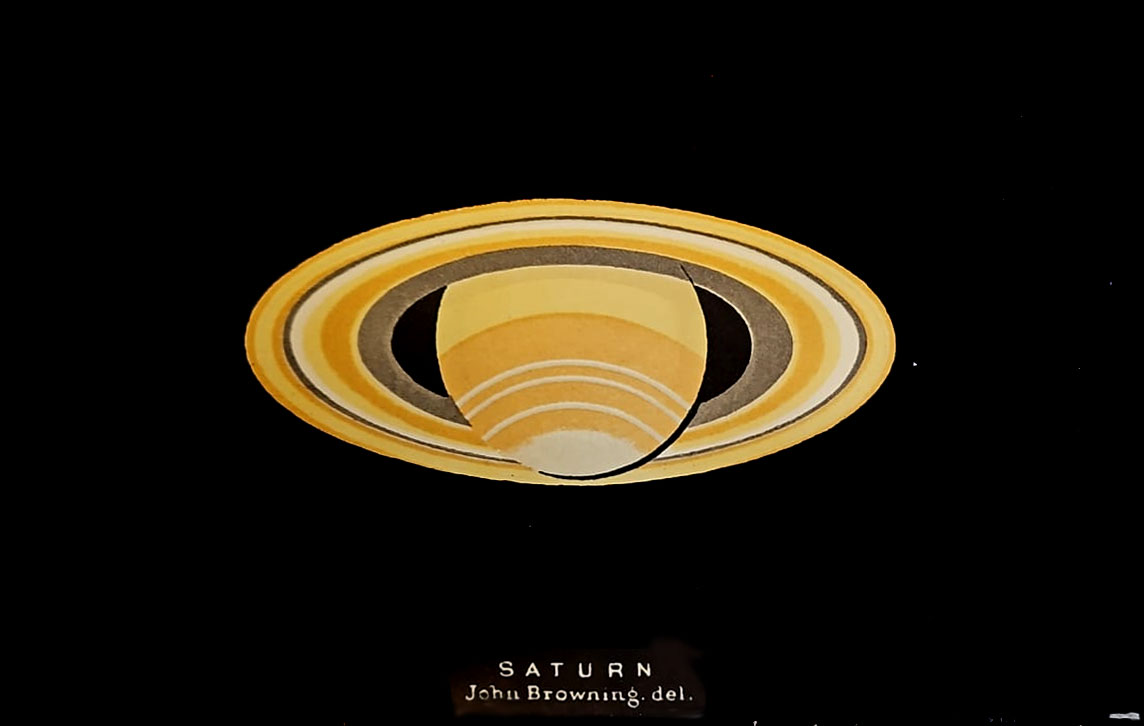
Saturn is certainly awe-inspiring, and if you’ve read this far you won’t be surprised to hear that “the great planet is designed for purposes of the noblest sort”. Proctor reminisces: “I can well remember the sensations with which—some eight years since?—I saw the ringed planet for the first time”. I myself also remember the time – “some 50 years since” in my case – when I had the same experience during an Astrophysics class field trip.
And yet Proctor considers Saturn itself to be inadequate for life as we have it on Earth, if only due to the paucity of solar energy at its orbital distance. The effect of the rings makes this worse: “as for the endurance of the total diurnal eclipses, it is only necessary to remark that, in Saturnian latitudes corresponding to that of London or Paris, the sun is totally eclipsed [by the rings – NZ] for more than five years in succession, while in a latitude corresponding to that of Madrid he is totally eclipsed for nearly seven years in succession. This suffices to show that an arrangement which the inhabitants of earth would find wholly unendurable prevails over a very large proportion of Saturn’s surface”.
If the rings obscure the sunlight, “as far as the satellites are concerned, there is no corresponding difficulty. They undoubtedly reflect the sun’s light to Saturn, and, if there really are intelligent beings on the planet, the satellites must undoubtedly present an interesting spectacle”. Unfortunately, “even though all the satellites were full at the same time, the quantity of light they could send back to their primary would be wholly inadequate to compensate for the planet’s great distance from the sun”. Bottom line: Saturn is simply too bleak for our kind of life.
Nevertheless Saturn’s attributes are described, including its greatest “peculiarity”, that being its “square-shouldered” figure. This refers to the fact that the planet seemed to some observers (including Sir William Herschel) to not only flatten at the poles and bulge at the equator – a true fact due to the rapid rotation and gaseous composition – but also to flatten at the equator, with the mid latitudes bulging out to give it a boxy appearance. This was an illusion due to poor telescopes, atmospheric interference and perhaps the effect of the rings muddling the view. And after considering evidence to rule out an illusion, Proctor concludes that “we seem almost compelled, therefore, to accept the conclusion that the planet Saturn is subject to the influence of forces which either upheave portions of its surface from time to time, or cause vast masses of
cloud to rise to an enormous height above the mean layer of Saturn’s cloud-envelope”. This deduction of extreme unfamiliar forces leads him to conclude that the planet (just like Jupiter) is very hot under its cloud cover, and serves as a miniature sun for its satellites. This solves the quandary of having the two giant planets serve no “purpose” – they are there to make life possible on their satellites!
Uranus and Neptune, the arctic planets
Considering how little can be observed from Earth of the next two planets, it is a marvel that they get a lengthy chapter of their own. Their orbits and inclinations feed much speculation about the seasonal changes of the sun’s presence in their skies, and cannot suggest a pleasant home for living creatures; but if such creatures do exist on Uranus, and are intelligent, we learn that they must be gifted mathematicians!
The idea is that because this planet’s rotational pole lies close to the plane of the zodiac, the constellations would exhibit mixed and complex motions, requiring the local observers to develop advanced mathematical skills to describe them. They would also have an advantage over Earth astronomers because the wider orbit of their planet would provide a longer baseline for measurement of stellar distances using the parallax method – observing the star from two opposite ends of the planet’s orbit.
On the other hand, they would face a problem because “the enormous length of the year of each planet requires that … the astronomers in Uranus and Neptune should be very long-lived … A Uranian who made one set of observations to determine stellar parallax when he was, say, twenty-five years old, would have to wait till he had nearly reached the threescore years and ten (not perhaps allotted as the span of Uranian life) before he could make the corresponding set … In Neptune life must be prolonged over the century (unless the study of observational astronomy commence during the babyhood of the Neptunians) in order that a complete set of observations … should be carried out. One cannot but conceive that a certain sluggishness must mark the progress of astronomy in these far-off worlds under such circumstances”.
The chapter ends with an optimistic conjecture that like Jupiter and Saturn, the outer giant planets are essentially small suns – not as resplendent as the one serving Earth, but “adding their influence to his in a variety of complicated but doubtless well ordered combinations, in such sort that the small worlds [their moons – NZ] which circle around them are provided with all that is needful to the well-being of their inhabitants”.
The Moon and other satellites
Proctor accepts our moon’s present lack of life given its known attributes (unlike William Herschel, who held an opposite view!); but he considers at length the possibility that it had Life ages ago. He considers the “tremendous volcanic forces” that left their mark upon the moon, and concludes that before dissipating they had a period when “they must have subserved that great purpose which seems the end of all Nature’s workings—the support of life”.
The moons of Jupiter and Saturn are subjected to lengthy discussions, all based on orbital data. Jupiter’s size as seen from each moon is computed, leading to “His belts’ changes of figure and color, only rendered visible to our astronomers by powerful telescopic aid, must be distinctly visible to creatures on his satellites, and cannot but afford reasoning beings on those orbs a most astounding theme for study and admiration”. Saturn is even more impressive, and “the inhabitants of the outermost satellite of all have the privilege of seeing the Saturnian ring system opened out much more fully than as seen from the other satellites, since the path of this moon is inclined some 15 degrees to the plane of the ring”.
Mercifully, “Of the satellites of Uranus and Neptune little can be said, because so little is known either respecting these orbs themselves or their primaries”.
Meteors and Comets: their office in the solar system
This chapter starts by going on and on to establish the enormity of the number of meteors and comets in the solar system (“millions on millions”, a phrase that would surely have gladdened Carl Sagan). I almost lost hope of understanding why this is relevant when I got to this amazing assertion: “we are bound to accept, as a legitimate conclusion from that evidence, the theory that at least an important proportion of the sun’s heat is supplied from the meteoric streams which circulate in countless millions around him”. The physics behind this is that the millions of meteors hit the sun, or collide with each other near it and fall in, feeding it with their energy.
But this isn’t the half of it. A few pages later Proctor shares a complete theory he has formed about the formation of the solar system: that the Sun and planets were formed — and are still growing — by the aggregation, collision, and continual infall of meteoric and cometary matter, rather than condensing out of a single rotating nebula.
Here is how he puts it: “We know that the materials composing meteors, and we conclude, therefore, that those composing comets, do not differ from those which constitute the earth and sun, and presumably the planets also. Therefore, under the continual rain of meteoric matter, it may be said that the earth, sun, and planets, are growing. Now, the idea obviously suggests itself, that the whole growth of the solar system, from its primal condition to its present state, may have been due to processes resembling those which we now see taking place within its bounds … Countless millions of meteoric systems, travelling in orbits of every degree of eccentricity and inclination, travelling also in all conceivable directions around the centre of gravity of the whole, would go to the making up of each individual planet”.
Get it?! The millions of “meteoric and cometic systems” – he asserts that their number must have been enormously greater originally than it is at present – aggregated and formed the planets, as well as giving the sun its power to this day. Proctor positions his theory as an alternative to Laplace’s nebular hypothesis, and goes on to derive from it the observed attributes of planetary sizes and orbits (which he claims Laplace’s process fails to explain).
Of course this is wrong, as are the assumptions that the sun and the gas giants share the composition of the Earth, and that the sun shines by cometary energy. In fact, today Laplace’s 1796 theory is still considered essentially correct, and Proctor’s is entirely forgotten (although it was published by Norman Lockyer in 1890 as “The Meteoritic Hypothesis”). Still, you have to admire Proctor’s audacity…
Other suns than ours
This chapter deals with remote stars – “orbs which no telescope that man can construct is likely to reveal to his scrutiny”, including Aldebaran, Betelgeux (sic), Alpha Centauri, 61 Cygni, and many others. The advent of Spectroscopy had already uncovered much about their chemical composition, and that is described in detail and then taken far off-field: “the existence of iron and other metals of the same class carries our minds to the various useful purposes which these metals are made to subserve on the earth. We are at once invited to recognize that the orbs circling around those distant suns are not meant merely to be the abode of life, but that intelligent creatures, capable of applying these metals to useful purposes, must exist in those worlds”. Of course that doesn’t mean that intelligent beings exist on every one of those worlds right now, because on Earth too there were long periods when no intelligent use has been made of its supplies of metal. But it can be deduced with confidence that at some time or other those worlds have been or will be peopled by intelligent creatures. (Sigh…)
The chapter concludes: “Though here we cannot, as in the case of the solar system, actually see the worlds about which we speculate, yet the mind presents them clearly before us, various in size, various in structure, infinitely various in their physical condition and habitudes, but alike in this, that each is peopled by creatures perfectly adapted to the circumstances surrounding them, and that each exhibits in the clearest and most striking manner the wisdom and beneficence of the Almighty”.
Of minor stars, and of the distribution of stars in space
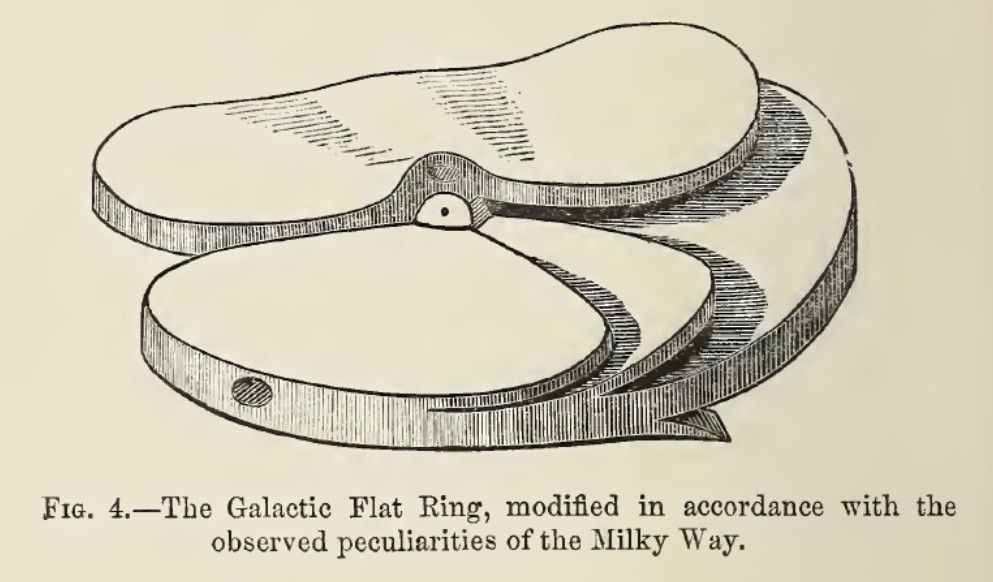
This chapter deals with the structure of the Milky Way galaxy. The accepted wisdom relied on Sir William Herschel’s “star gauging”, a project where he laboriously counted stars in all directions to establish the form of the galaxy. He assumed, erroneously, that all stars have the same intrinsic brightness, that they are uniformly distributed in space, and that his telescope could see to the edge of the system – all incorrect, leading to a galactic structure with the Sun at its center and extending this way and that based on what he could see.
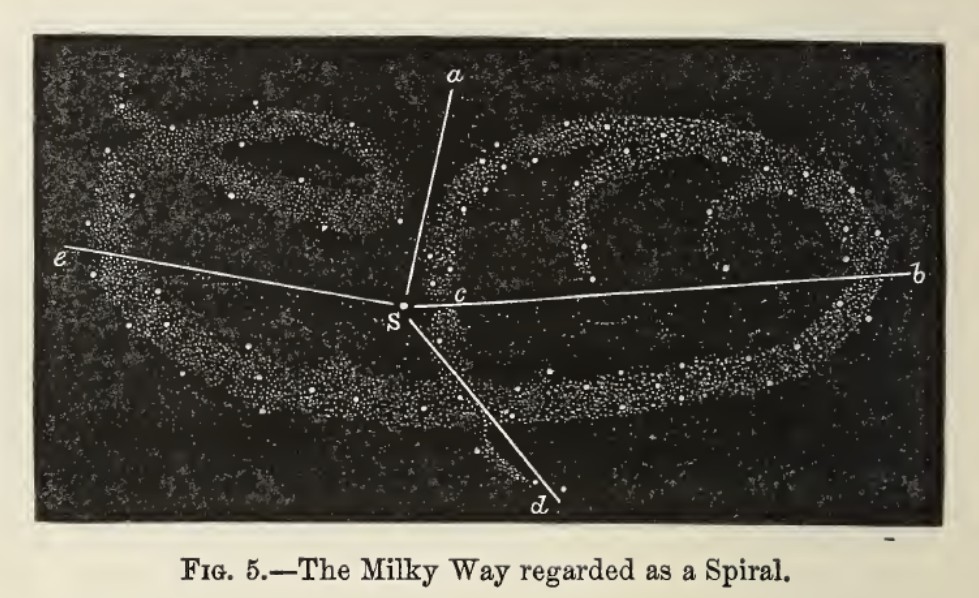
Proctor begs to differ: his belief is that the stars are not distributed uniformly, but are aggregated in complex “streams and whorls and spirals” that span a universe far larger than what our telescopes can penetrate. He also assumes a mixture of “luminaries” – the bright stars – and countless “minor stars”. All this negates Herschel’s assumptions, and therefore his galactic model; Proctor attempts to deduce an alternate model that is still consistent with the observations.
Of course, they were both trying to infer what the galaxy looks like “from the outside” while observing it with limited tools from the inside, which is a challenge to say the least. Using different assumptions, they drew from the observed star counts two very different models, seen in the images below: a three-dimensional diagram Proctor made based on Herschel’s ideas, and a spiral form that he proposed himself. With no idea of interstellar dust selectively blocking the view, both are equally wrong.
The chapter discusses in endless detail the nature of the distant stars, their distance and motion; but it lacks any reference to living creatures, so it fails to contribute to the book’s main theme.
The nebulae: are they external galaxies?
The title of this chapter highlights a major question that baffled 19th century astronomers, one that would remain unanswered until Edwin Hubble’s breakthrough in the 1920s: is the Milky Way the entirety of the stellar universe, or is it just one of many galaxies? They could see some fuzzy “spiral nebulae”, but had no way of determining whether these were gas clouds or star clusters located inside the milky way, or much larger external “island universes”.
Proctor starts with the misconception that “if our galaxy have limits, and there exist in space other galaxies, then those outer systems must be separated from ours by spaces exceeding
the dimensions of the several galaxies many thousand or many million fold in extent”. This is dead wrong: the average space between neighboring galaxies is some 50 times their diameter. With no way to measure it, Proctor derives his error by his favorite method – analogy and extrapolation: “We know… the distances separating the planets from each other exceed in an enormous ratio the dimensions of the planets. The distances separating our solar system from others enormously exceed the dimensions of the various solar systems. And we may conclude that in all probability the distances separating our sidereal system from other similar systems in space must exceed in an enormous ratio the dimensions of our galaxy”.
He does, correctly, accept that the Milky Way is of finite size, and he proves it by outlining Olbers’ paradox: “We know, indeed, that if light do not suffer extinction in traversing space (and we have as yet no evidence that it does), the extent of the sidereal system must be limited, since otherwise the whole of the starlit sky should shine with the brilliancy of sunlight”. (Today we know that light does “suffer extinction” due to absorption in interstellar dust and other causes). And then he adds that even absent the “extinction” an infinite universe might still exist without a white night sky, if the distances between galaxies, between clusters of galaxies, and between clusters of clusters and so on are immensely greater than their sizes; a point well made, since Olbers was assuming a homogeneous universe.
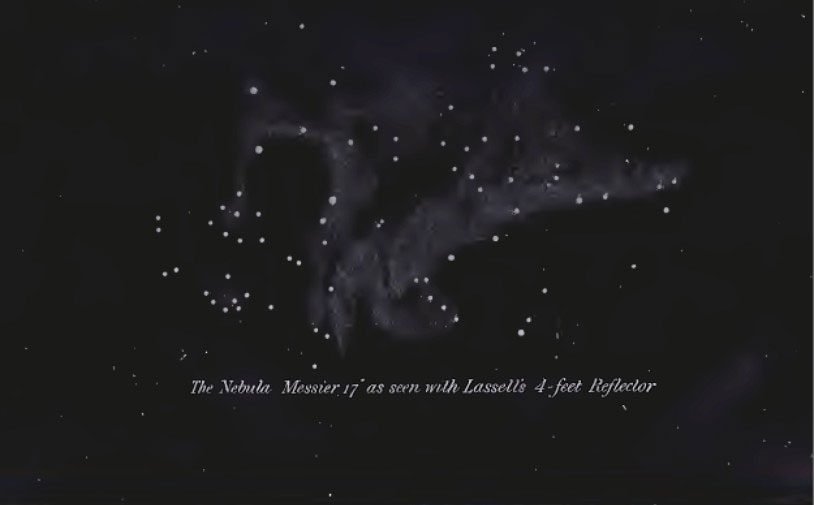
Proctor believes that all the nebulae are inside the milky way, and to prove it he analyzes the observed correlations of their locations with the ordinary stars. The image below, of what is called today the Swan nebula, is supposed to show how the stars are associated with the nebular matter.
This chapter, like its predecessor, neglects to consider the presence of life, except where it mentions that being inside the galaxy – yet looking so different from ordinary stars – the nebulae are “systems altogether different from the solar system, and thus suggest ideas of other classes of worlds peopled with their own peculiar forms of life”.
Supervision and Control
This concluding chapter discusses “the supervision and control exercised by the Almighty over his universe”, with the intent of reconciling it with the theories in the rest of the book. And the argument is definitely scientific: “It is not without a feeling of awe that one considers that the records of every action of our lives are not merely at this moment before God, but will for ever and ever be freshly present to Him: and that, not merely in the sense that He knows every thing (an idea too vague for man rightly to grasp), but by the action of physical processes such as our Faradays and Tyndalls deal with”. The “physical processes” enabling God’s knowledge are derived at length, starting with the finite speed of light: “Precisely as a daily newspaper gives us a later account of what is going on in London than of events happening in the provinces… so the intelligence brought by light respecting the various members of the solar system belongs to different epochs”. This is extended to the stars and the universe, and used to prove that a hypothetical observer traveling at relativistic speeds and looking at Earth could see all past events unfolding as the light showing them races past. But God is omnipresent, so he can see our entire past – and that of any world – at any time, all at once, without having to travel!
And there’s more of this scientification of religion: “If a great naturalist like Huxley or Owen can tell, by examining the tooth of a creature belonging to some long-extinct race, not only what the characteristics of that race were, but the general nature of the scenery amid which such creatures lived, we see at once that a single grain of sand or drop of water must convey to the Omniscient the history of the whole world of which it forms part. Nay … not only the history of a world, but with equal completeness the history of the whole universe … in the state and position of each single atom throughout infinity of space”. (Ah, the simple life of the scientist before Quantum Mechanics!…)
And not only the past – God can also deduce from that grain of sand the future of the universe – “No other view is compatible with the assumption of the Almighty’s infinite wisdom”. Divine wisdom, but applied to create knowledge via scientific deduction.
So much for Supervision… but then we have the question of Control: “does the Almighty, who supervises all things, exercise any controlling action upon the course of events?” This affects many deep questions, from the effect of prayer to the existence of miracles to the problems of free will and of the existence of evil; and all are given due treatment.
The bottom line according to Proctor is that had God’s wisdom, though great, been finite, then hands-on control and intervention in the workings of the universe would be necessary; but since God is perfect, he has created a universe subject to immutable physical laws, and “the whole scheme of the universe must needs be so perfect that direct intervention cannot at any time be required”. Everything that happens is what God wants, but he pre-programmed the universe so it will happen that way through all eternity. Not bad, for an astronomer!
Concluding observations (mine, not Proctor’s)
So these were some highlights from the content of Other worlds than ours, and I imagine you’ve found them as interesting as I have (you’ve read this far, haven’t you?). But it isn’t just the content: this is a book from another age, and its author’s thinking and methodology differ from ours; they deserve some attention too. Here, then, are some general observations about Proctor and his book.
A key element in the book is the tension between Science and Religion… or rather, the lack of tension, because the author is perfectly at peace with both these systems. On the one hand he is definitely a believer in intelligent design, as in “that the satellite-system of Jupiter subserves important functions, and affords, in reality, like all the works of the Creator, the amplest evidence of design, need not be questioned”. But at the same time he sees no conflict with what Science tells us: he just accepts that God’s design was to create the world as Science finds it to be.
And although he accepts creation as a given, the author is no creationist in the current sense. He assesses the Earth to be millions of years old based on geological observations; he accepts Darwin’s theory of evolution, adaptation and extinction; he assumes continents and oceans have shifted in the distant past, and recognizes the significance of fossils. Since God created everything, he must’ve created what we see in our telescopes and excavations. No conflict there, because Proctor is awed by creation, not by scripture.
Nor does he pull his punches in defending scientific views: “The earth, as seen by the inhabitants of Venus, must shine much more splendidly than Jupiter does in our skies. Our moon must be distinctly visible, so that, without the aid of any telescope, the inhabitant of Venus has such evidence of the Copernican theory as would suffice, if properly handled, to rout the ranks of the Ptolemaists, supposing there have ever been people in Venus foolish enough to imagine the tiny globe they live upon to be the centre of the universe.”
Mr. Proctor wasn’t only inspired by “recent scientific researches”; he contributed to them. He points out in the preface that he has “propounded views which differ from those usually accepted”; and he certainly has: we’ve seen, for instance, how his theory for the origin of the solar system challenges Laplace’s. For a book of popular science, this is unusual; most of them tend to merely present a “review of the literature”. And Proctor goes about it very professionally, dissecting his theories and the competing ones in minute detail to prove his point. Also professional is how he takes great pains to cite the other scientists in both text and image captions. Proctor may be writing popular science, but he does this with the rigor of a true scientist, using rational analysis and lengthy proofs throughout.
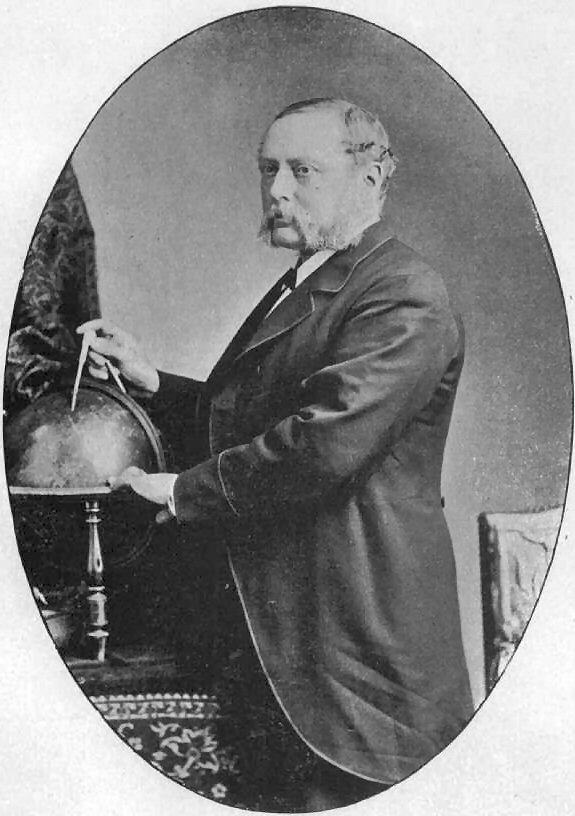
And to top it all off, Proctor is an excellent science popularizer. He makes the latest astronomical data accessible using a conversational style that the intelligent general reader could enjoy, often lightened up with a touch of humor. For example, when he hypothesizes that the natives of Jupiter are of small stature, he adds “Thus, Tom Thumb and other little fellows, if removed to Jupiter, might be wondered at for their enormous height, and eagerly sought after by any Carlylian Fredericks who may be forming grenadier corps out yonder”. (His contemporaries knew what he meant; If the reference eludes you, start your research here).
And if you’re curious to know more of Richard Anthony Proctor, he’s done enough to earn him a page on Wikipedia: take a look!
Bonus: a scan of the full book is available online, for example here.