
And now, Ladies and Gentlemen, I give you (drum roll…) Kaufmann’s Posographe!
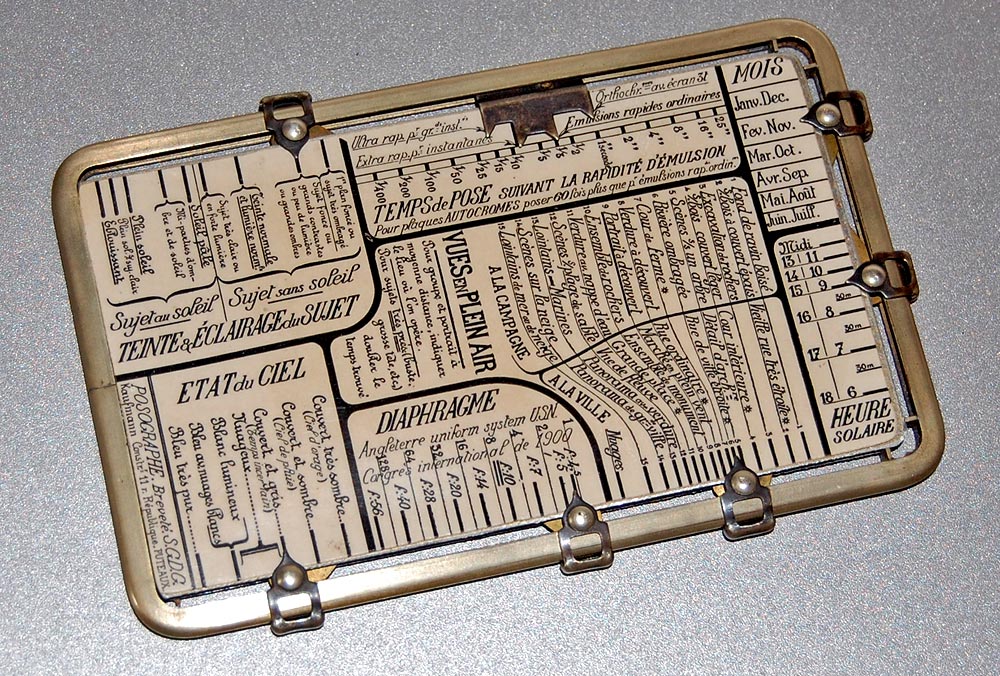
At first glance this is just a small rectangular plate, about 13 x 8 cm, covered with dense scribbles, with seven pointers fixed to its frame. Then you realize that the pointers are not fixed, but can slide on the frame… and then you note that they are somehow interconnected — moving any of the small ones will move the larger one this way or that. Strange. But when you see the diagram of the inner mechanism you realize what this is, and it can take your breath away (well, if you’re a techie like me it sure can).

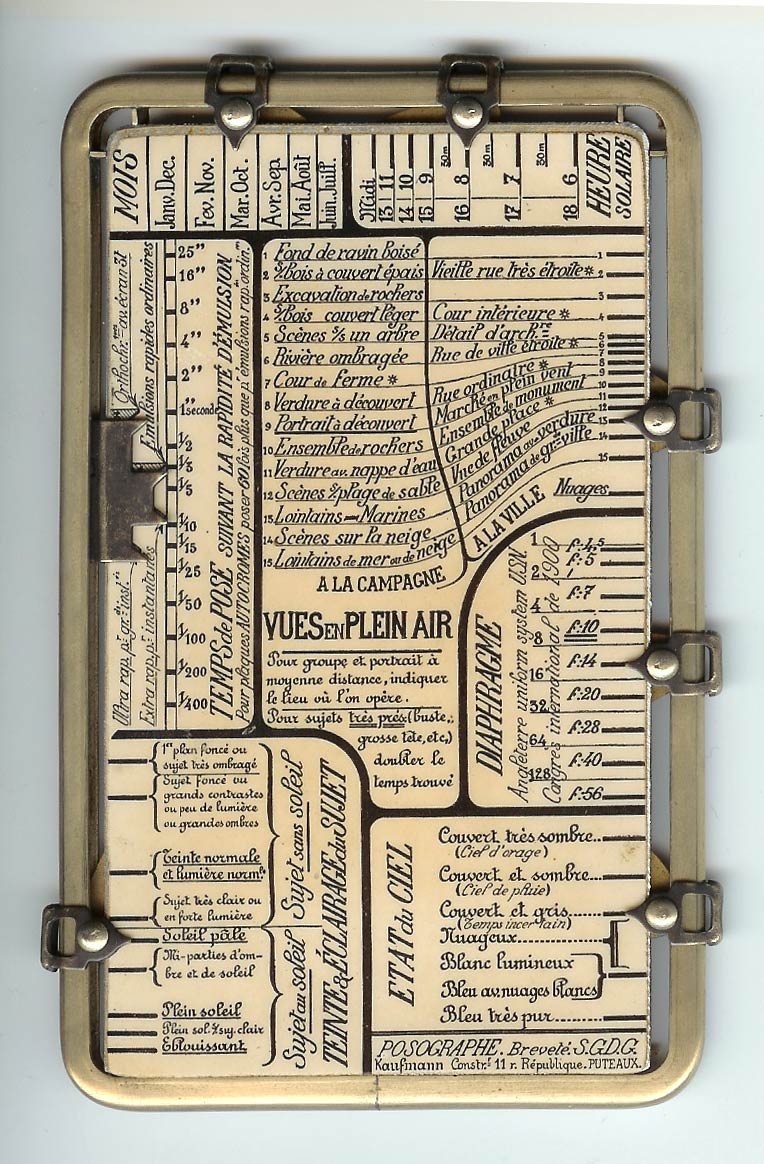
Kaufmann’s Posographe is nothing less than an analog mechanical computer for calculating six-variable functions. Specifically, it computes the exposure time (Temps de Pose) for taking photographs indoors or out (depending on which side you use). The input variables are set up on the six small pointers; the large pointer then gives you the correct time. The variables are very detailed, yet endearingly colloquial. For outdoors, they include the setting — with values like “Snowy scene”, “Greenery with expanse of water”, or “Very narrow old street”; the state of the sky — including “Cloudy and somber”, “Blue with white clouds”, or “Purest blue”; The month of the year and hour of the day; the illumination of the subject; and of course the aperture (f-number).
For example, the photo at the top of this page shows the outdoors side of the Posographe executing the following calculation: What exposure time should one use for a camera with an f/4.5 lens taking a picture of a subject in the shade on a narrow city street under a cloudy grey sky at 9AM (or 3PM) of a February (or November) day?
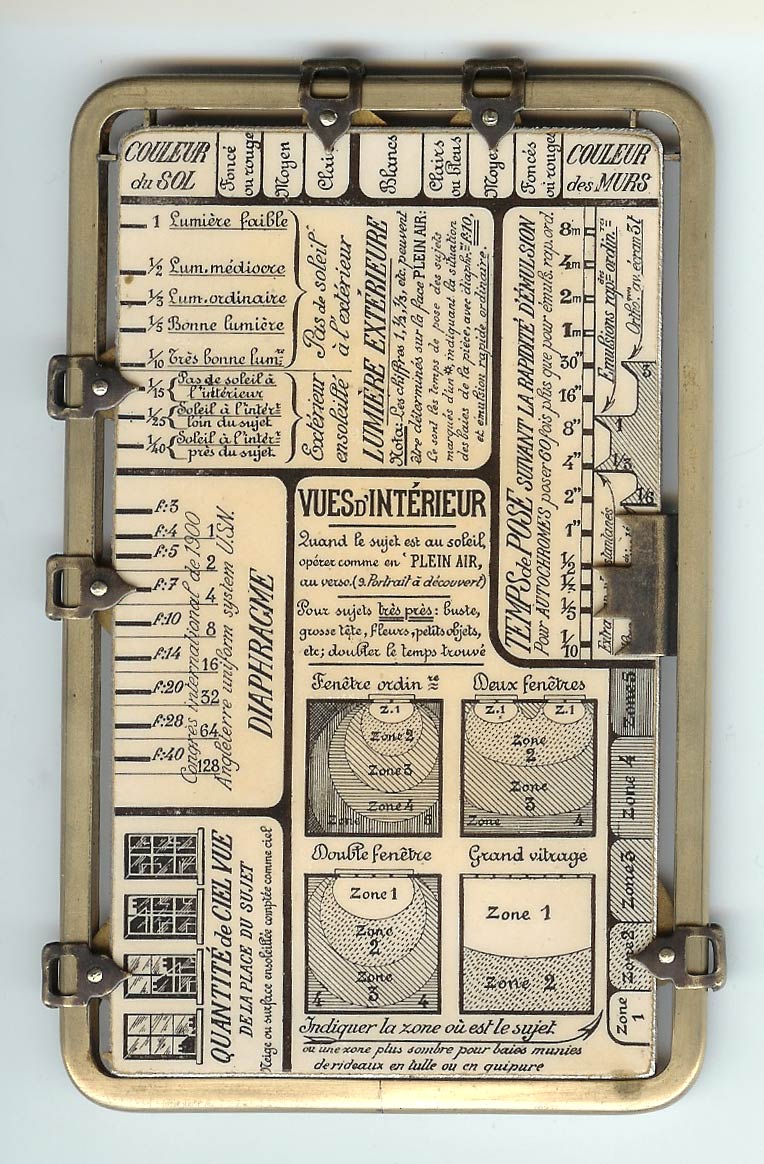
For indoor photos, we have the colors of the walls and floor; the location of the subject relative to the windows (depending also on the number of windows, and indicated by the little diagrams); the extent of sky in the window, as seen from the location of the subject (again illustrated in little pictures); the sunlight level outside, and how much of it, if any, enters the room; and the aperture.
The output indicator actually has four points, designed to show the respective exposure times for different emulsion types.
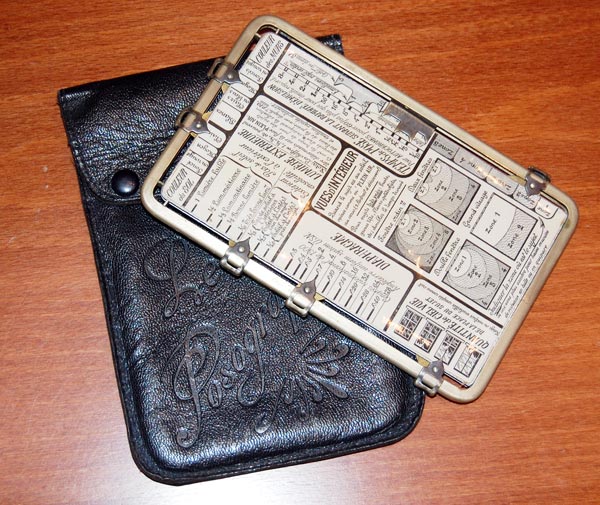
The above diagram, from the instruction manual, shows how the many pointers are all interconnected in just the right way to provide the appropriate computation. For a long time I wondered whether M. Kaufmann achieved this design empirically by trial and error, or by working out the math. Eventually I made contact with his great-grandson, who volunteered many insights that allowed me to write a detailed article for the Journal of the Oughtred Society, which you’re welcome to read. (To answer my question: Kaufmann used a systematic approach combining his training in mechanics with his knowledge of photography. First he did a literature search for the state of the art in exposure time calculation; then he tweaked and improved the findings using extensive tests, generating a set of nomograms which represented the solution in graphic form; finally he converted the graphs empirically to a mechanical movement.) The result, at any rate, is a true work of art, and comes in a lovely leather case embossed with the device’s name and an ornate floral design.
Exhibit provenance: eBay, from a gentleman in Quebec.
More info:
- More information about Kaufmann himself and his inventions can be found in my article in the Journal of the Oughtred Society.
- Ace Hoffman was inspired to develop an interactive software simulation of the Posographe, available here for Windows, Android and iOS devices.