
Evolution of the PC Hard Disk
I remember my first Hard Disk, which I bought for a good deal of money for my Commodore Amiga. It held 20 Megabytes, as opposed to the 880 KB (0.88 Megabyte) floppy disks that were all I had before this upgrade. There it is, second from the right in the photo below.
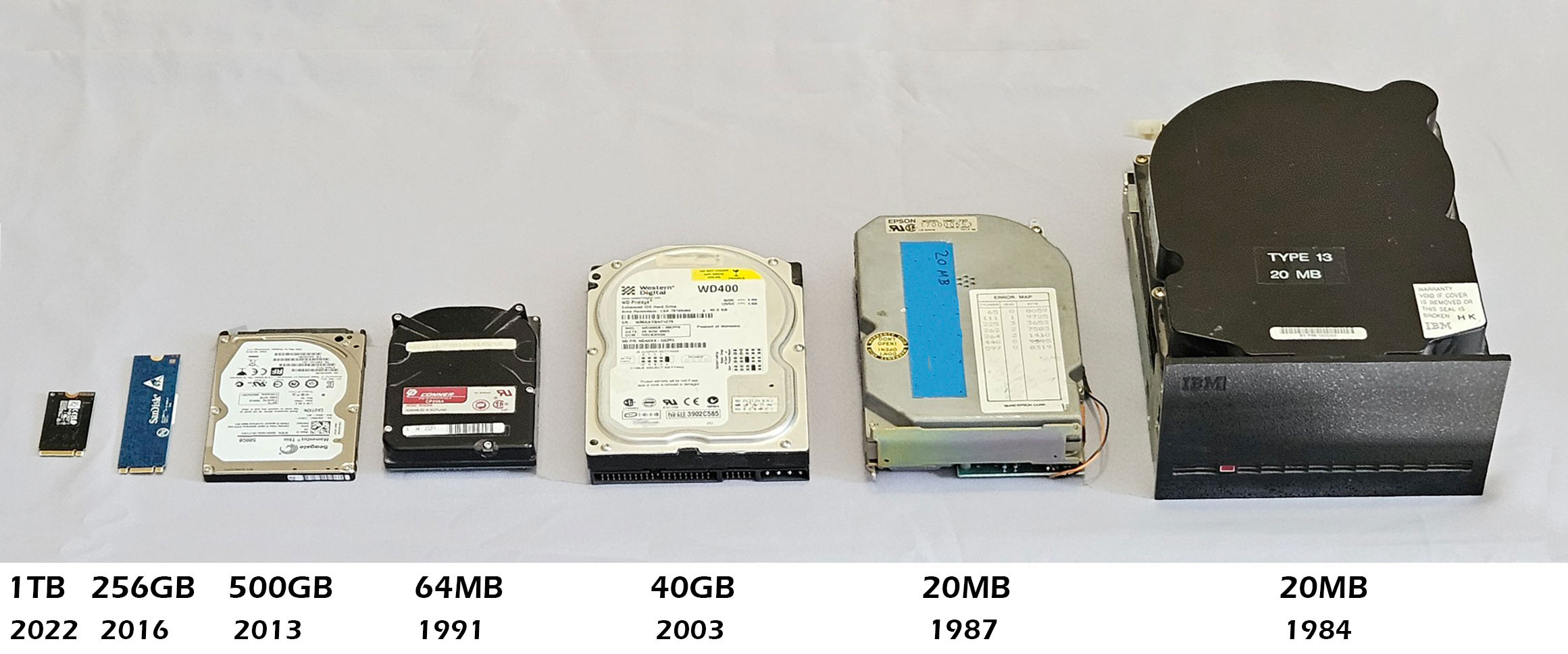
These are all from my junk box (yes, my Amiga croaked at some point after giving me years of delight); all but the giant at the right have been in use on my various machines over four decades of computing.
Like everything in computing, they get smaller and smaller, cheaper and cheaper over the years; and as you see in the captions, their storage capacity is getting huger and humongouser. I mean, 20MB is 20 million bytes – 160 million binary digits. That’s enough to store the bible four times over. But the tiny black rectangle at the left stores 1 Terabyte – and that is 8 billion bits, enough for some 240 copies of the encyclopedia Britannica with all its media, and a few Bibles for good measure. You can see the two drives in the next photo: the huge 20 MB next to the magnetic platters I removed from its belly, and the 1 TB SSD on the left. The former was in use on the original IBM PC/XT, and the latter is from a recently deceased notebook I had.

This photo also captures the most innovative transition in the history of the hard drive: for decades all mass storage in personal computers was magnetic, with information recorded on magnetic platters like the ten in the old PC drive. The density of bits per unit area rose fast, which is why later generations would contain only one or two small platters; but the principle remained the same. In the 1990s Solid State Drives arrived on the PC scene, and their capacity rose quickly. These are based on flash memory chips – no moving parts! – and like all VLSI devices can be miniaturized far faster than rotating disks can.
And forget the Britannica… a 1TB SSD can store a million good quality selfies and photos of cats… now there is a real triumph of technology!
Exhibit provenance:
The PC/XT drive must’ve come from some flea market or such, I forget where. The other drives all come from various computers I’ve used and decommissioned (to put it gently) over the years. And I have more where this sample came from…
Bonus hard disk:
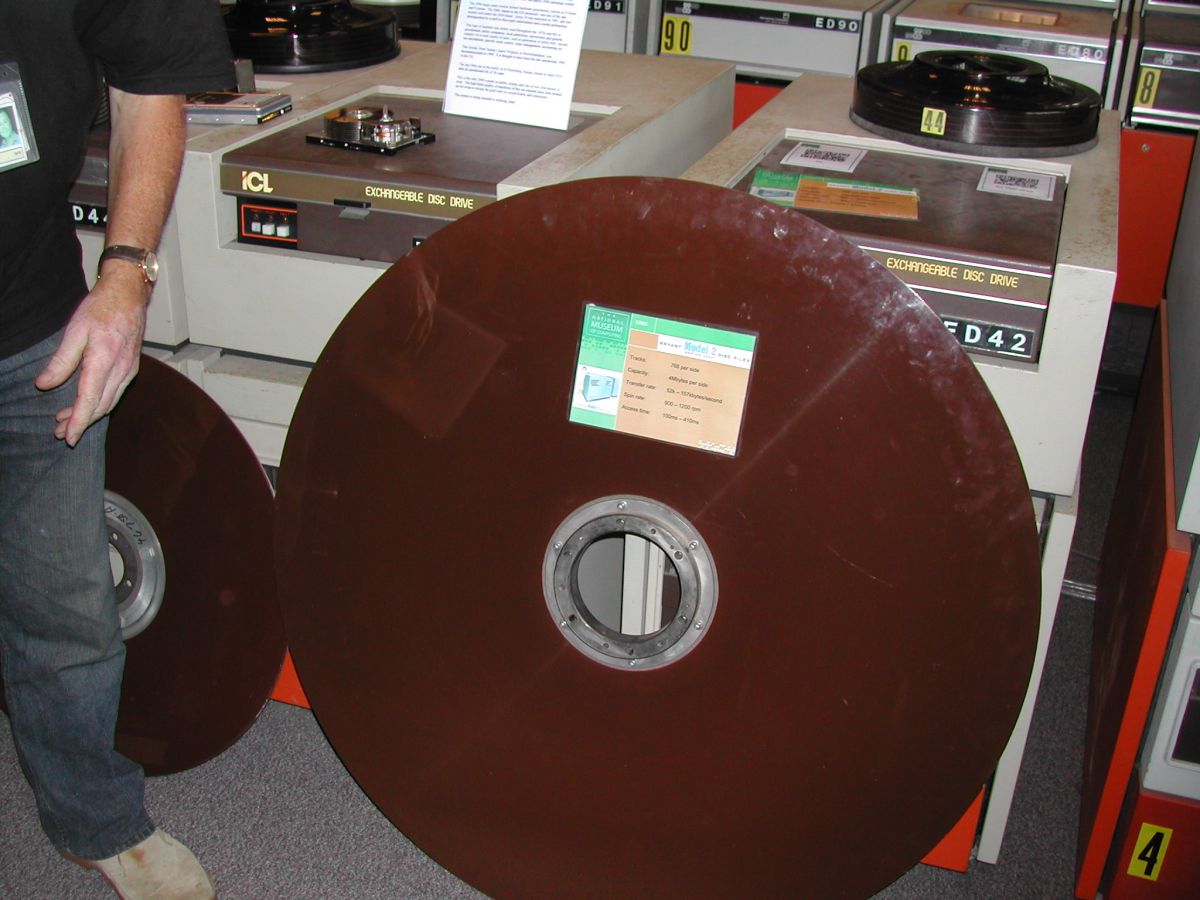
I took this photo at the National Museum of Computing at Bletchley Park. The pinnacle of 1965 technology: the larger platter can store 4MB on each side! Read more about this device here.
Hi Nathan- I have an Intel 7110 bubble memory device (purchased on EBay a few years ago) on the shelf in my office as another reminder of the progress in non-volatile storage. It dates to the late 1970s or early 1980s.
It has a capacity of 1 million bits (125 kilobytes), and is 37.5 mm x 34.3 mm x 9.7mm, weighing 48 grams.
A terabyte of storage constructed from these devices ( packed solid) would be a cube about 4.6 meters per side and weigh 384,000 kilograms. (Assuming I have my decimal points in the right place).
I have an 8 Terabyte drive on my desk, about the size of a hardback book. I’d need a stouter desk if it was made from bubble memory!
Hey Doug,I remember those bubble memories… a rare intel foray away from Silicon. I think I have one unit somewhere… I should find it and write it up on the site.
So… how many cats did you fit on the 8TB drive?… 🙂