
This article was originally published in the Fall 2020 issue of the Journal of the Oughtred Society
The subject of this article is possibly the simplest calculating device in my collection, and yet I can’t help feeling respect for its inventor for his ability to squeeze so much functionality into so little mechanism. It is also quite rare, and I had never heard of it prior to the serendipitous online sighting that allowed me to purchase it.
Structure
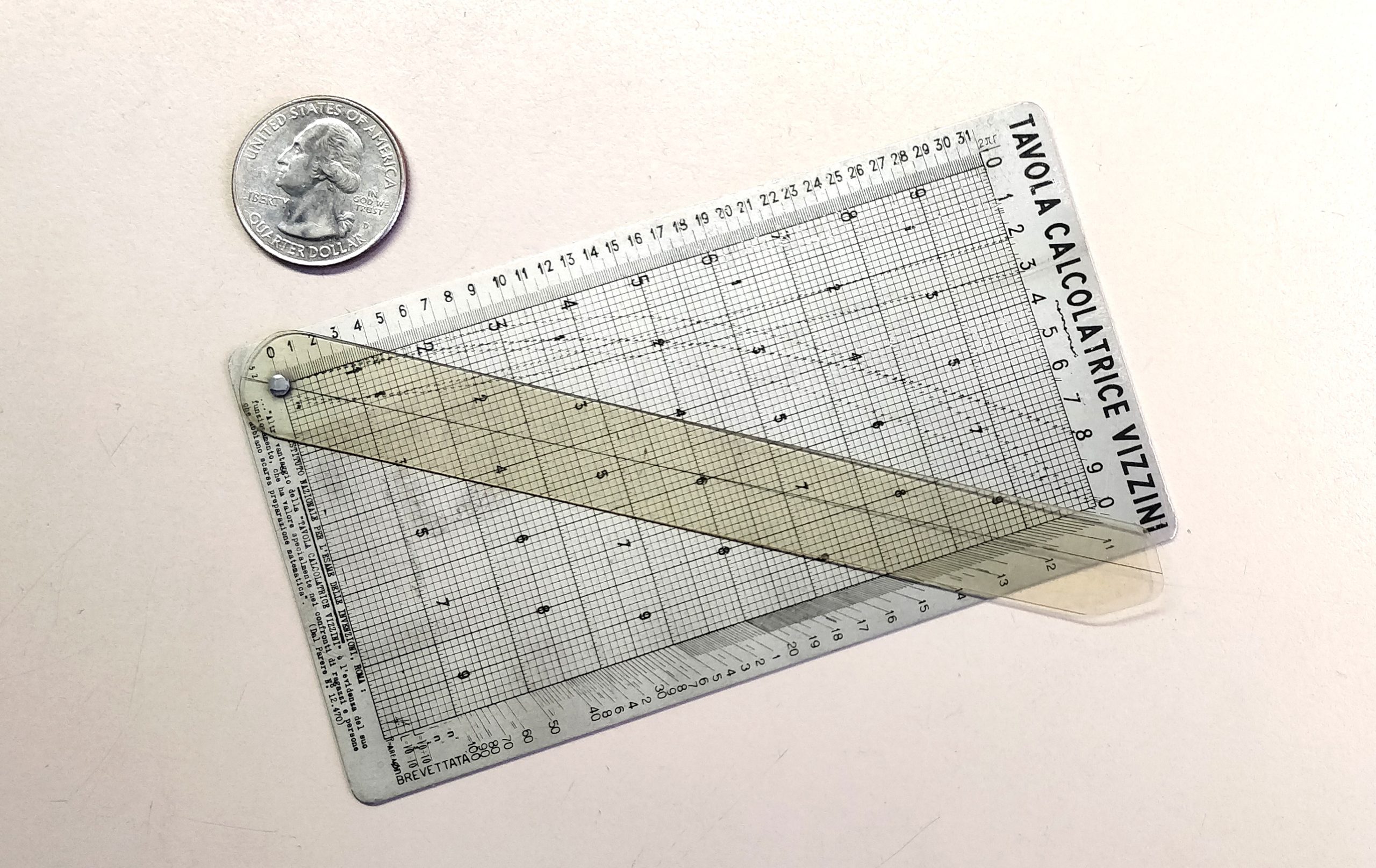
The pocket-sized device consists of a flat metal base (aluminum alloy, most likely) measuring 65×117 mm, with a transparent cursor hinged to its corner by a metal rivet. The cursor is made of celluloid or some similar material, and has a hairline down its middle.
The base carries a 50×100 mm grid. The Y axis is numbered 0 to 10; the X axis at the top is also numbered linearly 0 to 10 but this sequence continues down the right-hand side non-linearly to 100. It is worth noting that the rectangular grid actually represents a 100×100 unit coordinate system; the horizontal axis has been compressed to make the device pocketable.
In addition to this basic structure there are sequences of special marks on the grid that are used to calculate circle properties, powers and roots, as discussed below. The back of the base carries a set of instructions in a dense typewritten format.
Function
The purpose of this device (which is, in a sense, a nomogram with the straightedge constrained by a pivot) is to execute calculations of multiplication, division, square and cube powers and roots, as well as circumferences and areas of circles; especially – according to a quote from Italy’s National Institute for the Examination of Inventions that is given at the bottom of the base – for the benefit of “children and persons of little mathematical preparation”.
The basic multiplication operation is done by placing the cursor hairline on one multiplicand on the top or right-hand scale, and reading the product at the hairline on the horizontal line starting at the other multiplicand as marked just inside the left edge of the grid. For example, in the photo above the cursor is set at 12 on the right-hand scale and it intersects the horizontal “5” line at the value 6, representing the result 12×5 = 60.
Operations for powers and roots (for integer arguments) are made by going along a horizontal line emanating from the argument on the Y scale at the left edge of the grid, and reading the result where the tick mark for the desired function intersects this horizontal line. The tick marks are as follows: square – I; cube – Г; square root – ˩; cubic root – L; area of a circle of given diameter – ϙ.
Circumferences of circles are read directly on the leftmost vertical scale, adjacent to the diameter on the grid’s Y scale.
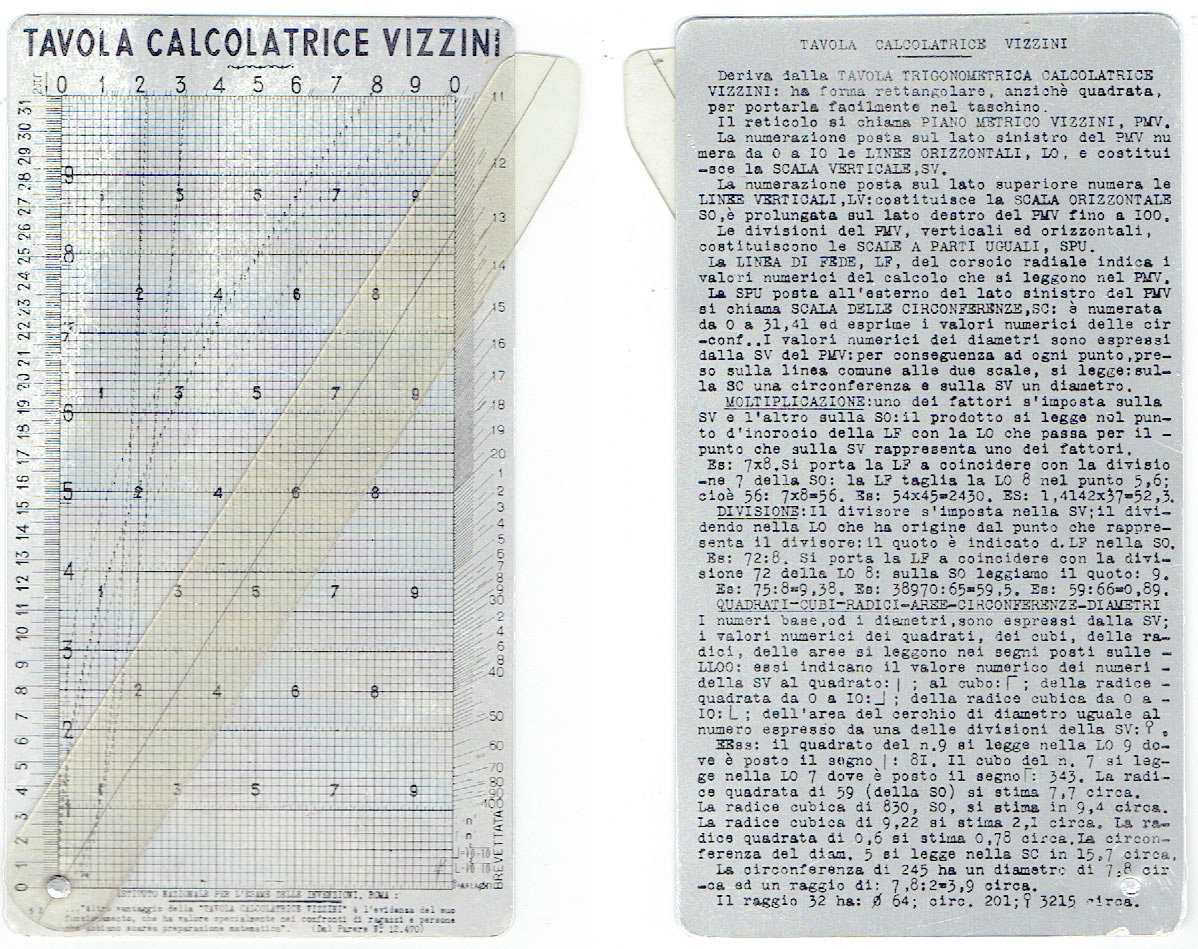
Below is a translation of the instructions on the reverse side. Not a model of clarity, but the information is all there. (Note: The two errors in the examples are in the original – catch them if you can!)
VIZZINI’s CALCULATING TABLE
Derived from VIZZINI’S CALCULATING TRIGONOMETRIC TABLE: it has a rectangular form, rather than a square one, to easily carry it in a pocket.
The grid is called VIZZINI’s METRIC PLAN, VMP.
The numbering on the left side of the VMP enumerates from 0 to 10 the HORIZONTAL LINES, HL, and constitutes the VERTICAL SCALE, VS.
The numbering on the upper side enumerates the VERTICAL LINES, VL: this constitutes the HORIZONTAL SCALE, HS, and is extended on the right side of the VMP up to 100.
The divisions of the VMP, vertical and horizontal, constitute the SCALES OF EQUAL PARTS, SEP.
The HAIRLINE, CH, of the radial cursor indicates the numerical values of the calculation which are read on the VMP.
The linear scale placed outside the left side of the VMP is called the CIRCUMFERENCE SCALE, CS: it is numbered from 0 to 31.41 and expresses the numerical values of the circumferences. The numerical values of the diameters are expressed by the VS of the VMP: consequently at each point, taken on the line common to the two scales, we read: on the CS a circumference and on the VS a diameter.
MULTIPLICATION: one of the factors is set on the VS and the other on the HS: the product is read at the intersection of the CH with the HL that passes through the point that on the VS represents one of the factors.
E.g., 7×8. The CH is brought to coincide with the division 7 of the HS: the CH intersects the HL 8 at the point 5.6; that is, 56: 7×8 = 56. E.g., 54×45=2430. E.g., 1.4142×37=52.3.
DIVISION: the divisor is set in the VS; the dividend in the HL that originates from the point that represents the divisor: the quotient is indicated by the CH in the HS.
E.g., 72:8. The CH is brought to coincide with the division 72 of HL 8: on the HS we read the quotient: 9. E.g., 75:8=9.38. E.g., 38970:65=59.5. E.g., 59:66=0.89.
SQUARES-CUBES-ROOTS-AREAS-CIRCUMFERENCES-DIAMETERS: the base numbers, or the diameters, are expressed by the VS; the numerical values of the squares, the cubes, the roots, the areas are read in the signs placed on the HL’s: they indicate the numerical value of the numbers of the VS, squared: I; cubed: Г; of the square root from 0 to 10: ˩; of the cubic root from 0 to 10: L; of the area of the circle of diameter equal to the number expressed by one of the VS divisions: ϙ.
E.g., the square of the number 9 is read on HL 9 where the sign I is placed: 81. The cube of the number 7 is read on HL 7 where the sign Г is placed: 343. The square root of 59 (of the HS) is estimated to be approx. 7.7. The cubic root of 830, HS, is estimated at ca. 9.4. The cubic root of 9.22 is estimated to be approx. 2.1. The square root of 0.6 is estimated to be approx. 0.78. The circumference of the diameter 5 is read on the CS as approx. 15.7.
The circumference of 245 has a diameter of approx. 7.8 and a radius of approx. 7.8: 2 = 3.9.
The radius 32 has: Ø 64; circ. 201; ϙ 3215 approximately.
If this is confusing, you can get a better idea by playing with it directly: I’ve published a photo of this find on Facebook, and a collaboration (see Acknowledgements below) ensued with the result of an online interactive simulation. This is available for your enjoyment (and solution of any pressing multiplication problems you may have) here.
Origin
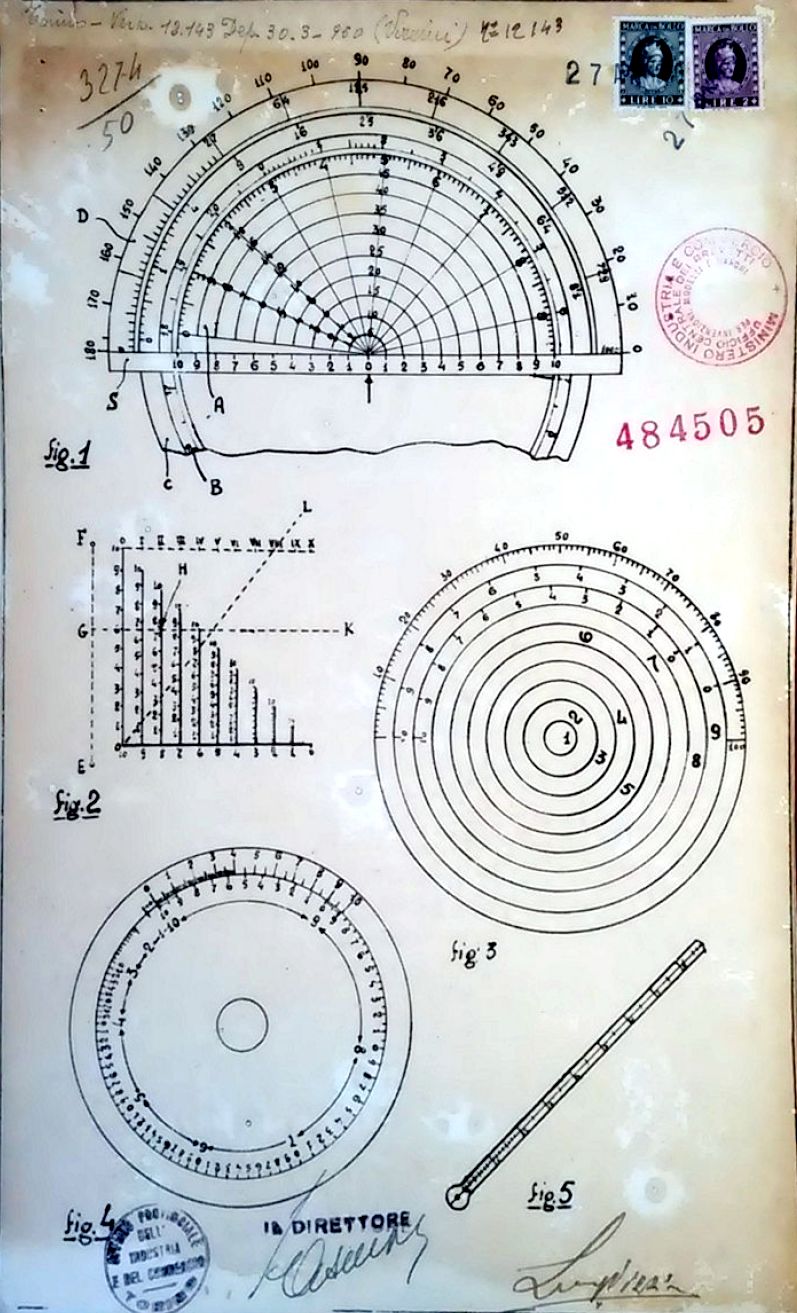
This little calculator was invented by Luigi Vizzini of Torino, Italy. An Italian patent (No. 4697081) was applied for in January 1950 and granted in March 1952. An additional patent (No. 4845052) was applied for in March 1950 and granted in Sept. 1953. Both applications contain multiple claims for design variations on the basic idea, including square, circular and semicircular versions (see a sample in the figure below). Vizzini sure had strong feelings for “calculating tables”!
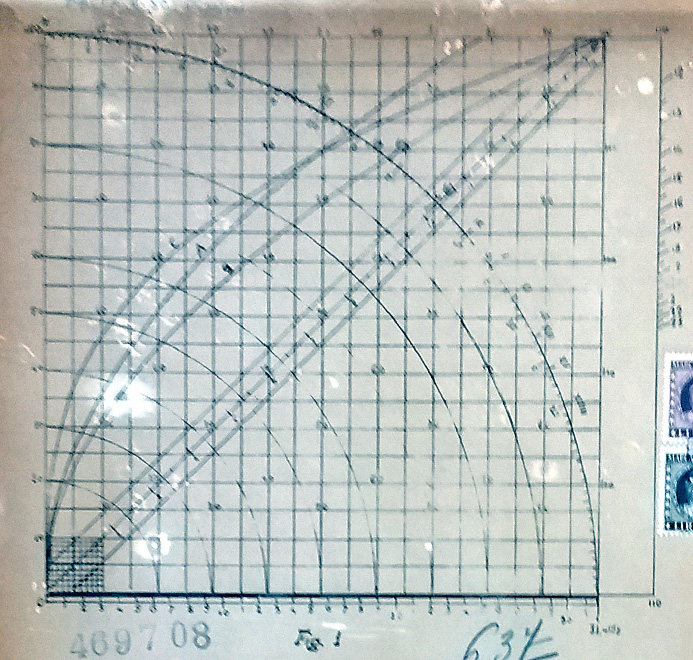
The design closest to the device discussed here is the first claim in the earlier patent, and is seen in the next figure. As can be seen, it is a square rather than rectangular implementation, which allows the cursor to carry a linear scale and the base to have circular traces equidistant from the origin (pivot). This must be the square “VIZZINI’S CALCULATING TRIGONOMETRIC TABLE” referred to in the instructions as the precursor of the current device.
Discussion
As we’ve seen, Mr. Vizzini was a creative and enthusiastic innovator; and yet there is no trace of his work product anywhere we can see. Even the device shown here doesn’t seem to be an actual commercial product. Nicola Marras, who translated the instructions, suggests that this must be a prototype unit. He points out that the instructions (in contrast to the well-written patent application) are written in sloppy Italian, are obfuscated and hard to read, and appear to be an uncorrected draft. They also contain arithmetical errors in the examples, which would be unthinkable in a production unit. If this is only a prototype, then we don’t have a single product by Vizzini in the hands of any collector I know (and I’ve presented this device at IM2019, where it was examined by many).
So, was it a flop in the target market? Or did it even make it to the marketing stage? Of course, we won’t know with certainty unless new information comes to light but I must point out that for all its minimalist elegance, the Calculating Table is not very useful, which may explain its apparent lack of success. Its main shortfall is its miniature size; it would be far better were it twice as large. That would negate the pocketability touted by its maker, but in most circumstances this would be acceptable. The target population seems to focus on schoolchildren, and a larger device would fit naturally in their school bag. As it stands, the small size reduces both legibility and precision (especially when interpolating the non-integer values of roots and circle areas).
I can also conjecture that the educator community may have taken a dislike to this calculator, for the same reason quoted by Jean-Antoine Lafay for its opposition to his Hélice à Calcul. Lafay had tried to market his helical slide rule to students, and he laments that,
“When I approached mathematics professors, they caused me great disappointment. … their almost universal response was negative, formulated roughly thus: ‘the goal of our teaching is to develop the spirit and intelligence of our students, and your purely utilitarian mathematics are of no use for that; they are even harmful’.”
Teaching children multiplication and division is a basic part of their early mathematical education, and a teacher may well oppose anything that would undermine the age-old method of doing it by memorization, pencil and paper.
Addendum
After this article’s submission I serendipitously discovered a reference to another, earlier device utilizing the principle of a pivoted cursor over a rectilinear table. The 1928 catalog of Tavernier-Gravet, the well-known French slide rule maker, shows the device below, devised by one H. Dardaillon. Unlike the more versatile Vizzini device, this one has only a single purpose: it calculates a total wage from the hourly rate times minutes worked.
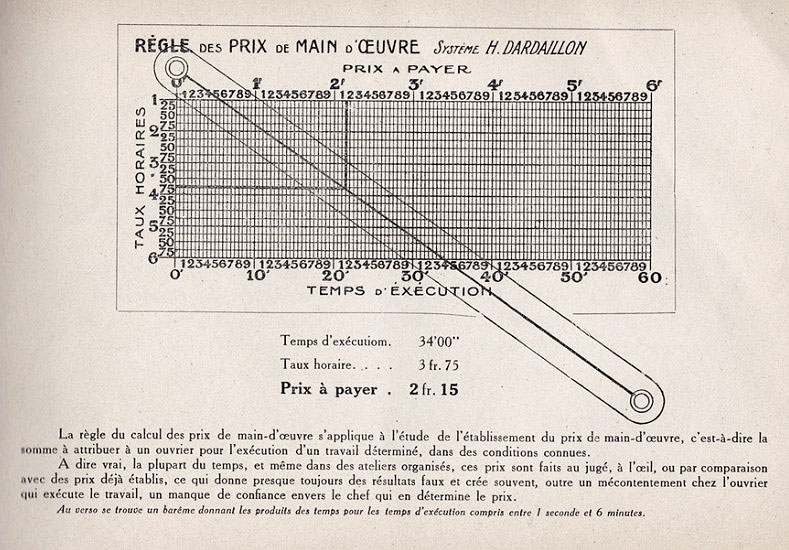
The text under the picture, in English translation, reads:
Execution time: 34’00”
Hourly rate: 3 fr. 75
Price to pay: 2fr. 15The rule for calculating the price of labor applies to the study of the establishment of the price of labor, that is to say the sum to be allocated to a worker for the execution of specific work, under known conditions.
To tell the truth, most of the time, and even in organized workshops, these prices are made by judgment, by eye, or by comparison with already established prices, which almost always gives false results and often creates, in addition, discontent on the part of the worker who performs the work, and a lack of confidence in the leader who determines the price.
On the reverse side is a scale showing the time products for run times between 1 second and 6 minutes.
Exhibit provenance:
A seller on the Fleaglass scientific antiques site.
More info:
Here is Vizzini’s patent 469708, and his patent 484505.
Acknowledgments
This article draws on much help generously offered by a number of friends spread around the planet. I am grateful to Nicola Marras, for translating the instructions and for sharing useful insights; to Andrea Celli, for hunting down the Vizzini patents in government archives; to Andries de Man, for creating the animated simulation of the device; and to Alvaro Gonzalez Firpi, for creating the CAD drawing used in the simulation.
I wish to thank John Vossepoel for permission to reproduce the image of the Dardaillon calculator, and for making the entire 1928 Tavernier-Gravet catalog available here.