
A unique hand-made industrial calculator
Some of my favorite slide rules are the one-of-a-kind handmade ones, and while most have an obvious function, this one kept me in the dark for a long time.
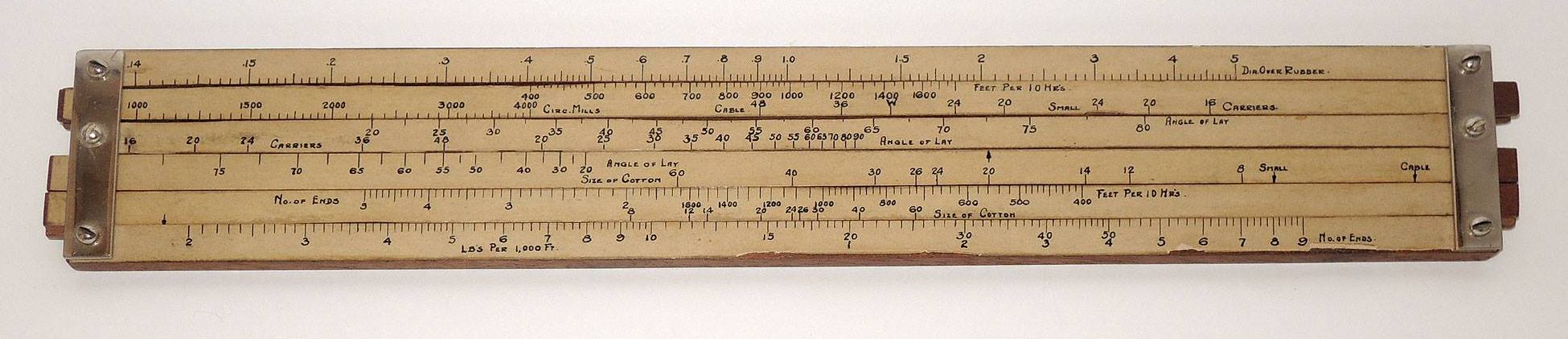
I bought this slide rule at an Oughtred Society swap many years ago, with no idea who made it or for what purpose. It’s a rather complex device, with three stators and three slides, and a multitude of scales meticulously hand-drawn in India ink on paper glued onto wood. The scales carried names like “No. of ends”, “Lbs. per 1,000 ft”, “Circ. Mills”, “Feet per 10 Hrs”, “Dir. over rubber”, “Cable”, and others.
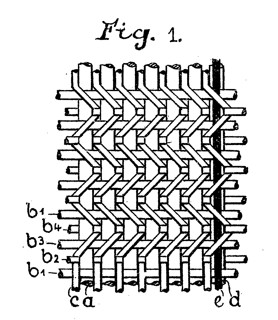
Originally I conjectured that this had something to do with manufacturing insulated cables of some kind. I mean, it literally says “cable” on one of the scales, and others refer to lengths and cross sections… and as a radio amateur, cables come to me naturally. However, my fellow collector Nicola Marras shared another possibility. He pointed out that “No. of ends”, “lbs per 1,000 feet”, “Angle of lay”, etc. are textile related, but “Dir. over rubber” is normally not; their juxtaposition pointed him to a patent from 1930 for a process for the preparation of “India rubber textile fabrics” in which rubber threads are meshed with regular threads, as seen in this patent drawing.
This idea made sense, but I lacked any detailed insight into how everything fit in. I provisionally called the slide rule a “textile calculator” in my inventory, but continued to search for additional knowledge: over the years I brought this device to collector community events, both physical and virtual, to see if anyone had further ideas. Finally I got a course correction from Andries de Man, who realized that I had misread the caption “Dir. over rubber” – it was actually “Dia. over rubber”, i.e. “Diameter over rubber”, which returns the focus to electrical cables after all, as does “Circ. Mills”. His subsequent research and mine came to the conclusion that this is a calculator for planning the manufacturing process of electrical cables with a copper core, a rubber insulation layer, and an outer layer of braided cotton. Like in this image, from a 1948 catalog:
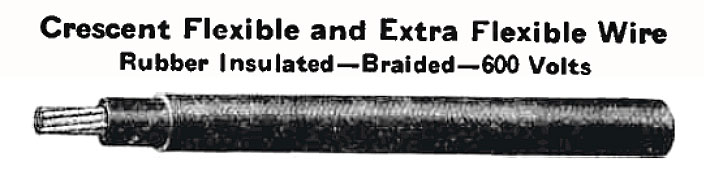
The slide rule deals with the last production stage, the laying down of the cotton braid over the rubber insulation.
Not being acquainted with cable making technology, I had to do some online digging into current and vintage braiding machine literature, and I found the parameters on my slide rule mentioned again and again in the context of braiding machines. I also learned that these machines are pretty cool! The bobbins feeding the cotton yarn dance endlessly around each other in weird patterns, so the yarns can end up in the correct braid pattern. You can see this in action in this video.
So now we know what all those terms mean:
- Carriers – the holders carrying the bobbins of cotton yarn
- Size of cotton – the size of the yarn
- Number of ends – the number of individual yarns being braided
- Angle of lay – the angle of the braided yarn relative to the length of the cable
- Lbs per 1,000 feet – the weight of the cotton being consumed per length of cable
- Feet per 10 hours – the rate of production.
- And the misleading “Dia. over rubber” – the outer diameter of the rubber layer.
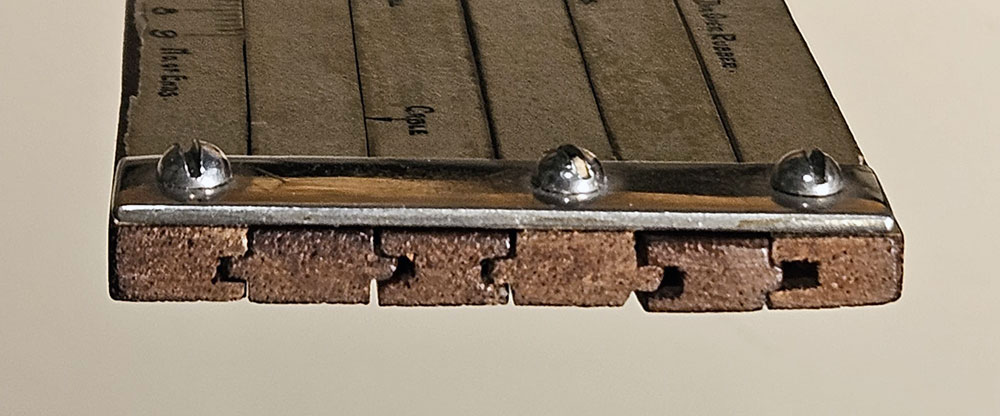
This is very probably a calculator made locally at some factory, possibly a one of a kind. The ink-on-paper is a giveaway; also, the end braces are secured with short wood screws, instead of connecting to similar braces on the opposite side. I doubt any commercial factory would do it this way. That said, the quality of this device is remarkable, and the design is well thought out: the three slides are even keyed so they can only be inserted in the correct sequence, as can be seen in the side view.
Accurate dating is impossible, but the first half of the 20th century is about right. I’d love to learn who made it, but that is not likely to happen…
Exhibit provenance: purchased at an Oughtred Society swap.
More info: See here another impressive hand-made slide rule.