
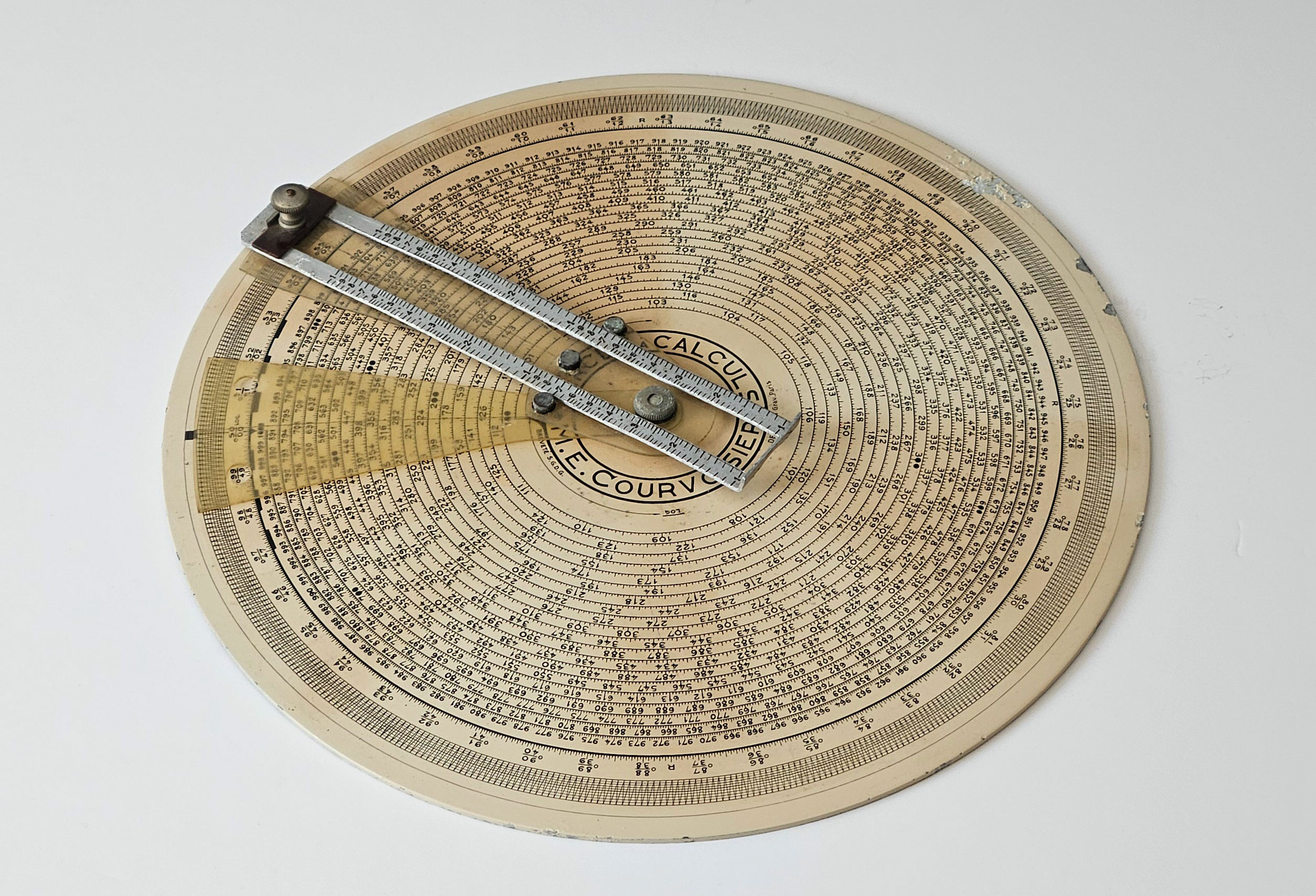
The spiral slide rule, whose logarithmic scale is wound tightly into many turns on a flat disc, has a key advantage: it allows you to cram a very long scale – many meters – onto a compact disc of maybe 20 cm diameter. While this combines precision with usability, there is a downside: with all those turns of the spiral under the radial cursor hairline, you need to figure out which turn to read the result on!
Many makers simply ignore this problem and leave it to the user to figure it out. But now and then you run into an inventor who attempts to solve it directly by adding to the device an indicator that points out the correct turn. One such inventor was Louis Ross, whose impressive device I describe here. Another in M.E. Courvoisier, whose “Cercle a Calculs” (Calculating Circle) is shown in the image above.
This device has a 20-turn, 8 meter long spiral on a flat aluminum disc 24 cm in diameter, with two celluloid cursors pivoted at its center; these allow you to multiply and divide, as on most circular slide rules. But it also has a long aluminum ruler that can slide in and out along one of the cursors, and be fixed to it by tightening the clamp at its far end. This is the turn indicator, which bears two identical two-cycle log scales at its two edges. To see how it works, here is a worked out example. Following the instruction manual, I refer to the simpler cursor as S and to the one with the ruler as LR.
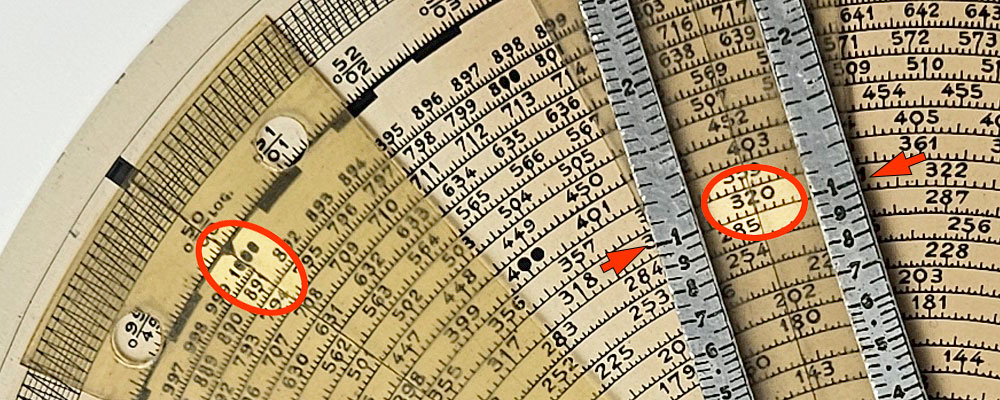
Problem: calculate 3.2 x 4.
Step 1. Preparation of the cursors. Place the hairline of cursor LR on 320. Slide the ruler to set its middle “1” at the spiral turn containing the number 320 and tighten its clamp. Hold LR in this position and place the hairline of cursor S at the top end of the spiral (marked 1000).

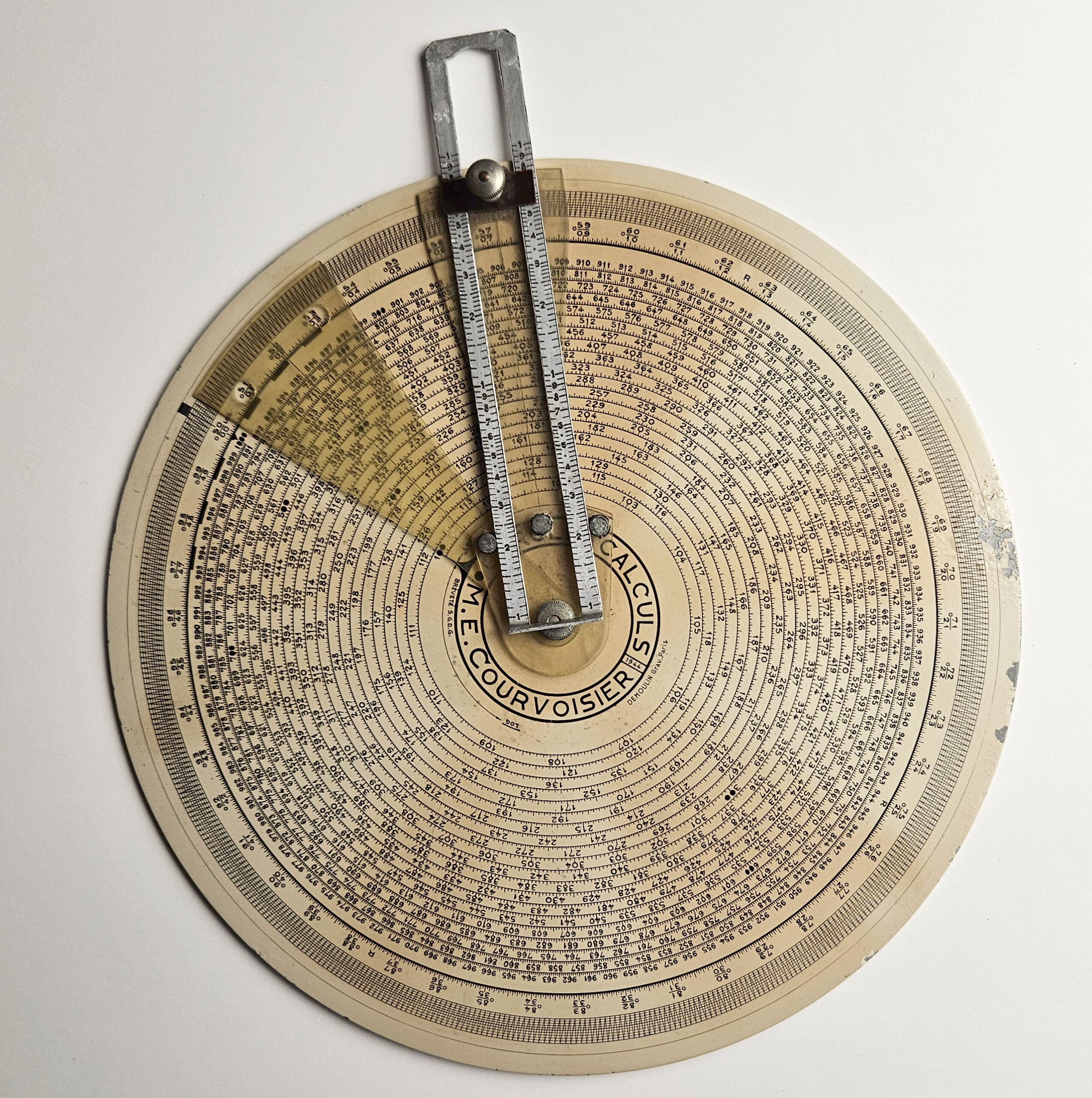
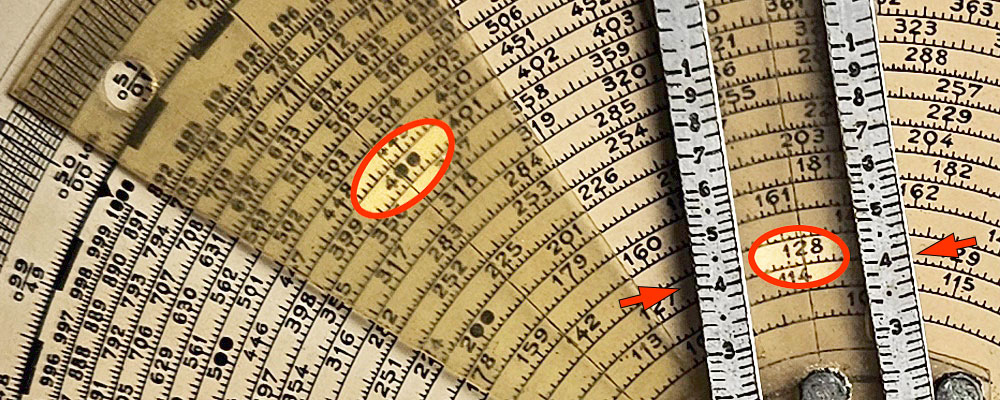
Step 2. Movement of the cursors. — rotate the two cursors, keeping their relative position fixed, to place the hairline of cursor S on 400.
The result can now be read at the intersection of the hairline of LR with the spiral turn that is under the digit 4 of the ruler: 128, i.e., 12.8.
That’s it! Fast and easy to use. In principle it does what the Ross Precision Computer does, but the Courvoisier solution is simpler than Ross’s, and its usage is faster and a lot less fiddly.
And what caught me by surprise is this realization: that both devices use the same principle, which amounts to placing a small radial straight slide rule perpendicular to the spiral scale, and using it to repeat the calculation (at lower precision) along the radius of the disc. But Ross does it by adding a complete slide rule, with two straight stators and a moving slide between them; while Courvoisier achieves the same goal with only the one straight scale on the ruler, which serves as the slide. So where is the other scale – the stator? Why, it is the spiral scale! Or rather, in a sense, the projection of the spiral scale on the radius of the disk. We have here the only asymmetrical slide rule I’ve ever seen – two log scales, one straight and short at 6 cm, the other an 8 meter spiral. Not only does this remove the complication and cost of a full slide rule like Ross’s, but it also places the slide rule right where it’s needed, on the cursor LR, next to the multiplicand in step 1 and later next to the result in step 2. So ingenious!
Less convenient is Courvoisier’s solution for calculating logarithms. At first this had me completely baffled: there is a linear scale marked “LOG.” near the edge of the disc, but how it shows logarithms was quite unclear. The instructions are confusing, and the patent actually shows a different (and, in my view, superior) scale structure to the one in my exemplar.
The solution appeared in a single sentence in Ed Chamberlain’s article (referenced below): “To find a logarithm of a number, one first needs to remove the [ruler], turn it over to reveal a linear scale, and reinsert it”. That was a surprise!
And indeed, once I disassembled the ruler I found on its backside two 6 cm long scales: a linear 1-10 scale marked Log and a 1-100 scale marked with the square root symbol.
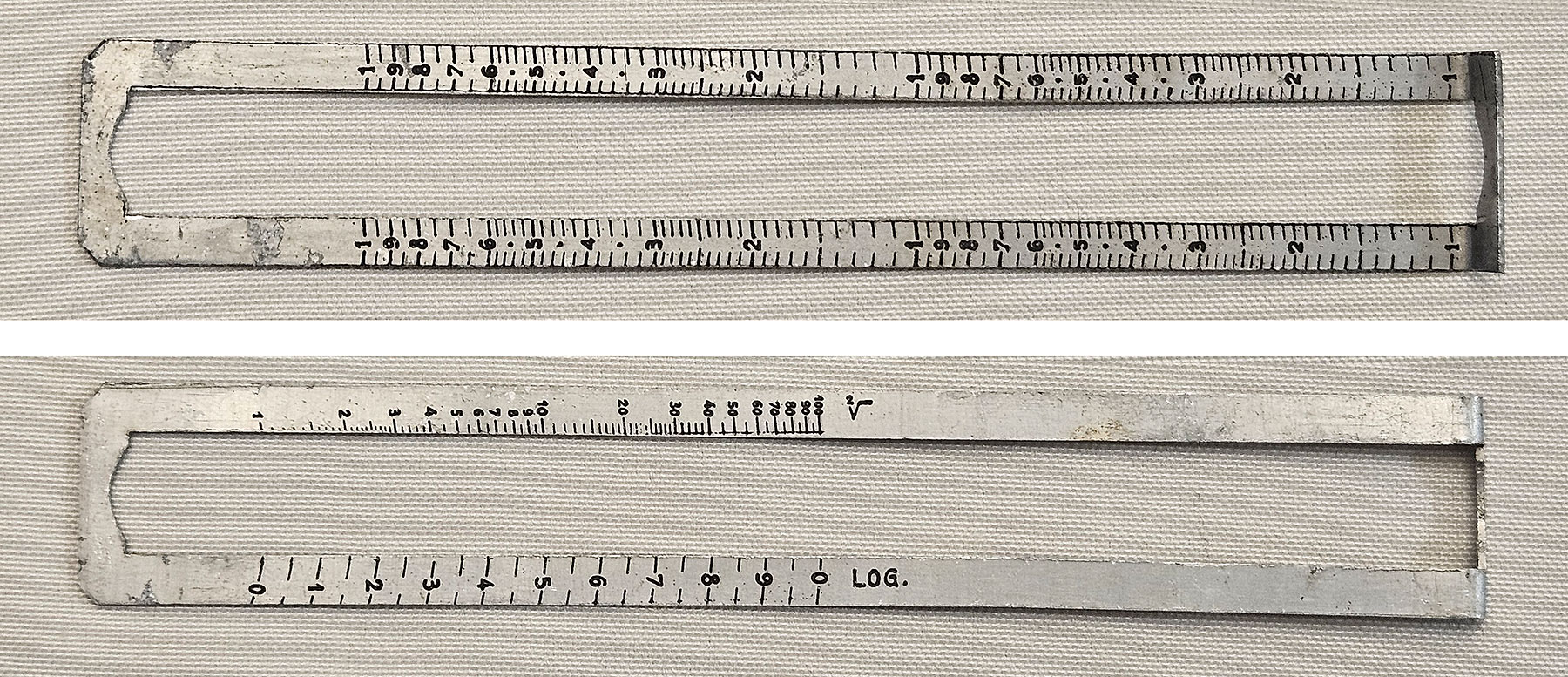
I have yet to decipher the roots calculation, but I now have the logs in hand. Here goes:
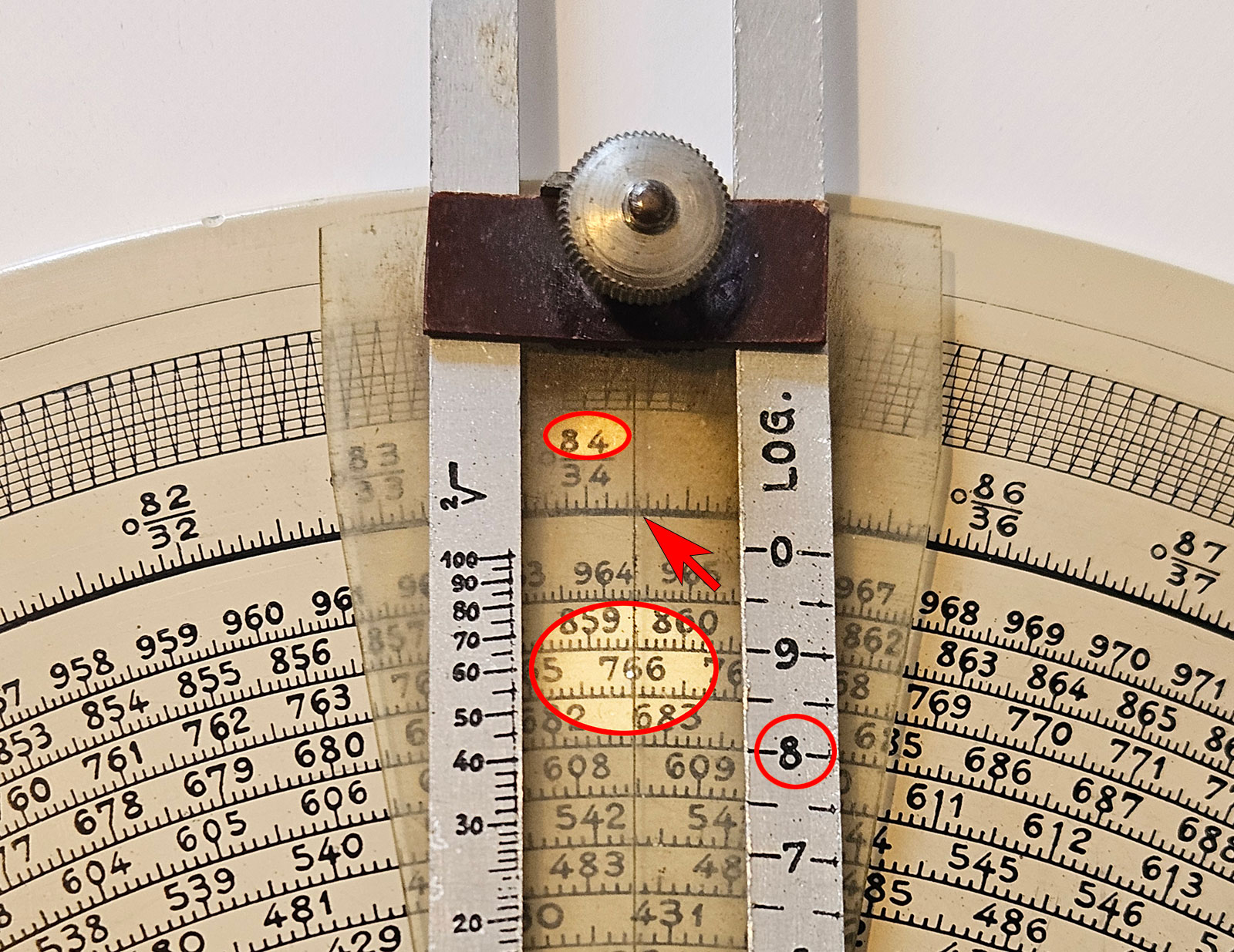
Problem: find the logarithm of 766.
Solution: Having reversed the ruler and fixed it so the LOG scale on it spans the spiral from 100 to 1000, rotate cursor LR so its hairline is on 766.
Result: Read out the mantissa of the log as follows: first digit on the ruler – the digit below the 766, which is 8. Next 4 digits under the LR hairline on the LOG scale at the top, 8423. Thus Log(766) =2.88423, the correct value to 5 decimal places! (The LOG scale showed two numbers – 84 and 34 – which apply to arguments on different halves of the spiral. You can pick the correct one based on the approximate reading on the runner.)
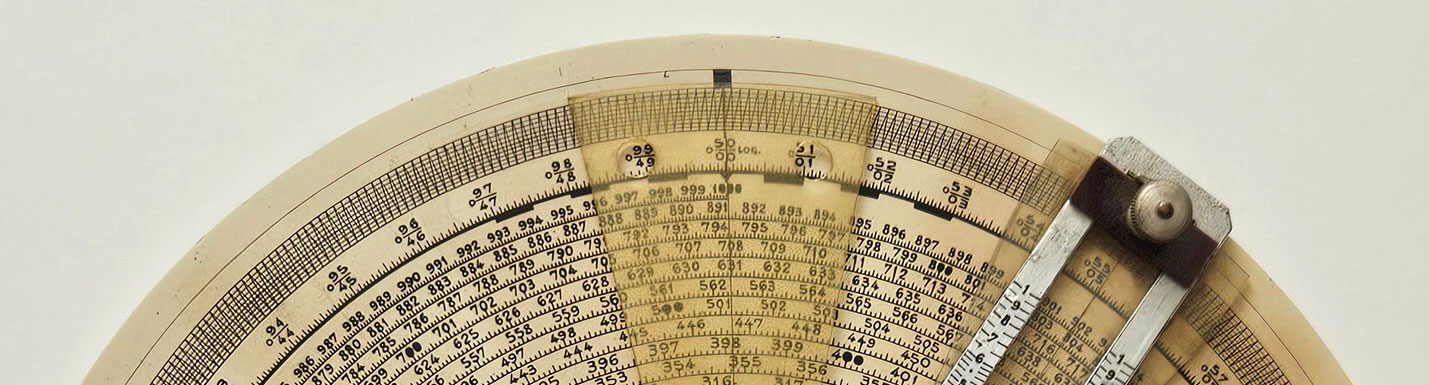
The device also has some other features, seen in the photo below: there is the interpolation scale with the diagonals (which I doubt was used much), and there are the two holes in cursor S whose purpose eludes me. There are also some aids to navigate the spiral: the radius between 100-1000 is marked by the black rectangle at the top of the photo and by black arrows pointing to those two numbers, and the multiples of 100 on the spiral all have their two zeros filled in black, creating a great visual cue.
Then there is provision for the case when the two multiplicands are very near to the spiral ends (the 1000 mark). This will make the two celluloid cursors overlap,and the ruler will add to the clutter. To fix this, the sides of the cursors are themselves radial (their extension crosses the pivot), and the instructions specify pulling the ruler off-center and out of the way and using the edges of the cursors instead of their hairlines. Courvoisier had put a lot of thought into his invention!
Oh, and what’s on the back side? Nothing. Absolutely nothing. But here’s a photo if you want to see for yourself…
The inventor of this unusual slide rule was Monsieur Maurice-Édouard Courvoisier, a Frenchman who applied for a patent in Paris in 1944 and received it in 1946. The delay was caused by the realities of the German occupation of France at the time of submission, as stated in the patent grant.
Exhibit provenance: a good day on eBay.
More info:
- The French patent and the instructions manual are available on the Photocalcul web site.
- Article by Ed Chamberlain, giving what little information is available on this device. Note that the assertion therein that the patent revises two earlier ones is an error in the interpretation of the French legalese.