
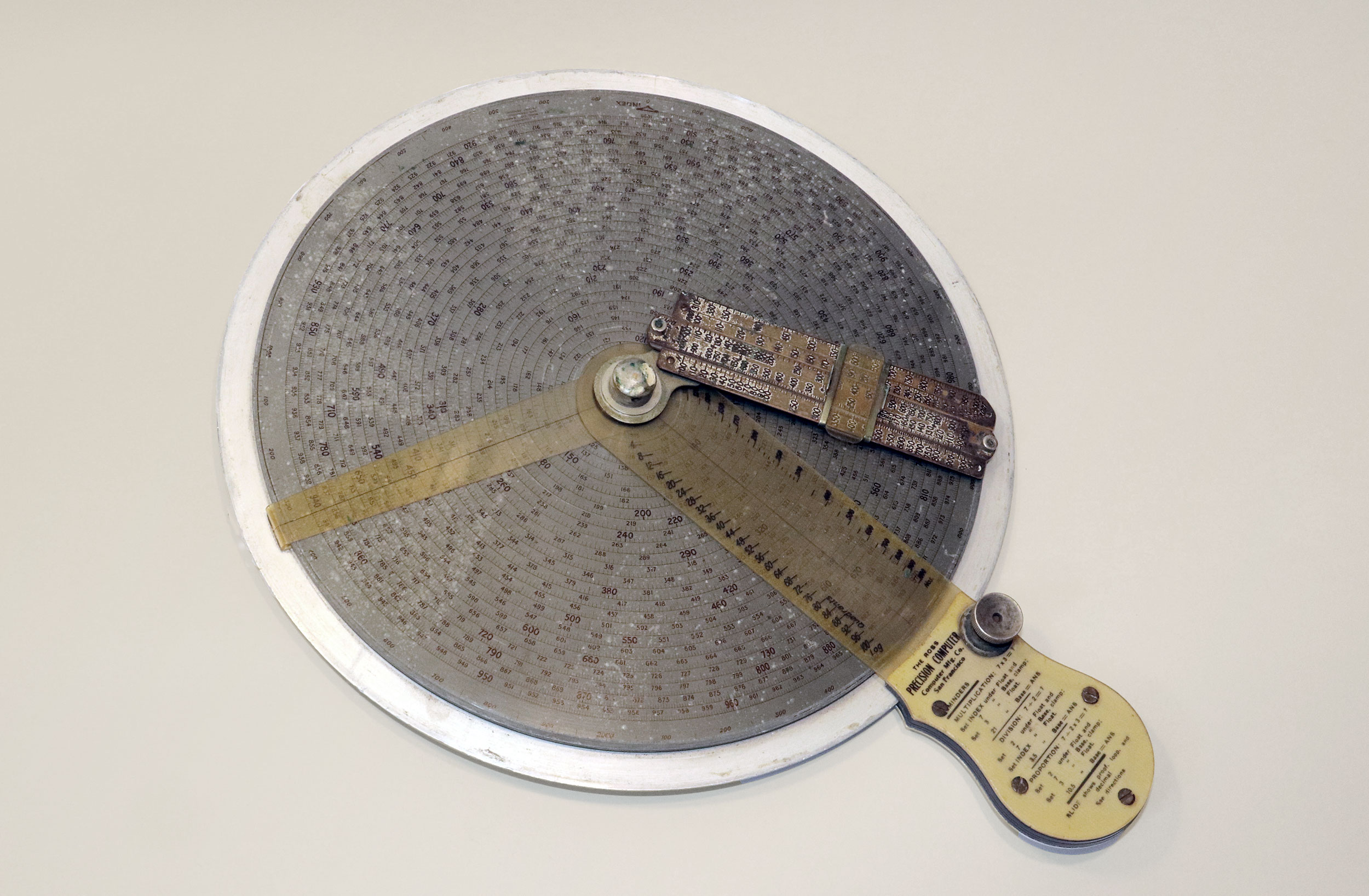
The Ross Precision Computer has every right to its name: it is precise to five decimal places across its entire range. There are other long-scale slide rules of similar capability but they are huge (see my Thacher for example); the Ross can be held in one hand and carried in a briefcase.
The device
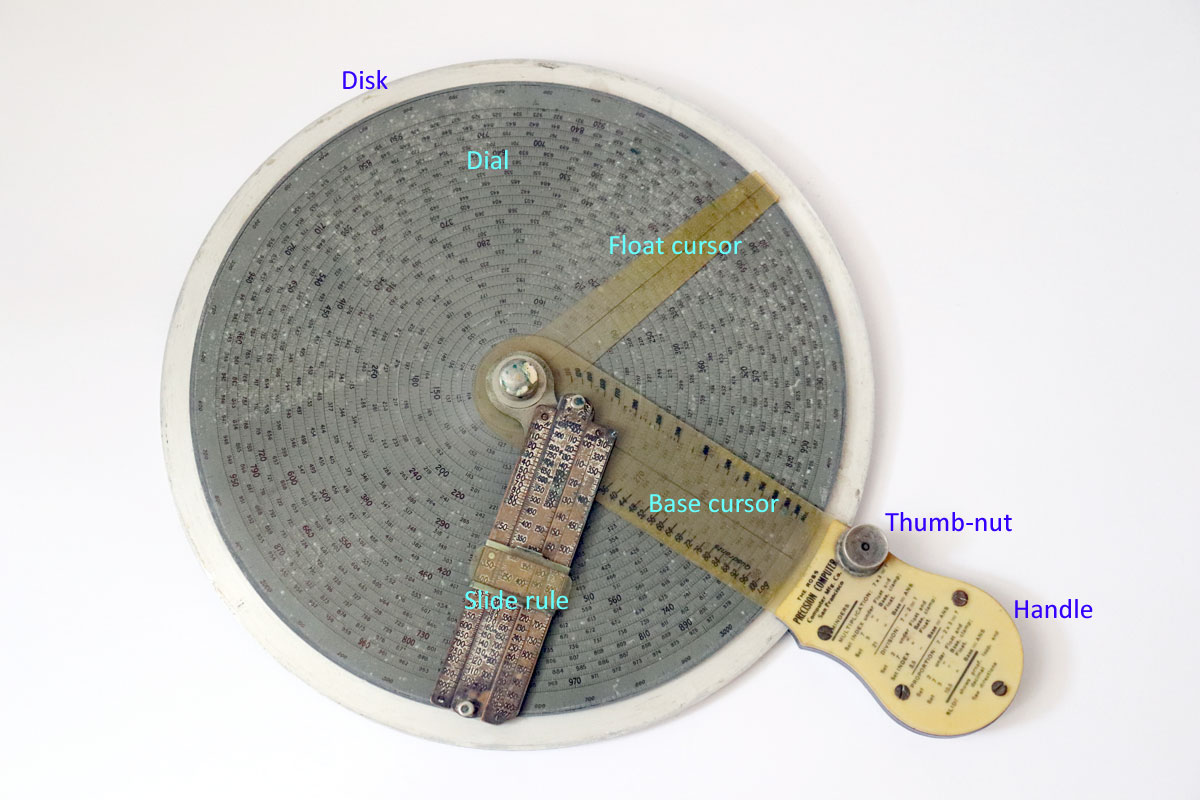
In principle this marvelous device is a spiral slide rule on a disc (called a “Dial” in the instructions) measuring 21 cm across. The spiral scale has 25 turns, and its total length is some 9 meters — small wonder that it gets those five decimal places (a standard straight slide rule has 25 cm scales, and can give you 3-4 digits). However, this is not your usual spiral slide rule, which only has a dial with two radial cursors. It does have the two cursors (a “Base cursor”, which is fixed to a handle, and a skinnier “Float cursor”), but it also has a “Disk” behind the dial, and a small straight slide rule; all these elements rotate independently around a central pivot, except for the float cursor that is fixed at its far end to the rim of the Disk. These parts are identified in the image below.
And more details:
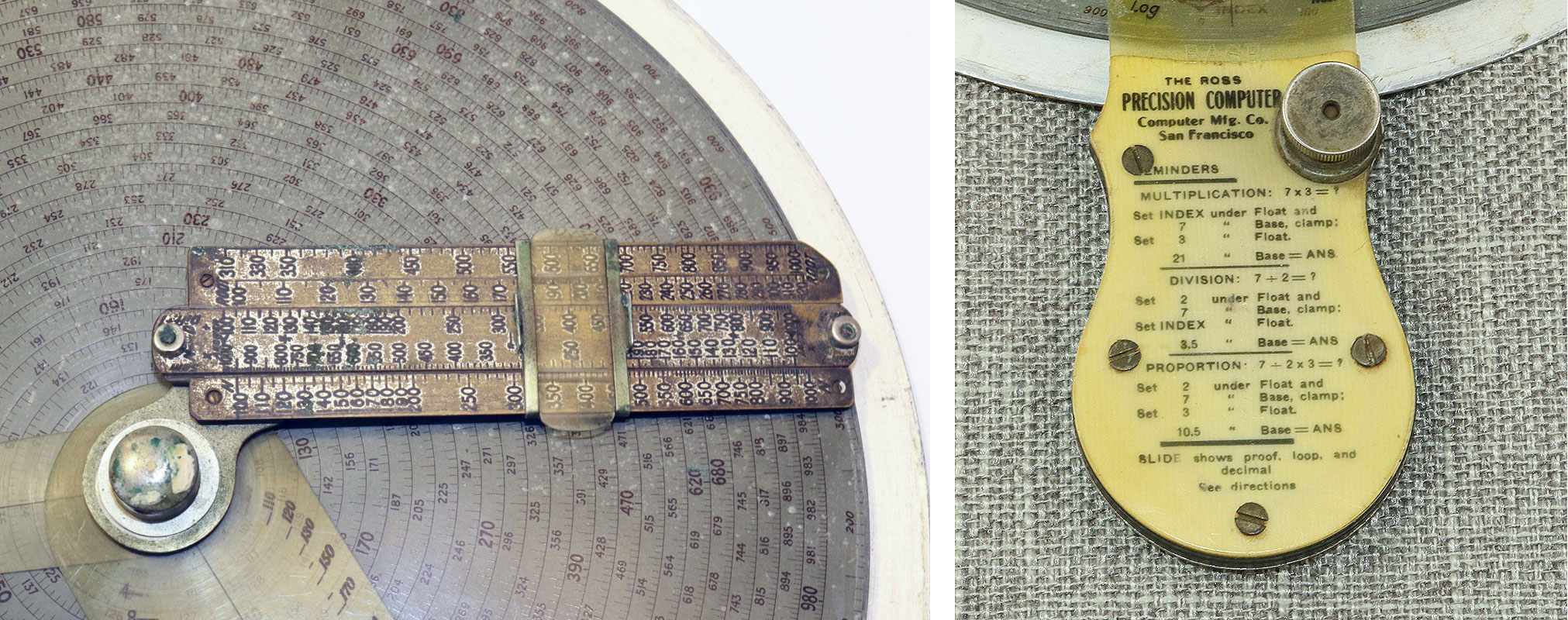
Unfortunately, Louis Ross’s materials science expertise was not up to his design prowess. Most Ross computers surviving today suffer from heavy corrosion due to poor choices of metals and finishing techniques. The problem is that the dial is usually made of enamelled “pot metal” — a cheap alloy known for its inferior quality. The enamel, as well as the white coating on the small slide rule, tend to pit, discolor or wear off. The unit seen here is actually in good shape compared to most; I’ve seen others where corrosion has rendered the scales entirely illegible. Rarely the dial was made of stainless steel or brass, which have survived in better shape, but such units are as rare as hens’ teeth (here is one).
Usage
To illustrate how the Ross Precision Computer works, here is a step by step multiplication example:
Problem: calculate 1.841 x 3.25.
Step 1: Rotate the dial to bring the “Index” arrow at its rim (which is located at the outer end of the spiral scale) under the hairline of the float cursor. Note that to rotate the dial you can grab it between thumb and forefinger, putting the latter through any of the three large cut-outs in the back of the disk.
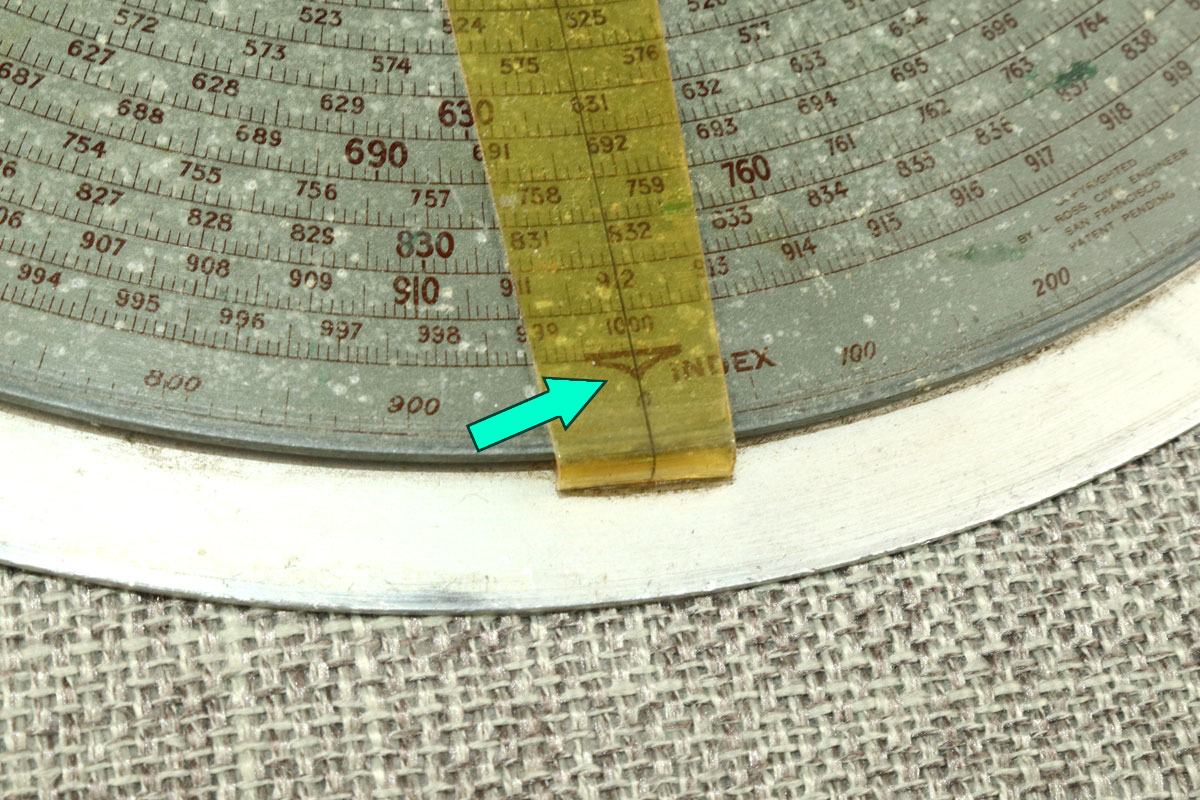
Step 2: rotate the base cursor by (moving the handle) to bring 1841 on the dial under its hairline. The labels at the right edge of the base cursor help identify the correct spiral turn.
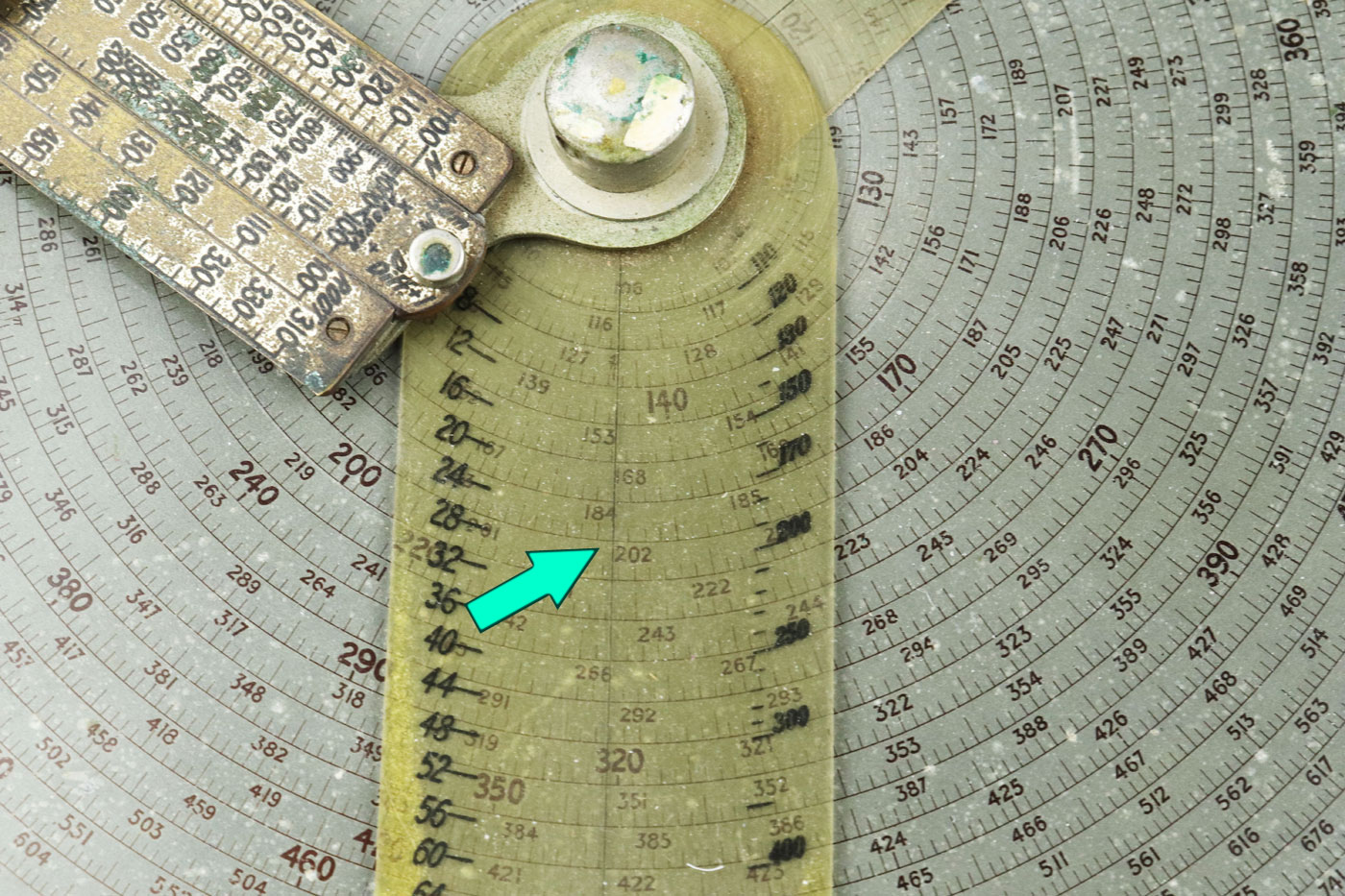
Step 3: tighten the thumb-nut to lock the base cursor to the back Disk. This fixes the angle between the two cursors, since both are now connected to the Disk’s rim.
Step 4: rotate the dial to bring 3.25 under the float cursor hairline.
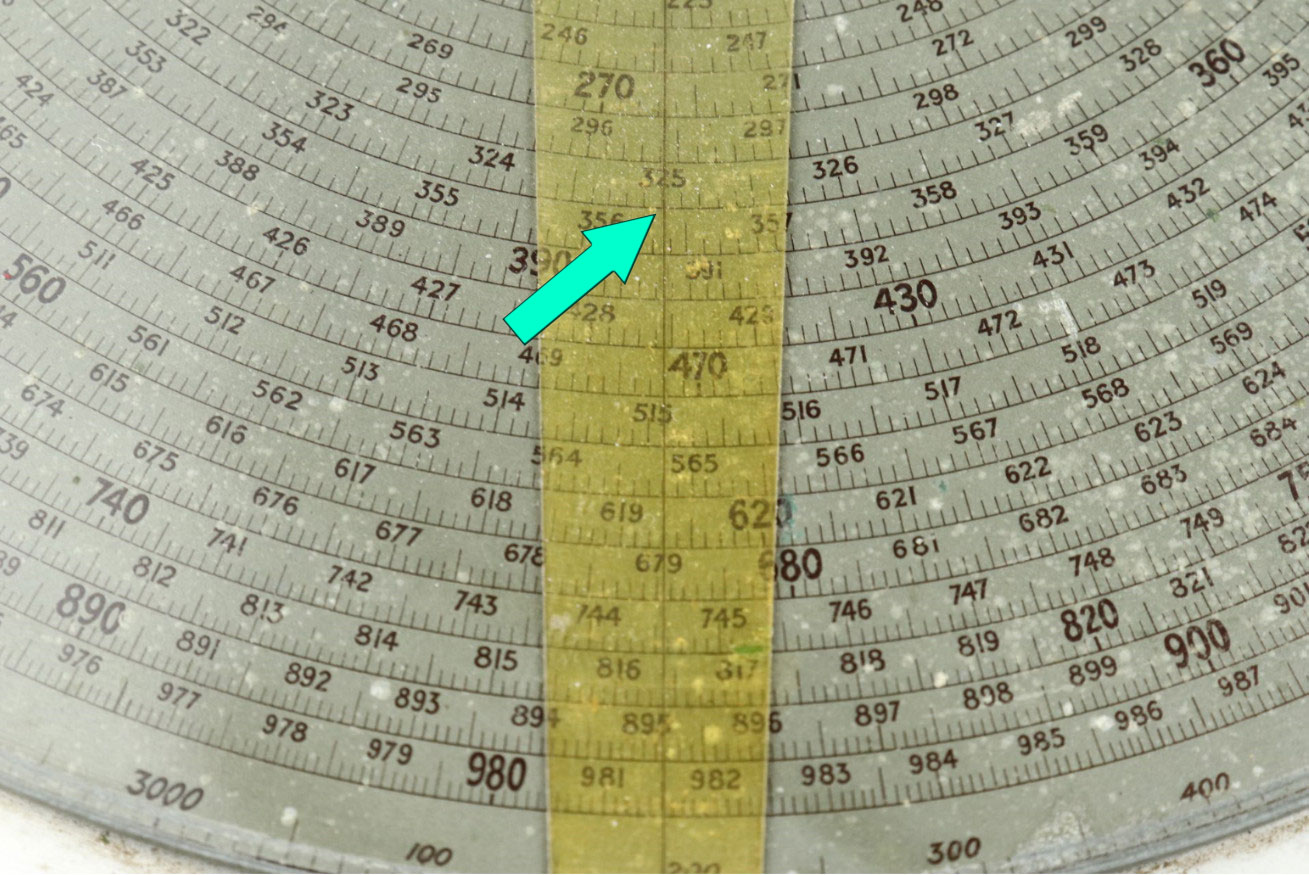
The answer is now under the hairline of the base cursor… but on which spiral turn?
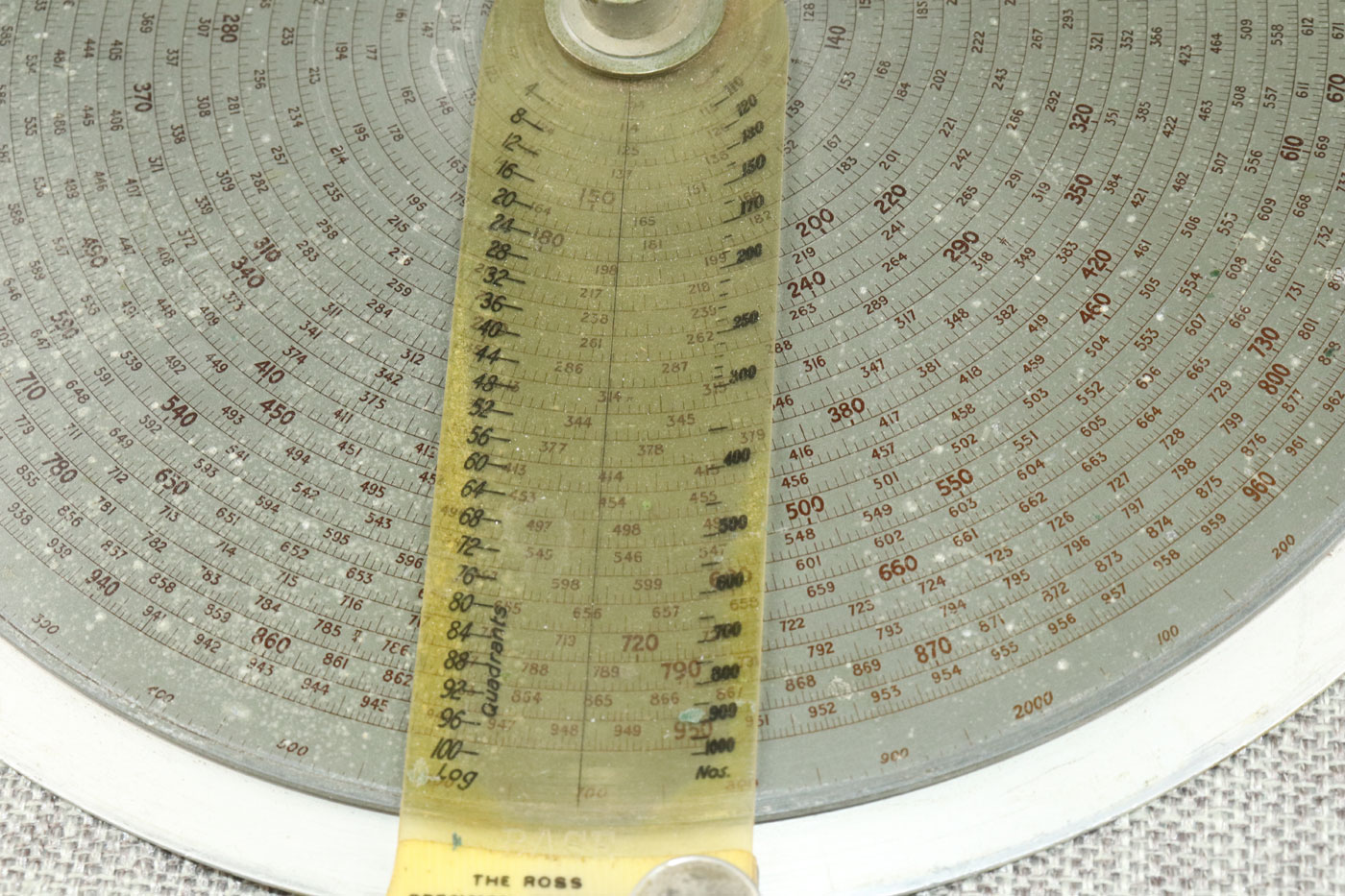
Step 5: Use the small slide rule to calculate the approximate answer. You do this by moving its slide so the 1841 on the slide’s left scale is at 325 on the scale next to it on the rule’s stock. The result, a tad less than 600, is read on the stock opposite the arrow marked “Answer” on the slide’s bottom end (the arrow is wedged between 100 and 1000). There are two “Answer” arrows at the two ends of the slide, so one is always pointing at the scale on the stock).
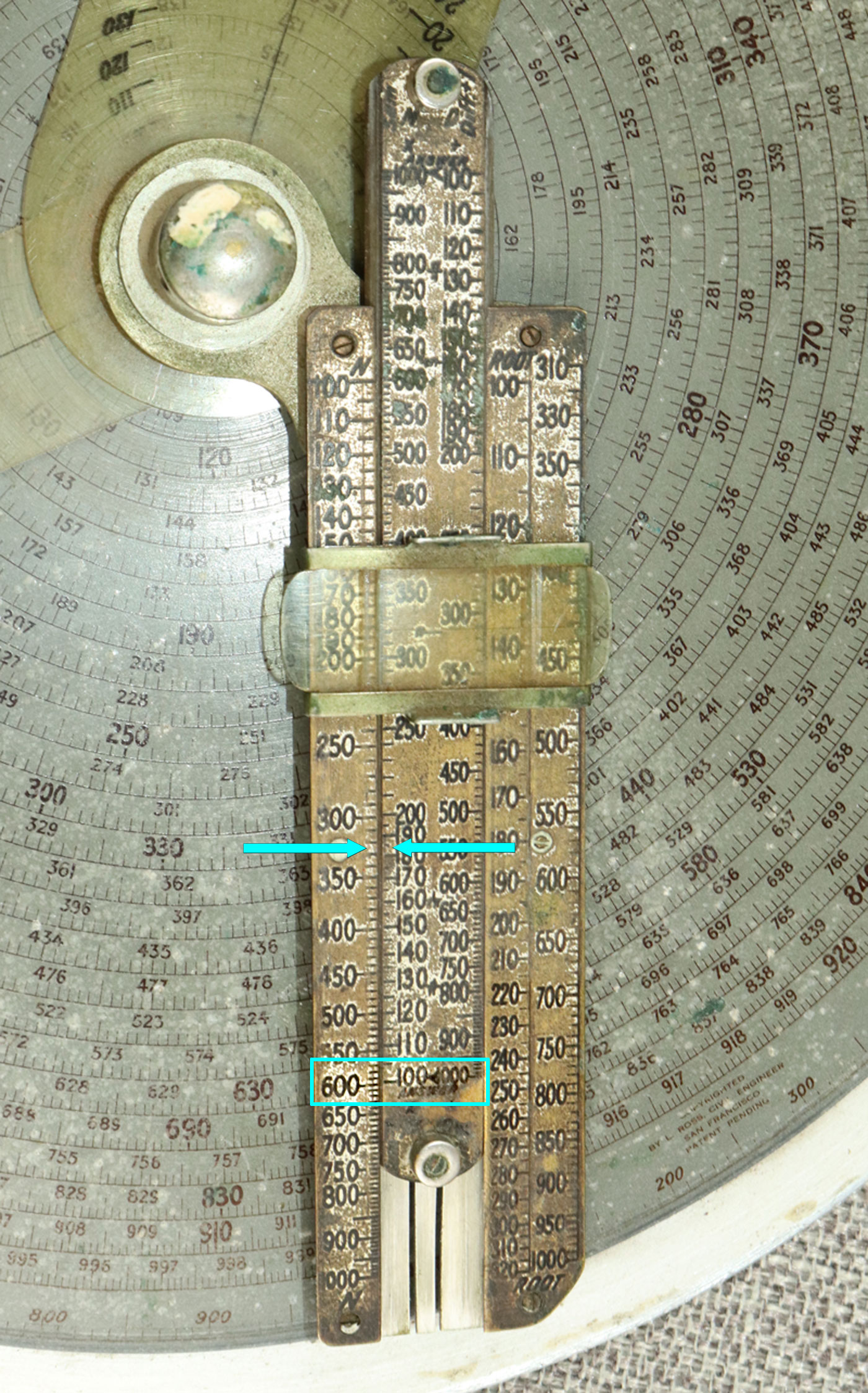
Step 6: Move the small slide rule to the right of the base cursor. The precise answer appears under the base cursor’s hairline in the spiral turn pointed at by the aforementioned “Answer” arrow: 59835. This is a good approximation of the exact value: 3.25 x 1.841 = 5.98325000. This isn’t quite the advertised five digits precision, but it’s pretty close.
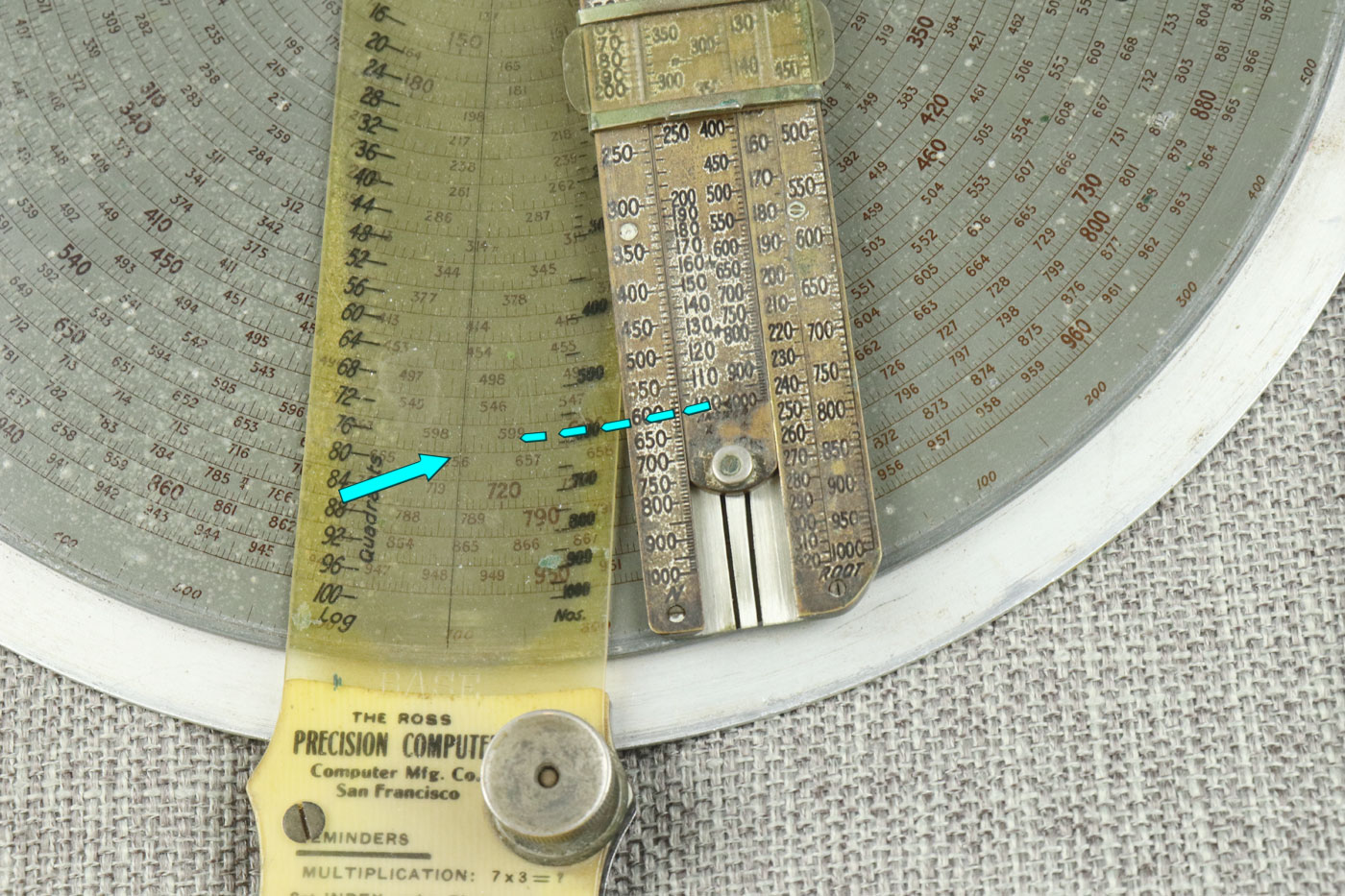
If you followed this, you can see the ingenuity of Ross’s invention. All spiral slide rules use the two radial cursors, and give the answer under a hairline in one of them; but they don’t tell you which spiral turn to read it on. The little linear slide rule on the Ross device solves this problem by pointing directly at the correct turn on the main spiral.
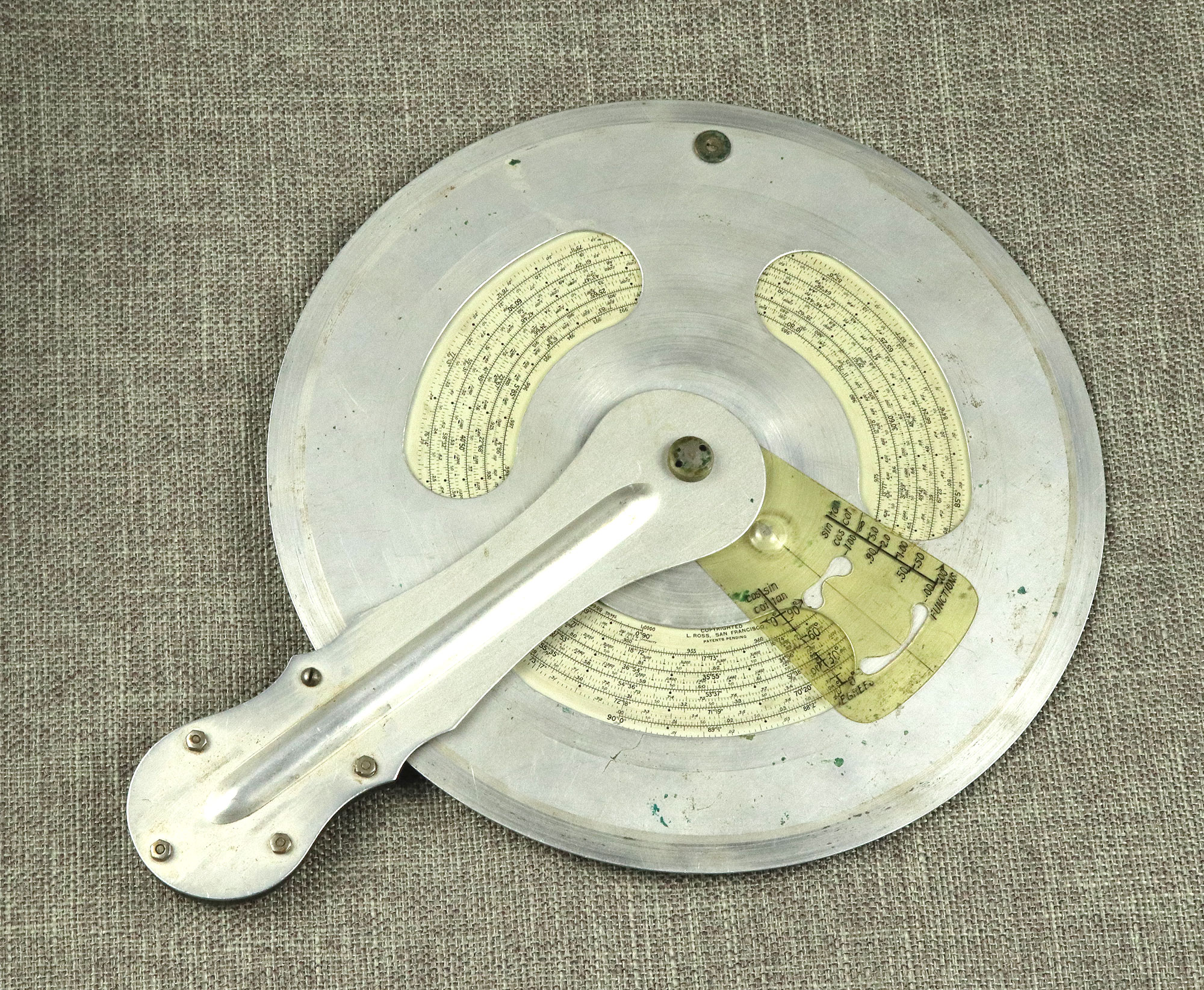
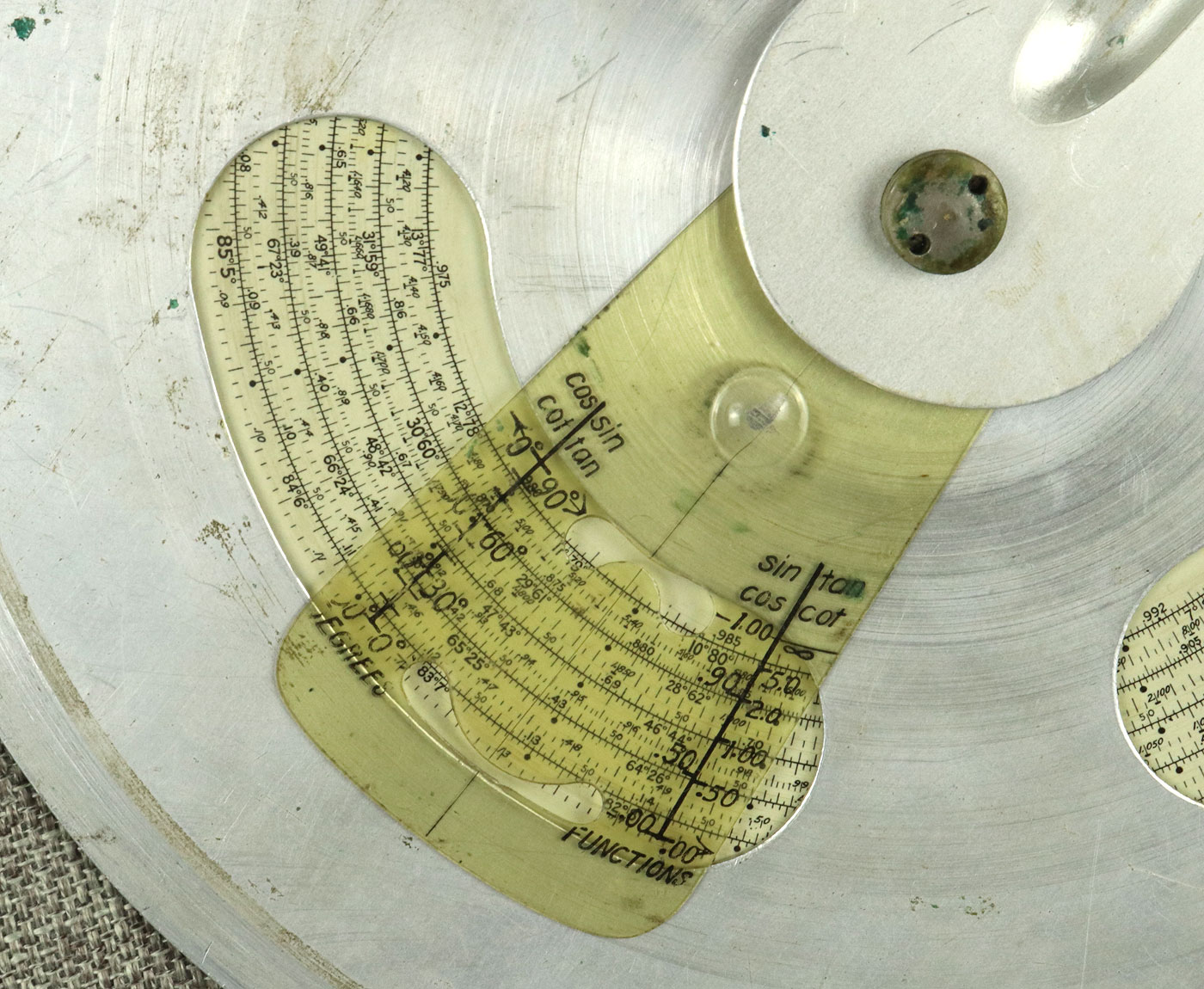
Division is done in a manner similar to the above, with minor changes. Trigonometric functions of angles are presented along a five-turn spiral on the back of the device, as seen in the photos below. Five place logarithms are calculated using the “quadrant” scale at the left of the base cursor together with the scale on the outer rim of the dial. You can read the manual if you want the details.
The inventor

Louis Ross (pictured) was born in the Ukraine in 1879 and immigrated with his family to the USA in 1892. He attended Harvard College and graduated in civil engineering. In addition, he taught Harvard courses in Applied Mechanics. He worked as a surveyor for the United States Geological Survey and in 1907 opened a practice as surveyor and civil engineer in San Francisco. In 1911 he was appointed a US Deputy Surveyor, and in parallel he started to develop his slide rules. In the next few years he introduced a number of models, and in 1915 he established the Computer Manufacturing Company in downtown San Francisco, though it seems likely that he was its only employee. The Precision Computer shown here came out in the same year. Ross continued to make his slide rules until about 1928, when he shut down his company and returned full time to his original civil engineering and land surveying profession.
Ross took his device seriously — the manual goes into great detail, and includes advice on how to improve one’s “personal accuracy” by eliminating interpolation biases through a series of tips and exercises.
Exhibit provenance: eBay.
More info:
- Edwin J. Chamberlain, The Ross Precision Computer, Journal of the Oughtred Society Vol. 25, No. 1, 2016 Pg 10
- Edwin J. Chamberlain, A Biography of Louis Ross, Journal of the Oughtred Society Vol. 25, No. 1, 2016 Pg 29
- The manual of the Ross Precision Computer, and some additional content, is available courtesy of the Oughtred Society here.
- See this article for another spiral slide rule with a different turn indicator concept.