
An unusual Soviet power station operating chart
Here is another one of those flea market finds that you buy on faith: you have no idea exactly what they are, but they’re weird enough to catch your interest, and you hope you’ll be able to figure them out later. In the case of this one, it took some effort…
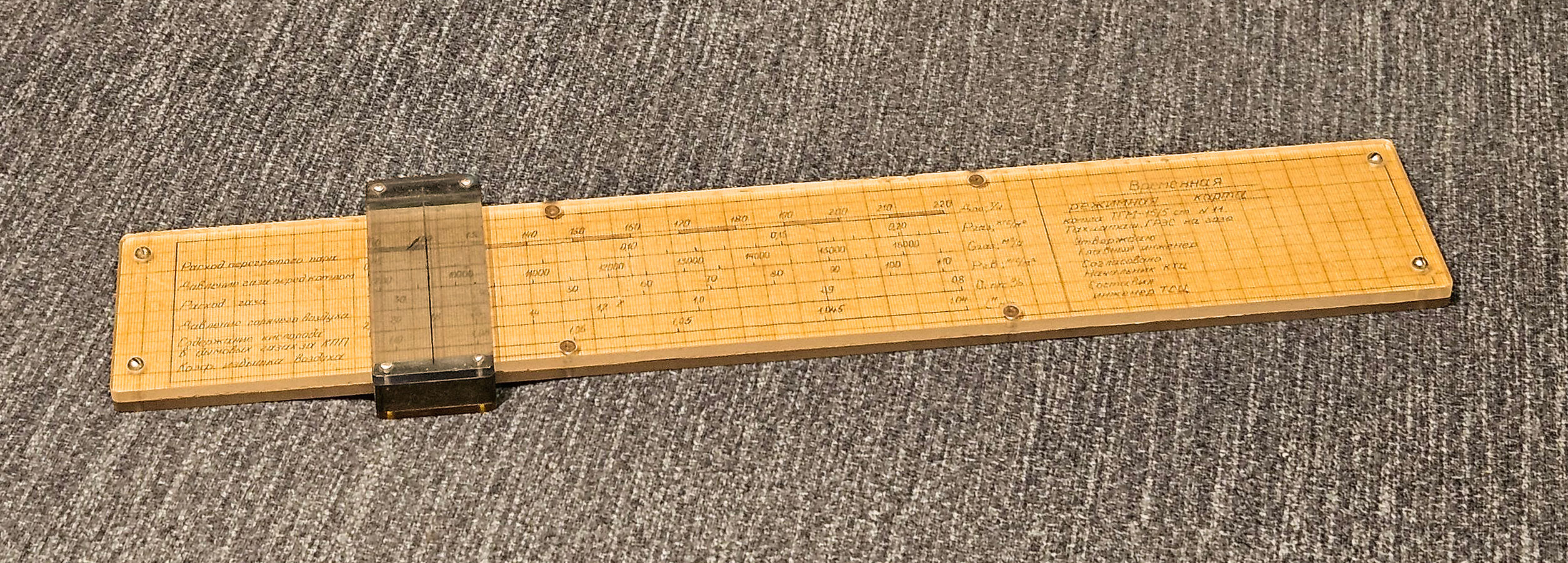
This isn’t even a proper slide rule. It is a rule (a hefty one, 45 x 8 x 1 cm excluding the cursor), it has numerical scales, it has a cursor – but it lacks a slide. The front has six scales and a block of text; the back is all text, but text in Russian script that I couldn’t read. What I could easily see, however, is that it’s handmade – scales and text are meticulously hand drawn (in pencil, it seems) on millimetre-ruled graph paper that is sandwiched between two thick acrylic sheets (what in the West we call Perspex or Plexiglas). Below are the front and back of this rule.
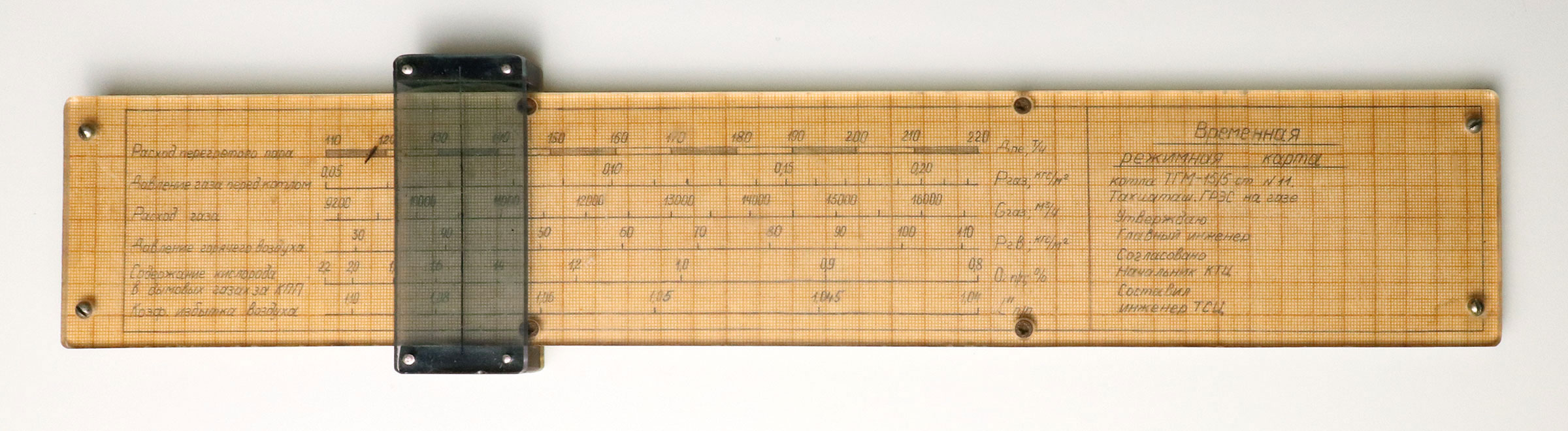
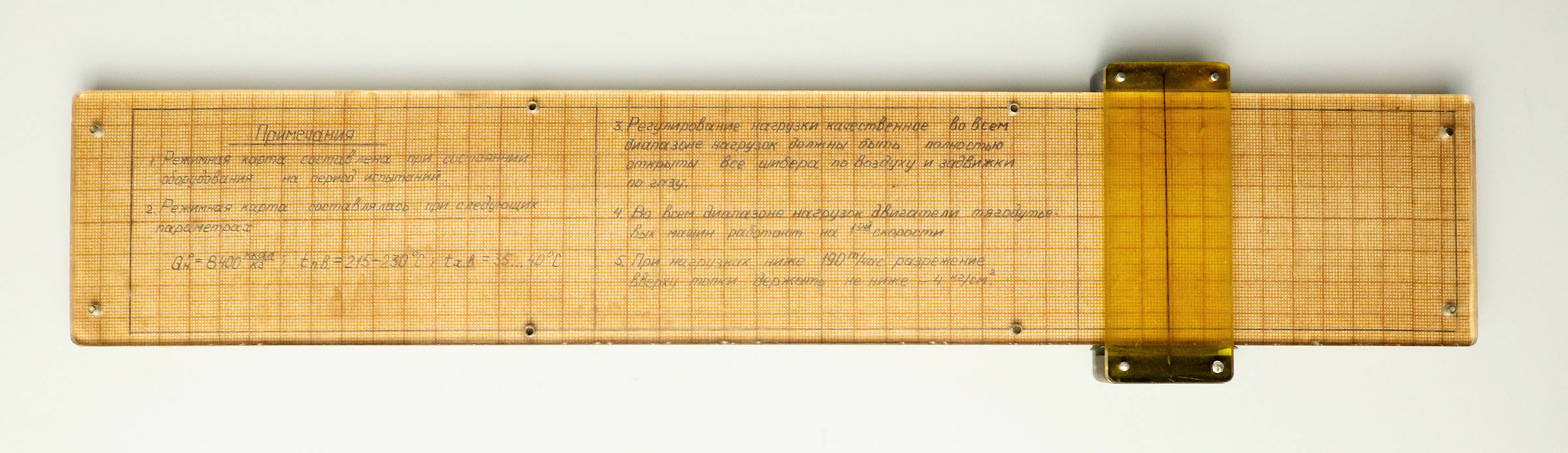
If you want to have a go at deciphering the texts, use the enhanced-contrast versions here and here. For my part, I asked a Russian-speaking friend to translate, did some further research, and as far as I can tell here is what the rule says:
Front of rule – scale captions (top to bottom)
- Heated steam consumption
- Gas pressure before the boiler
- Gas consumption
- Hot air pressure
- Oxygen composition in the exhaust gases after the control unit
- Excess air coefficient
Text block at right of scales
Temporary operating regime chart
- of boiler TGM-15/5 ct N11.
- Takhiatash State District Power Station gas-fired operation
- Approved by Chief Engineer
- Reviewed by Head of the Boiler-Turbine Department
- Written by Thermal Department Engineer
Back of rule
Notes
- The operating chart was written based on the actual condition of the equipment during the trial.
- The operating chart was written according to the following parameters:
QHP = 8400 kcal/kg; tn.B. = 215–230 ºC; tx.B = 35… 40 ºC - Load control is qualitative. Throughout the entire load range, all air dampers and gas valves must remain fully open.
- Throughout the entire load range, the draft–fan motors operate at first speed
- At loads below 190t/hour, maintain a furnace-top draft not less than 4 kg/cm².
I was never into power station engineering, but I’ve done my stint as a process engineer at Intel; this language is not entirely alien to me. So here is what I can deduce from it:
- This is an operating regime chart. It specifies the required operating parameters of a gas-fired boiler in a thermal power station, under various load conditions. For any required steam output, it allows the operator to read the corresponding fuel and air supply parameters and the expected combustion conditions directly from the aligned scales.
- Interestingly, it is not part of the boiler’s instruction manual provided by its manufacturer; it was created by running a trial of the equipment and recording the various parameters under different conditions. The resulting chart would be used to control the boiler in future normal operation, so it would need to be correct; hence the stated approvals by engineering and management.
- Given that its function is primarily for lookup rather than computation, it is interesting that they produced this chart as a (kind of) slide rule, rather than just a chart on paper, or a nomogram, or even a lookup table, which would’ve been the conventional way of doing it.
Speaking of this slide rule: it is very well-built and pretty much indestructible. I conjecture that the plant had many of these charts – one for each boiler, and possibly updated ones made at regular intervals. So perhaps they had the Perspex plates produced in quantity by a machine shop (the tapped and countersunk screw holes are exactly what such a shop would produce), and when a new chart was drawn they’d just fit it between two of the plates. The graph paper strips may also have been prepared in quantity, because the one on the back is divided in three panes, one of them left unused. The resulting device is overly massive, reflecting the sturdy workmanship of industrial machinists, as opposed to the finesse of slide rule makers.
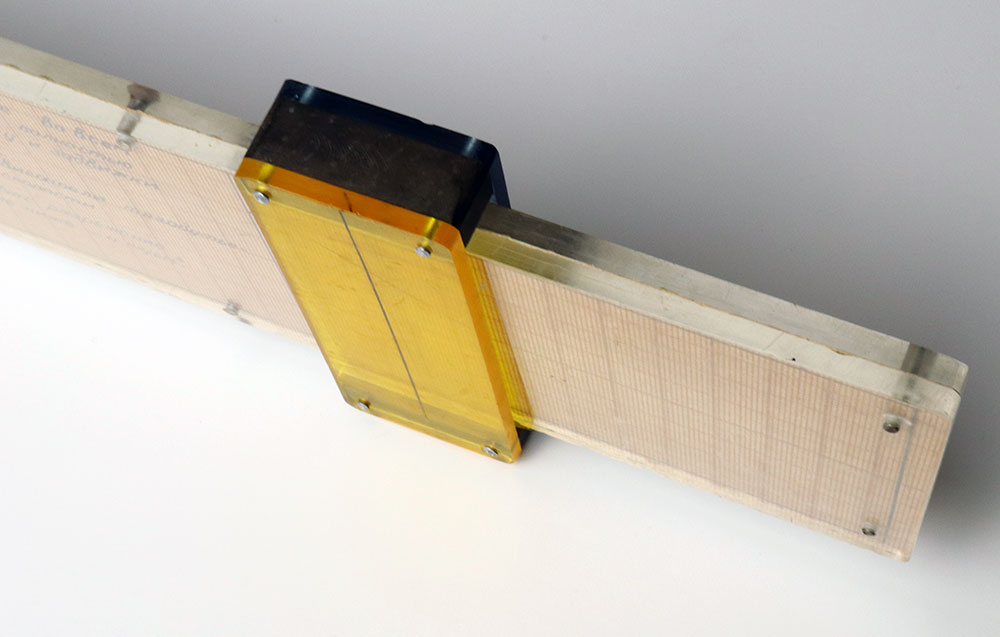
This leaves the matter of the cursor, which is also way too massive. It has hairlines on both sides, which is redundant on the scale-less back; and the side that is used with the scales is smoky gray, a poor choice, especially when the other side is a lighter shade of orange. Still, it did the job, which is to find corresponding values on the six scales.
And the nicest bit is that I can’t tell when this item was made (probably in the 1960s or 70s), but I know exactly where it was made and used: in the Takhiatash GRES (State District Power Station), which is located in Takhiatash, a city in Karakalpakstan, an autonomous region of Uzbekistan. This station was commissioned in 1956 with a 100 MW capacity, and was upgraded repeatedly over the years; today it is producing 730 MW, and looks quite impressive in this photo:

Photo credit: Jahanbaev via Wikimedia Commons
And I wonder – how did this chart get from a remote town in Soviet Uzbekistan to a flea market in Israel? Perhaps the unnamed Thermal Engineer who drew the chart, or one of the technicians in the Boiler-Turbine Department, immigrated to Israel after the fall of the Iron Curtain, and brought this as a memento of their career. And then, in the way of the world, a time came when the engineer’s heirs saw no further use for it and sold it. Be that as it may, I’m glad I bumped into it, thus allowing it to remain in the hands of an appreciative engineer.
Exhibit provenance: the Giv’on square flea market, Tel Aviv.
More info: I wish I had some!
Hi Nathan,
Seems to me it is a close relative to this KHH wasserchemicer from at least a decade or 2 prior. https://www.vintagemanstuff.com/product/khh-wasserchemiker-steamboiler-syst-dr-janssen-slide-rule-1930-germany/. Aimed at making the work for the engineer easier when performing calculations “under high pressure”…no time for mistakes…get the rule!
Hi Kevin,
I’m afraid the description you have on vintagemanstuff is in error… the KHH rule is a specialized slide rule for quality control of boiler water in steam generators, notably regarding the mineral content of the water. Interesting device indeed, if unrelated to my Soviet chart.