
When you take a slide rule out of its box, you are treated to a marvelous sight of multiple intricate scales, numbers and captions. The one exception is the Otis King slide rule: open its little box, and you see a short metal cylinder, half chromed, half painted black. No scales, no numbers… just plain bland surfaces.
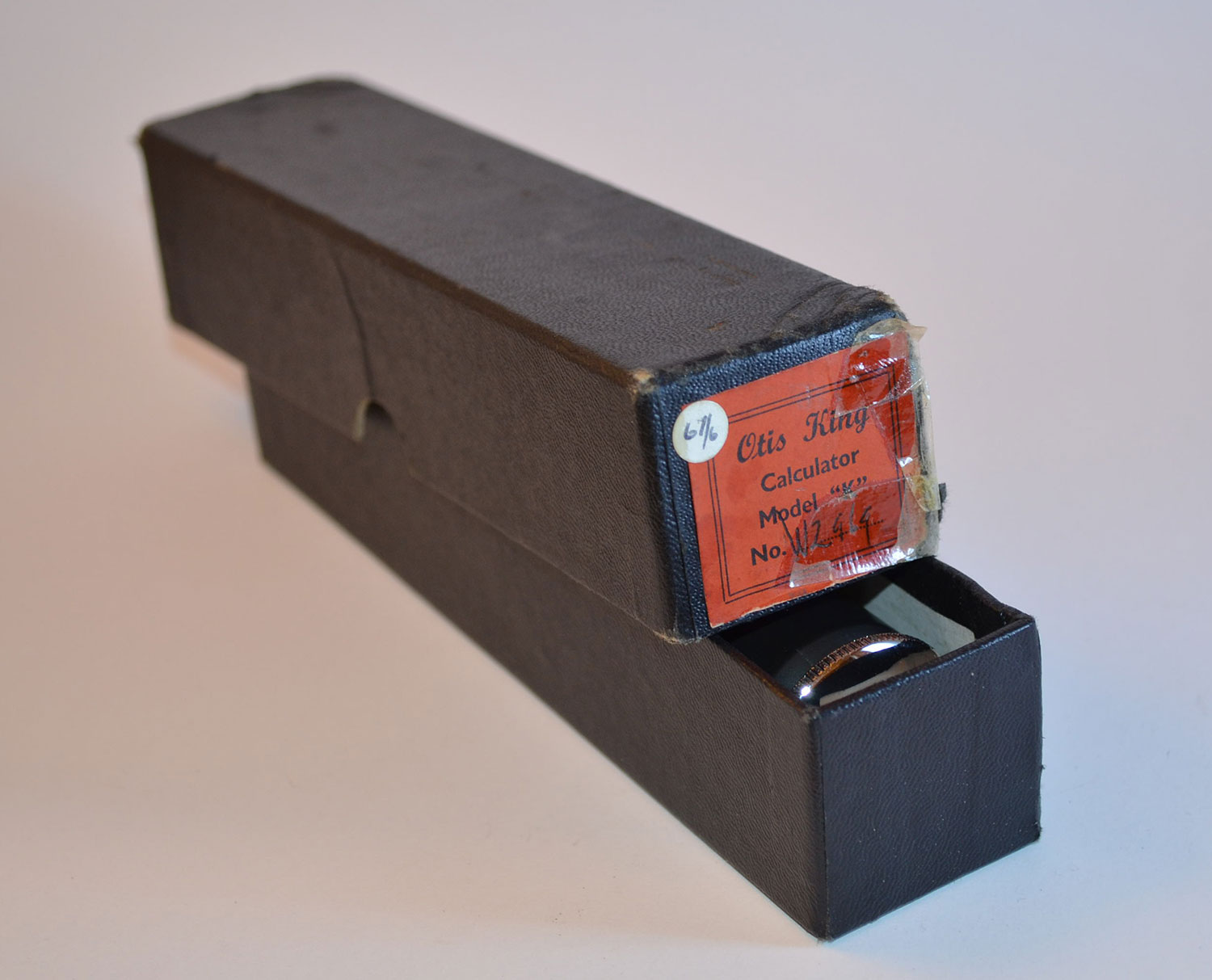
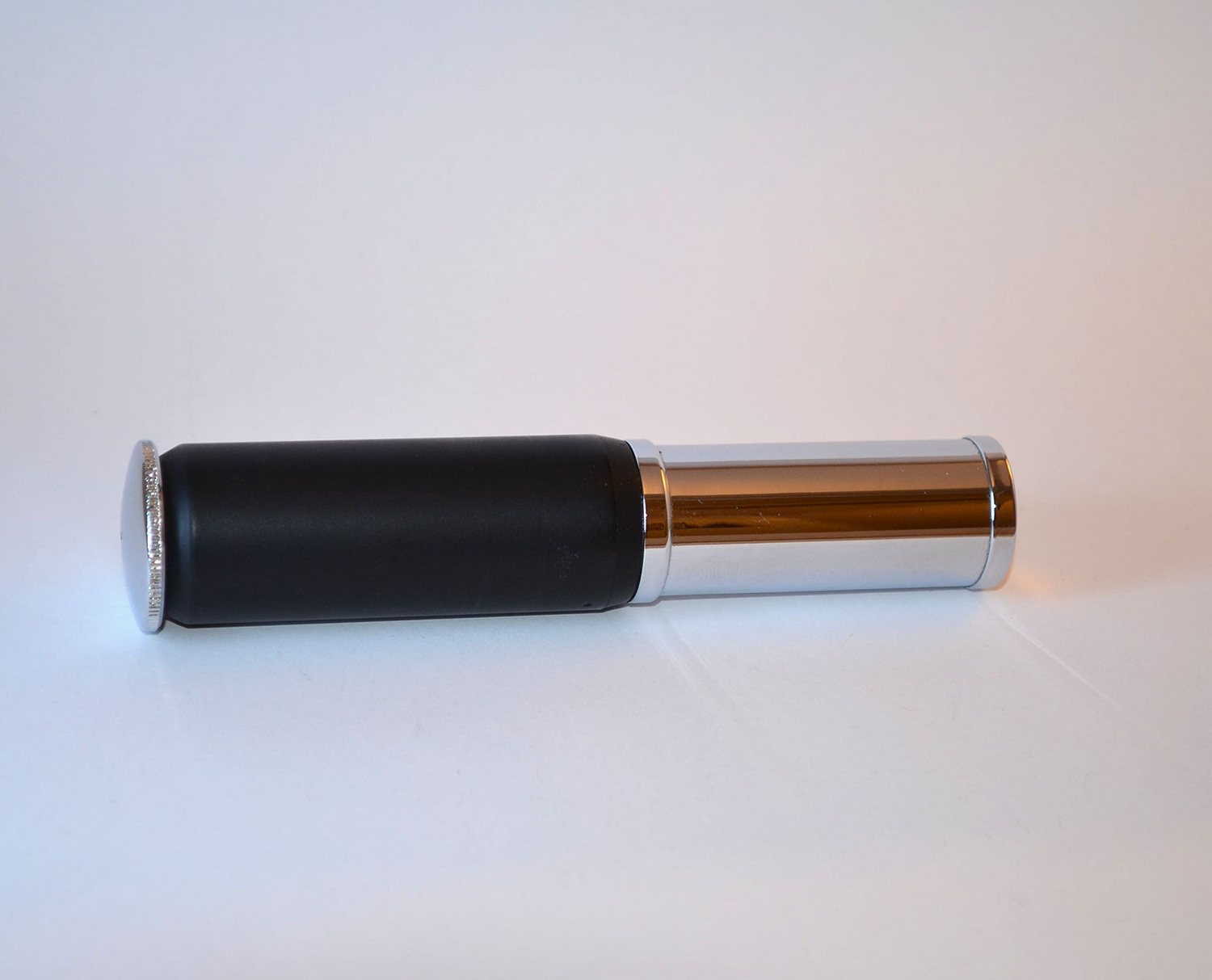
Until you grab the two ends and pull. When you do that, you definitely get treated to scales and numbers…
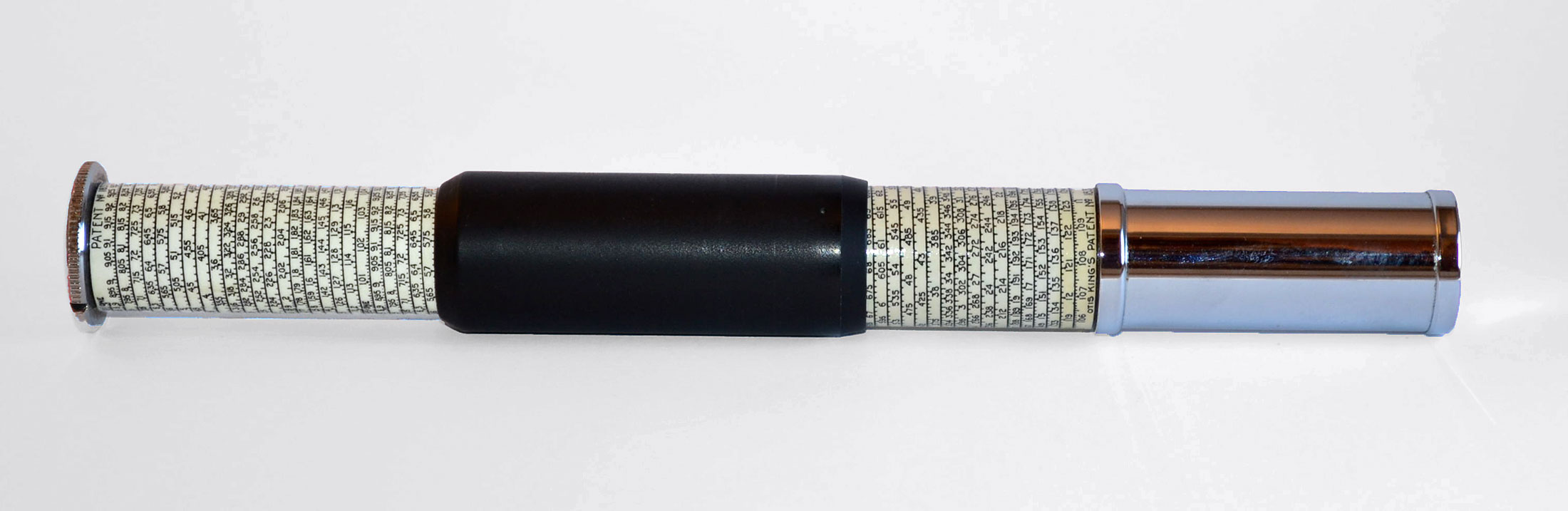
And quite a lot of them – in fact, the scales that are wound tightly around the two cylinders total 503 cm in length!
The Otis King calculator is composed of three tubes that telescope together: two – with scales – that can be pulled in and out of each other (the lower one, at the right in the photos, ends with a chromed handle), and a cursor with two index marks at opposite ends that can slide over them both. Here are two extreme states of the device:
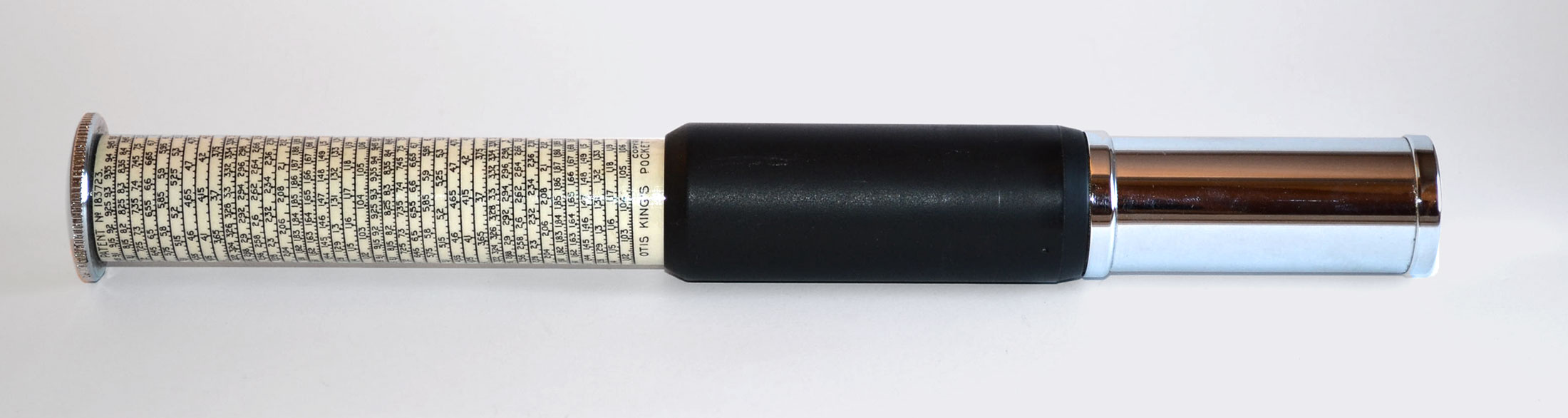
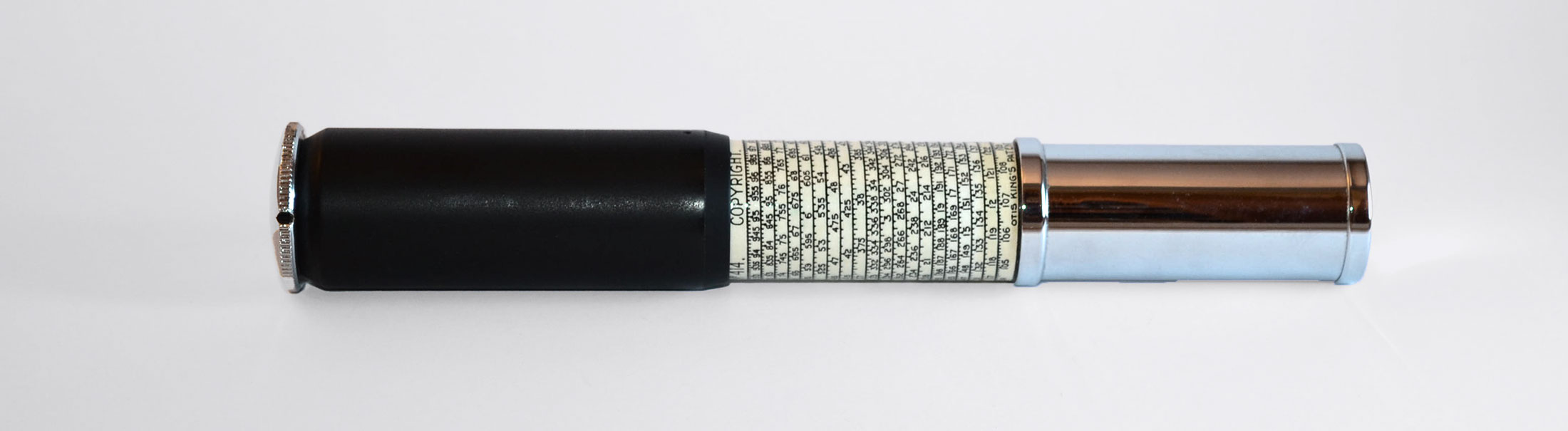
The scale on the top part consists of two logarithmic cycles, and the one on the bottom has a single cycle; each cycle covers a length of 66 inches. The scales spiral around the cylinders, which is reminiscent of the R. H. Smith slide rule, or the Lafay Hélice a Calcul; but where those devices have one helical scale and two independently moving cursor indices, the OK has two independently movable scales and a single cursor with two fixed indices.
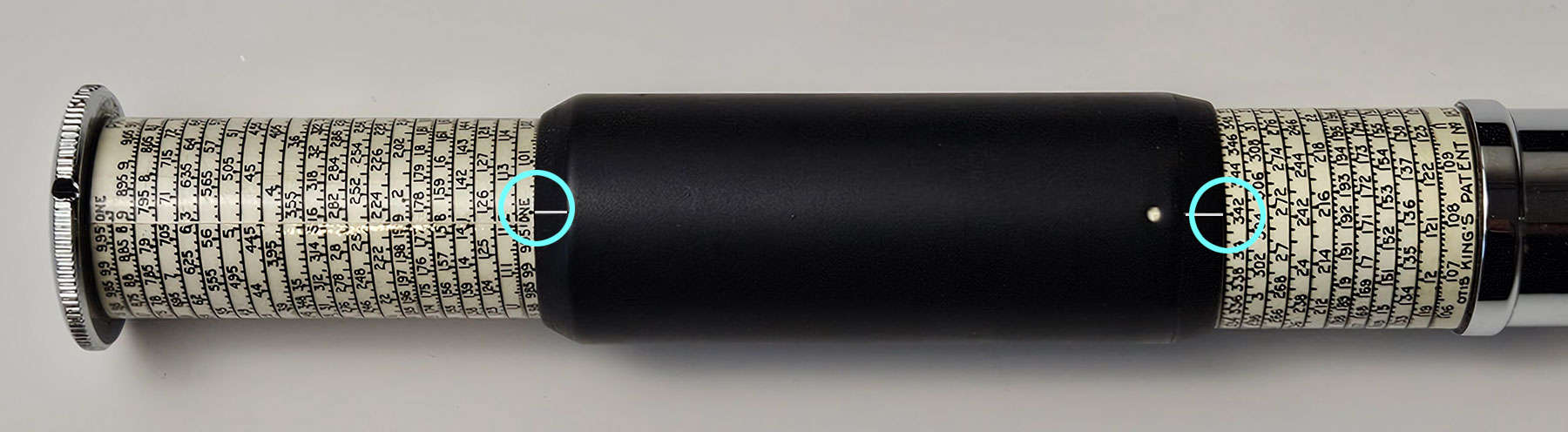
Using the Otis King is fairly simple, once you get the hang of it. For example, to multiply 342×195, you first point the bottom index of the cursor (remember, in my photos bottom means right hand) next to 342 on the bottom scale, and then set the top index of the cursor to the ONE at the center of the top scale:
Next you grab the device by its handle and move the cursor so its top index rests at 195 on the top scale:
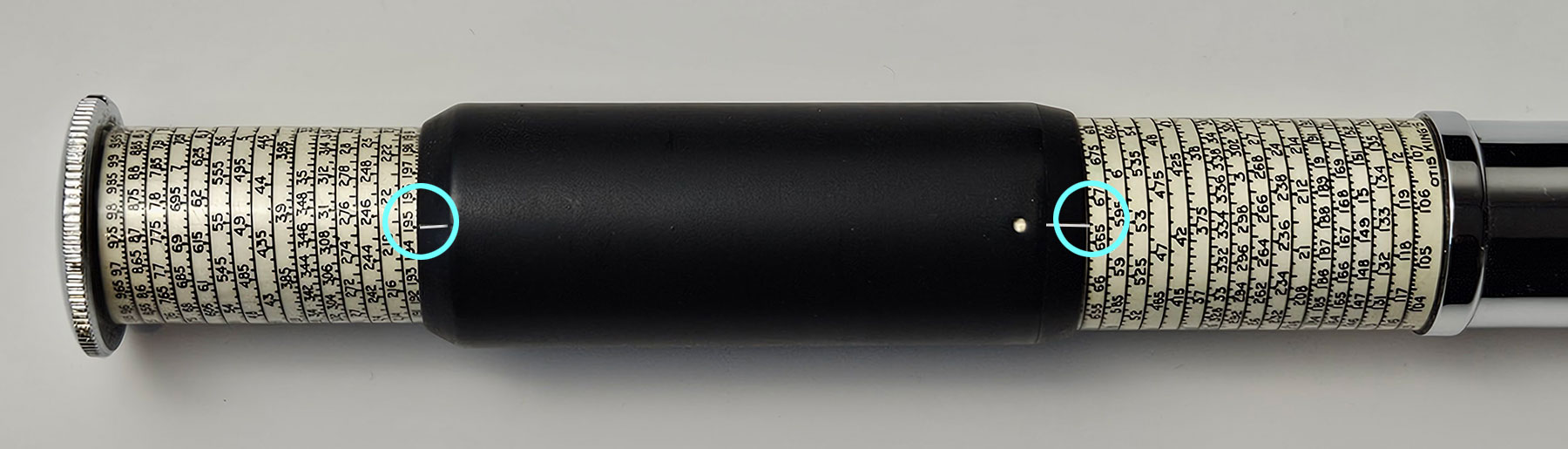
The answer can now be read at the bottom index of the cursor on the lower scale, and as you can see it is 6669 (as on all slide rules, the decimal point is not accounted for – the correct answer is 66690). Division is done in a reversed procedure, naturally. Admittedly the last significant digit of the result is hard to discern with certainty, but you can get 3.5 to 4.5 digits of accuracy, depending on which end of the scale you’re at – quite good for a device that can fit in a pocket.
The internal structure of this deceptively simple device is quite ingenious; the key is to control the friction between the parts so the two scales stay put when the cursor is moved over them. You can see the details here.
Otis Carter Formby King (1876-1944) patented this slide rule in the UK in 1921, and it was manufactured by Carbic Ltd. of London until the early 1970s. It was quite successful, with over 100,000 made, and came in many variants that differed in scale set (some have a linear log scale in addition to the ones shown above), and in minor design details like scale color and cursor finish. The device seen above, Ser. No. W2969, was made in the early 1960s. The photo below shows a second unit I have, which is the only known exemplar of the Type 7 variant, one of the earlier versions with white scales on a black background. It carries Ser. No. B1332 and dates from around 1930.
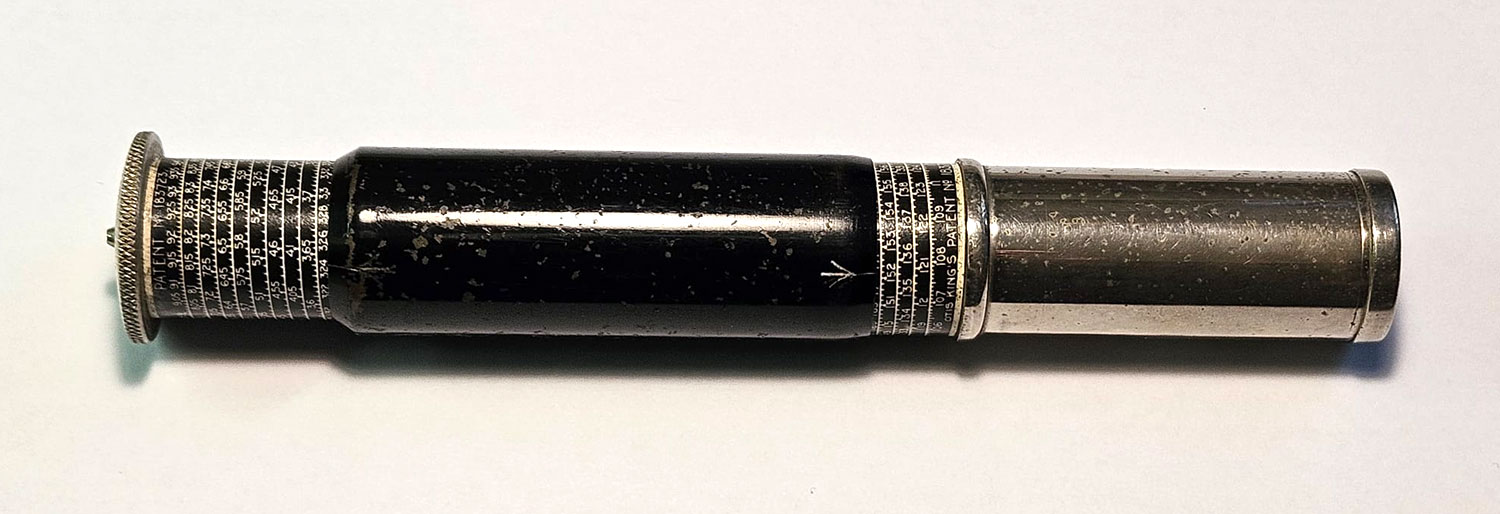
Exhibit provenance:
I don’t remember where I got the first unit; but the second, the older one, was purchased in a collectors meeting in the UK.
More info:
- A wealth of information is available on Jaap’s web site.
- The instructions manual.
- The original patent awarded to Otis King.
Really useful. I have one. I do have the original instructions but extra help is always appreciated.
Glad to be of help, Keith! 🙂