
Confusion… and solution!
The M.T. slide rule does only one task, and it’s a simple enough task; strange, then, how difficult it was for me to decipher its functionality.
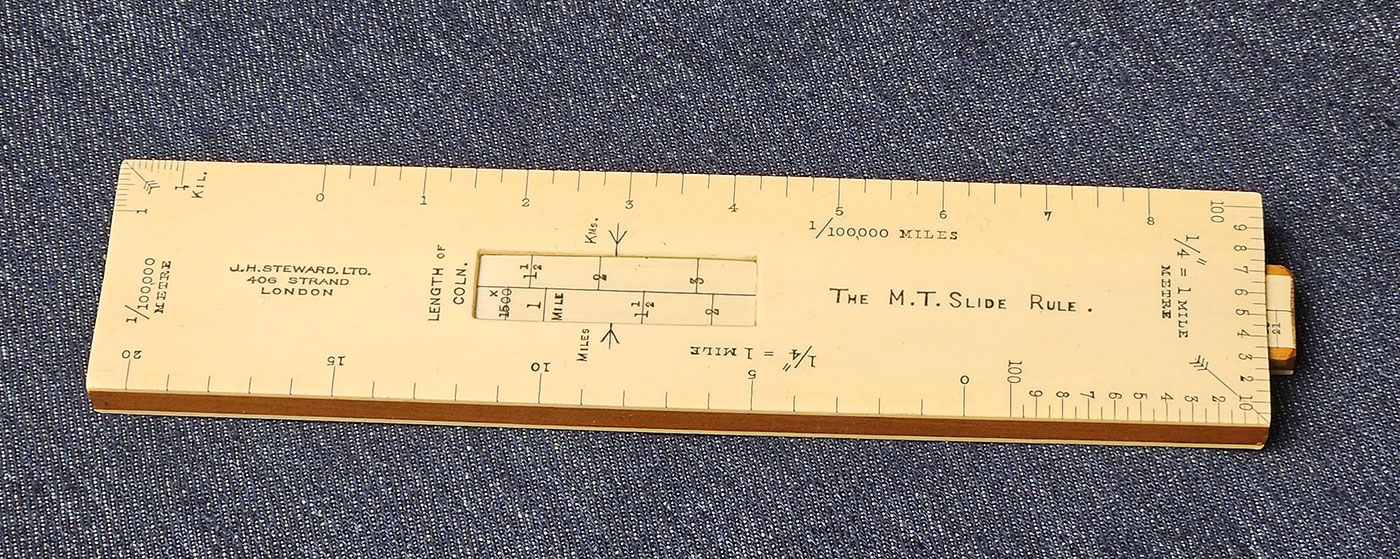
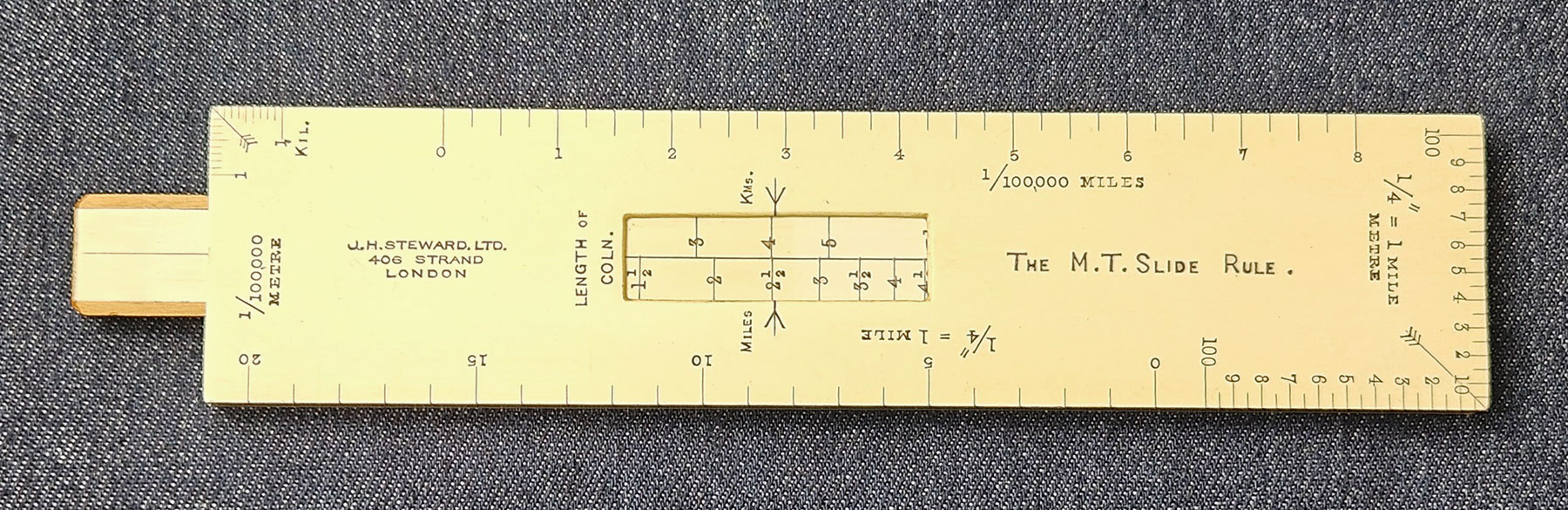
The purpose of this little slide rule (it is 18 cm long) is to compute the time it will take a column of vehicles (think military convoy) to drive past a landmark on the road, for instance a bridge or an intersection. Your put the number of vehicles (No. VEHs.) next to the number of vehicles per mile (V.T.M),which gets you the length of the column, and you read the TIME next to the speed, M.I.2H. Simple – the governing formula is s=v*t, as we learned in middle school. Or so you’d think…
And in fact, you’d think wrong. It won’t work. Not on this slide rule. Refer to the back side in the second image below and I’ll explain why.
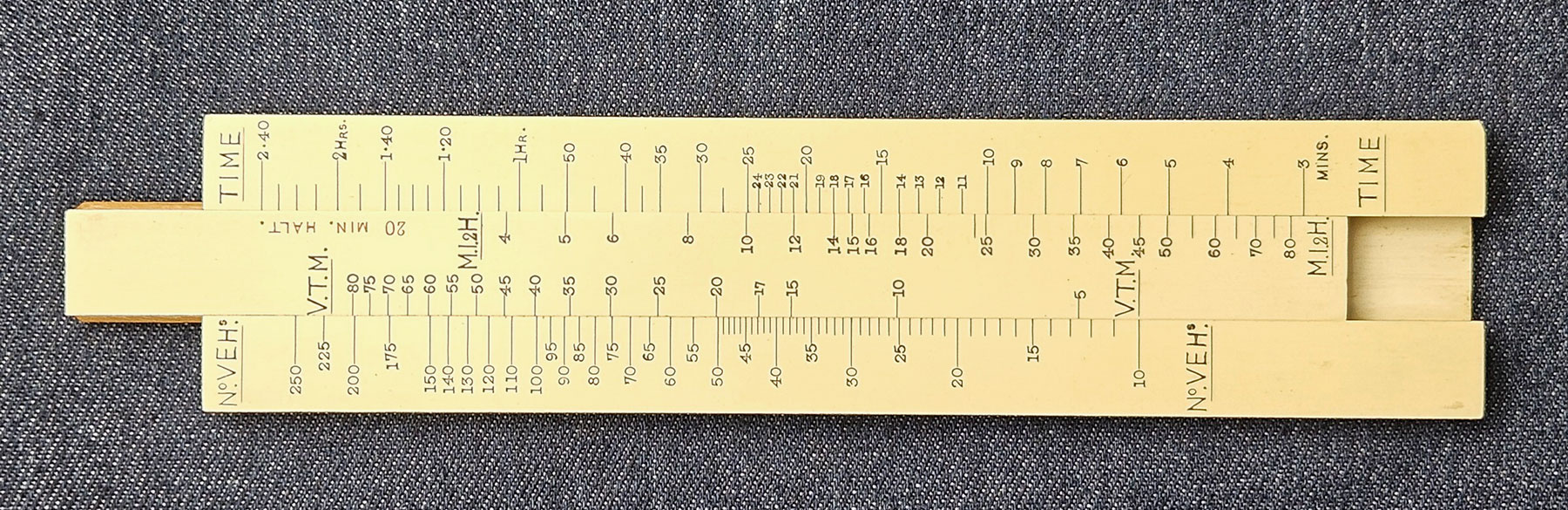
There is actually a version of this slide rule that has the speed scale captioned M.I.H (Miles in Hour, what we call MPH) where the formula does work and gives the correct result; you can see it here, on Tina Cordon’s extensive web site.
I took a while to figure out why my version fails to do the same. At first I thought it was because M.I.2H means Miles in two hours, so I tried to adjust the calculation by a factor of two. But no luck… I still got a wrong answer.
Then, and only after some help from ChatGPT (a slide rule aficionado, it turns out) I got it. M.I.2H does indeed mean Miles per two hours, but that is not the speed of the moving column. The critical clue is the added caption 20 MIN. HALT that is present on my rule (but not on Tina’s). This refers to an assumption that the column moves at constant speed, but stops for 20 minutes out of every 2 hours: 100 minutes driving and 20 minutes resting. The M.I.2H is the total distance traveled in the two hours – including the rest break. If you do the math, the relationship between M.I.2H and the actual speed of a moving vehicle in MPH, Sv, is
Sv = M.I.2H * 0.6
And then there’s another assumption: that the convoy does not stop while moving across the landmark. This means that its speed while moving past it is Sv, not M.I.2H/2.
None of this is expressly stated on the slide rule (and I don’t have an instructions manual for it); and it is definitely confusing: you dial in the distance covered in 2 hours with breaks but calculate the crossing time assuming no breaks. What a mess!
But now that we know all this, the formula becomes:
Convoylength = No. VEHs / V.T.M
Time = convoylength / Sv = convoylength / (MI2H*0.6)
I still found it strange that they’d use such units and assumptions, but then I devised the following imaginary example to give them context, and it now makes more sense (The above photos show the slide rule set to compute this example):
Major: How soon can we get that supply convoy to our present position?
Sergeant: Well, it’s 200 miles away, and those trucks can cover 25 miles every 2 hours, so they’ll get here in 16 hours.
Major: But they have to stop for refueling, don’t they?
Sergeant: Oh, that’s already included in the 25 figure. It accounts for a halt of 20 minutes out of every 2 hours.
Major: What worries me is this small bridge that’s exposed to enemy fire. How fast can they cross it?
Sergeant: Well, obviously they won’t halt to refuel right there, so they’ll cross at their cruising speed of 15 MPH. The column is 2½ miles long, so they’ll cross the bridge in 10 minutes.
Major: Well, let’s pray they make it.
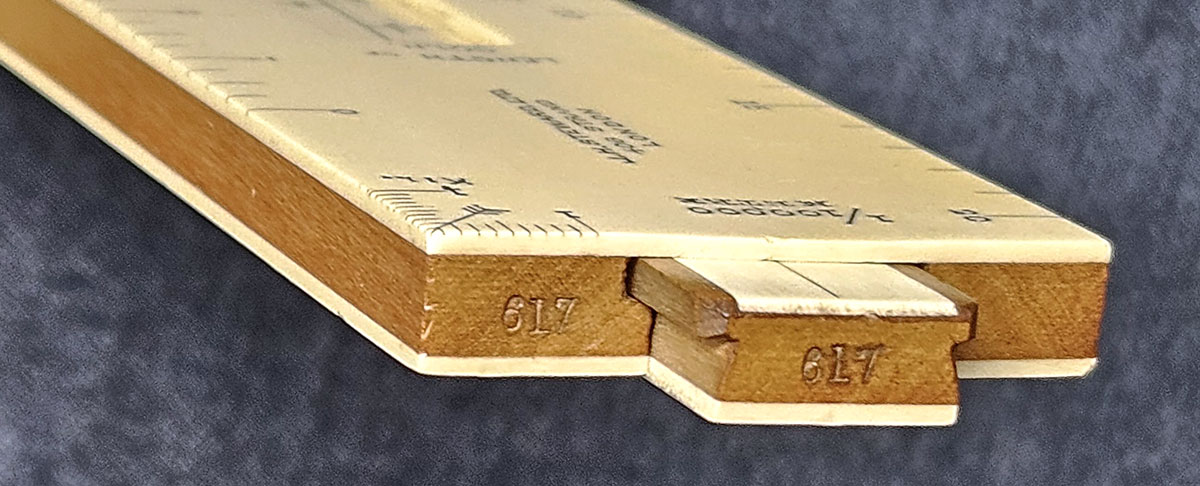
Confusing or not, this is a very well-constructed slide rule. It is made of wood covered with celluloid (or something similar), and on its front the length-of-column scale shows through a window, which allows the use of the rest of the real estate for some map reading scales.
This slide rule was made by J. H. Steward Ltd. of London, probably in the 1920s or 1930s. The company has been making a large variety of scientific instruments from 1852 to 1975, always under management of descendants of the original founder, James Henry Steward (1817–1896). More on them all in the article by David Rance (see below).
I scoured the web to find more about this system of “MI2H” speeds and halts, and found nothing. In particular I wanted to see whether there were other slide rules “hard coded” to handle convoys that stop for less than 20 minutes in 2 hours, which seems somewhat lazy. What if they stop for only 10? Was there a slide rule for that scenario? I found none, until John Hunt Snr, a master collector, sent me the image of a circular slide rule he has, which I reproduce here with his permission.
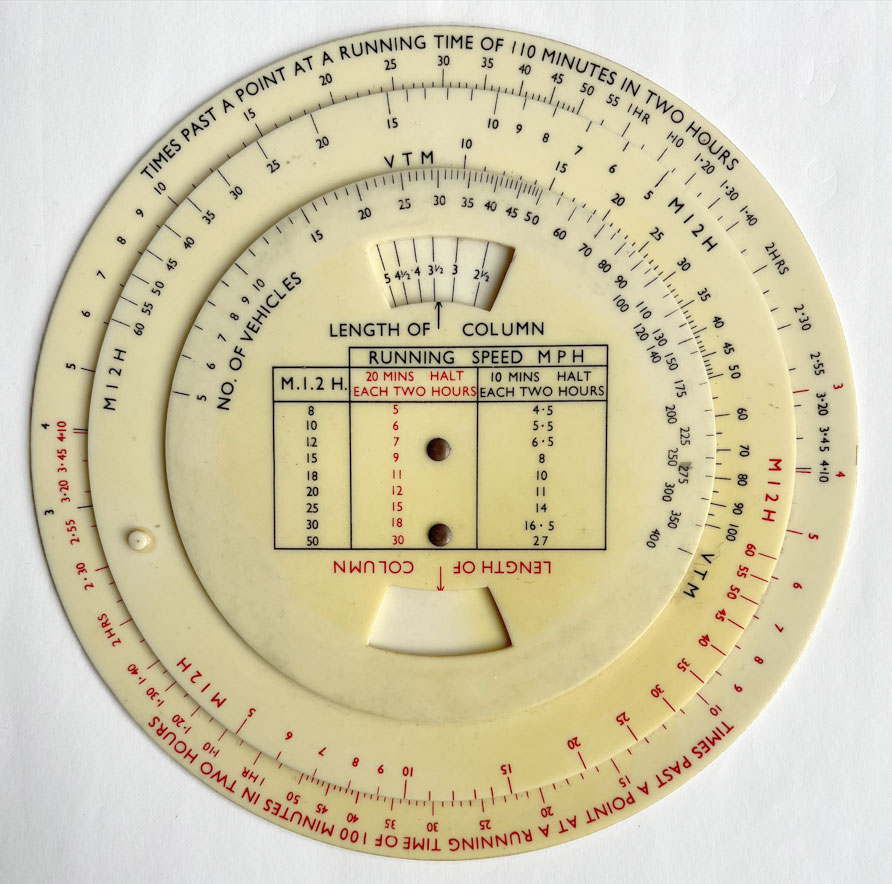
This circular slide rule (of unknown make, but probably American) has two functions – the black scales calculate “Times past a point at a running time of 110 minutes in two hours”, and those in red give “Times past a point at a running time of 100 minutes in two hours”. Steward could have learned a lesson in clarity from this product! Anyway, the red scales are equivalent to the M.T. rule I have, and the black ones handle the brisker convoy I’ve imagined. Both use the weird “MI2H” units, and the table in the middle converts between this and Vs, validating the formula I’ve derived above.
Exhibit provenance: eBay, from a seller in the UK.
More info:
Read all about the multi-generational business that produced this device in J. H. Steward: a family dynasty, by David Rance, in UKSRC Slide Rule Gazette issue 12.